Machine Learning Explained for Small Business Owners

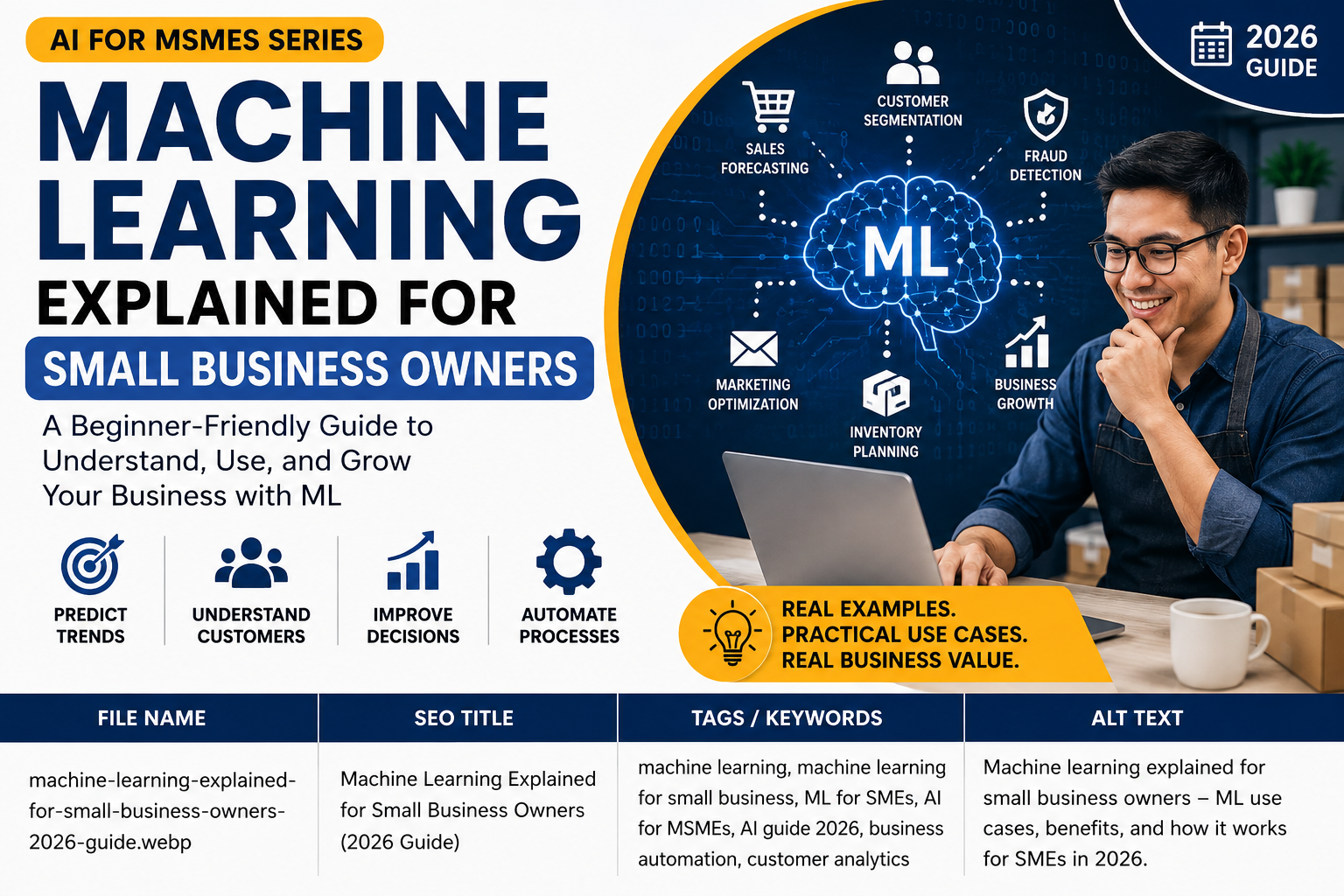
Machine Learning Explained for Small Business Owners
Machine learning is becoming one of the most important technologies behind modern artificial intelligence (AI). Although the term may sound highly technical, small business owners do not need to become data scientists to understand how machine learning works or how it can create practical business value.
From predicting customer demand and identifying purchasing patterns to improving marketing campaigns and automating repetitive decisions, machine learning can help small businesses turn data into useful insights. The technology is already embedded in many of the digital tools businesses use every day.
For small and medium-sized enterprises (SMEs), understanding machine learning is especially useful because it provides a foundation for understanding many modern AI applications. It also helps business owners evaluate AI software more realistically, identify suitable use cases, and avoid investing in technology simply because it is marketed as "AI-powered."
This guide explains what machine learning is, how it works, how it differs from traditional software and generative AI, and how small businesses can use it in practical ways.
What Is Machine Learning?
Machine learning (ML) is a branch of artificial intelligence that enables computers to learn patterns from data and use those patterns to make predictions, classifications, recommendations, or decisions.
Traditional software generally follows explicit instructions written by developers. A conventional program might receive an input, process it according to predefined rules, and produce an output.
Machine learning works differently. Instead of programming every possible rule manually, developers provide an algorithm with data from which it can learn statistical patterns.
For example, imagine a small online retailer that wants to predict which customers are likely to purchase a product. Rather than creating thousands of rules manually, the business could use historical customer data containing information such as previous purchases, browsing activity, order frequency, and product categories.
A machine learning model can analyze these patterns and estimate which customers are more likely to make a purchase in the future.
In simple terms:
Traditional programming: Rules + Data → Output
Machine learning: Data + Expected outcomes → Learned model → Predictions
The model can then be used with new data to generate predictions or classifications.
Why Does Machine Learning Matter for Small Businesses?
Small businesses often have limited staff, limited budgets, and limited time. At the same time, they generate valuable data through sales transactions, websites, social media, customer interactions, invoices, inventory systems, and other digital platforms.
Machine learning can help turn this information into actionable business insights.
The biggest opportunity is not necessarily replacing employees. In many cases, the more practical objective is helping employees make faster and better-informed decisions.
For example, machine learning can help answer questions such as:
- Which products are likely to sell next week?
- Which customers are most likely to stop buying?
- Which marketing campaigns are generating the strongest results?
- Which transactions appear unusual or potentially fraudulent?
- How much inventory might be required?
- Which leads are most likely to become customers?
These capabilities can make machine learning particularly valuable for growing businesses that have accumulated enough data to identify meaningful patterns.
How Does Machine Learning Work?
Although machine learning systems can be highly sophisticated, the basic workflow can be explained through several steps.
1. Collect Relevant Data
Machine learning begins with data. The quality and relevance of that data have a major influence on the usefulness of the resulting model.
A business might collect data from sales records, customer databases, website analytics, inventory systems, customer support interactions, or other legitimate business sources.
For example, a restaurant might have historical information about daily sales, menu items, day of the week, holidays, promotions, and weather conditions. Such information could potentially be used to identify patterns in customer demand.
2. Prepare the Data
Raw business data is rarely perfect. It may contain missing values, duplicate records, inconsistent formats, or irrelevant information.
Data preparation involves cleaning and organizing the information so that a machine learning system can use it effectively.
This stage is often underestimated. A sophisticated algorithm cannot automatically compensate for fundamentally poor-quality data.
3. Train a Model
During training, a machine learning algorithm analyzes historical data and identifies relationships or patterns.
The algorithm adjusts its internal parameters to improve its performance on the task it is designed to perform.
For example, a sales forecasting model may examine historical demand and learn relationships between sales volume, seasonality, promotions, product categories, and other variables.
4. Evaluate the Model
A model should not simply be judged on how well it performs on the data used to train it.
Businesses and developers typically evaluate models using separate data to determine whether the model can generalize to situations it has not previously seen.
This is important because a model can appear highly accurate while actually memorizing patterns that do not generalize to new situations.
5. Make Predictions or Classifications
Once a model performs adequately, it can be used with new data.
Depending on the application, the output could be a prediction, probability, classification, recommendation, or another type of result.
6. Monitor and Improve the Model
Machine learning is not necessarily a "set it and forget it" technology.
Customer behavior, markets, products, and economic conditions can change. A model that performs well today may become less accurate as the underlying data changes.
Businesses therefore need appropriate monitoring, evaluation, and maintenance processes.
Machine Learning vs. Traditional Software
One of the easiest ways to understand machine learning is to compare it with conventional software.
| Traditional Software | Machine Learning |
| Uses explicitly programmed rules | Learns patterns from data |
| Behavior is primarily defined by code | Behavior depends partly on learned parameters |
| Works well for predictable rule-based processes | Can be useful for complex patterns and predictions |
| Usually requires developers to change rules manually | Models can be retrained with new data |
This does not mean machine learning is always better than traditional programming. Many business processes are easier, cheaper, and more reliable when handled with conventional software.
The right choice depends on the problem.
Machine Learning vs. Generative AI
Machine learning and generative AI are closely related, but they are not interchangeable terms.
Machine learning is a broad field of AI in which systems learn patterns from data. It includes many different approaches and applications.
Generative AI refers to AI systems designed to generate new content, such as text, images, audio, video, or code.
Modern generative AI systems commonly rely on machine learning techniques, particularly deep learning and large neural networks.
For a small business owner, the distinction can be useful:
- Machine learning can predict future sales.
- Machine learning can classify customers.
- Machine learning can detect unusual transactions.
- Generative AI can draft marketing copy.
- Generative AI can summarize documents.
- Generative AI can generate images or other content.
If you want to understand the broader technology category first, see our guide to Generative AI and why it matters to small businesses.
Common Types of Machine Learning
Supervised Learning
Supervised learning uses labeled examples to train a model.
For example, a company might provide historical customer records labeled as "purchased" or "did not purchase." A model can learn patterns associated with those outcomes and use them to classify new customers.
Common applications include classification and prediction.
Unsupervised Learning
Unsupervised learning works with data that does not have predefined labels.
One common application is customer segmentation. A model may identify groups of customers with similar behavior without the business explicitly defining those groups beforehand.
This can help businesses discover patterns they may not have noticed manually.
Reinforcement Learning
Reinforcement learning involves an agent learning through interaction with an environment and receiving feedback based on its actions.
Although reinforcement learning is important in areas such as robotics, games, and optimization, it is generally less common as a starting point for typical small-business AI projects.
Practical Machine Learning Use Cases for Small Businesses
1. Sales Forecasting
Machine learning can analyze historical sales patterns and other relevant variables to estimate future demand.
A retailer, for example, might use forecasting to anticipate which products are likely to experience higher demand during certain periods.
Better forecasting can support inventory planning and reduce the risk of excessive stock or stockouts.
2. Customer Segmentation
Businesses can use machine learning to identify groups of customers based on purchasing behavior, engagement, demographics where appropriate and lawful, or other relevant signals.
These segments can help marketers develop more relevant campaigns instead of treating every customer identically.
3. Customer Churn Prediction
Customer churn occurs when customers stop purchasing or discontinue a service.
A machine learning model can analyze historical behavior and identify patterns associated with customers who previously left.
Businesses can then investigate whether proactive customer service or retention strategies are appropriate.
4. Fraud and Anomaly Detection
Machine learning can help identify transactions or activities that differ significantly from normal patterns.
This can be useful for online businesses, financial operations, marketplaces, and other businesses where unusual transactions may require additional review.
5. Recommendation Systems
Recommendation systems analyze behavior and preferences to suggest products, content, or services that may be relevant to a customer.
Even smaller businesses can benefit from recommendation capabilities embedded in modern commerce and marketing platforms.
6. Marketing Optimization
Machine learning can analyze campaign performance and help businesses identify patterns in customer engagement.
Depending on the platform, ML-powered systems may assist with audience targeting, campaign optimization, lead scoring, or advertising performance.
7. Inventory Planning
Businesses with sufficient historical data may use machine learning to improve demand forecasting and inventory decisions.
This can be particularly valuable for retailers, distributors, restaurants, and businesses that manage products with variable demand.
How Machine Learning Can Improve Small Business Productivity
Machine learning can contribute to productivity in several ways.
First, it can reduce the amount of manual analysis required to identify patterns in large datasets. Instead of employees reviewing thousands of records manually, an ML system can process the information and highlight relevant patterns.
Second, machine learning can support faster decision-making. A sales manager, for example, could receive demand forecasts instead of relying exclusively on intuition.
Third, ML can support automation. When a prediction or classification can reliably trigger a predefined workflow, the business may be able to automate part of the process.
However, automation should be designed carefully. Predictions are not guarantees, and important decisions may still require human review.
This is particularly important when AI outputs affect customers, employees, finances, privacy, or other sensitive areas.
What Data Does a Small Business Need for Machine Learning?
There is no universal minimum amount of data required for every machine learning project.
The amount and quality of data required depend on the problem, model, complexity, expected accuracy, and availability of relevant examples.
A small business might already have useful data in:
- Point-of-sale systems
- Accounting software
- Customer relationship management platforms
- E-commerce systems
- Website analytics
- Inventory databases
- Marketing platforms
- Customer service systems
However, having a large dataset does not automatically make a machine learning project successful.
Data must be relevant, sufficiently representative, appropriately collected, and handled responsibly.
Data Quality Matters More Than Business Owners Think
One of the biggest mistakes in AI adoption is assuming that sophisticated technology can compensate for poor data.
If a business has inaccurate, incomplete, outdated, or inconsistent information, a machine learning model may produce unreliable results.
This is sometimes summarized by the principle "garbage in, garbage out."
Before investing heavily in machine learning, businesses should examine the data they already have.
Useful questions include:
- Where does our data come from?
- Is it accurate?
- Is it duplicated?
- How frequently is it updated?
- Are important fields missing?
- Can we legally and ethically use it for this purpose?
- Who is responsible for maintaining it?
Do Small Businesses Need Their Own Machine Learning Model?
Usually, not necessarily.
One of the most important lessons for small businesses is that adopting machine learning does not always mean building a custom model from scratch.
Many modern business platforms already include machine learning capabilities. Businesses can access predictive analytics, recommendation engines, forecasting tools, fraud detection, customer segmentation, and other ML-powered features through software subscriptions or cloud platforms.
This is where understanding what AI software is and how it can help SMEs becomes useful.
For many small businesses, using an existing AI-powered application is more practical than hiring a machine learning engineering team.
Custom development may make sense when a business has a unique problem, substantial proprietary data, sufficient technical resources, and a clear financial justification.
How Much Does Machine Learning Cost for a Small Business?
The cost can vary dramatically.
A business may access basic machine learning features as part of an existing software subscription with little or no additional development cost. More advanced applications can involve expenses for data preparation, cloud computing, model development, integration, security, monitoring, and specialist expertise.
Instead of asking only, "How much does machine learning cost?", business owners should ask:
- What business problem are we solving?
- How much time or money could the solution save?
- How accurate does the system need to be?
- Do we already have the necessary data?
- Can an existing software product solve the problem?
- What ongoing maintenance will be required?
This approach keeps AI adoption focused on measurable business value rather than technology for its own sake.
Challenges and Risks of Machine Learning
Data Bias
Machine learning models learn from data. If the training data contains systematic biases or does not represent the intended population or business environment, model outputs may also be biased.
Incorrect Predictions
No machine learning model is perfect. Predictions can be wrong, particularly when conditions change or when the model encounters situations that differ from its training data.
Privacy Concerns
Businesses must consider privacy and applicable data protection requirements when collecting and processing customer or employee information.
Security
AI systems and the data supporting them should be protected against unauthorized access, misuse, and other security risks.
Model Drift
Customer behavior and market conditions can change over time. A model that performed well in the past may gradually become less reliable.
Lack of Human Oversight
Businesses should avoid treating machine learning predictions as unquestionable facts. Human review remains important when decisions carry significant financial, legal, operational, or customer consequences.
How to Start Using Machine Learning in a Small Business
Step 1: Identify One Specific Problem
Start with a business problem rather than the technology.
For example, "We need AI" is not a useful project definition. "We want to improve weekly inventory forecasts" is much more specific.
Step 2: Determine Whether Machine Learning Is Appropriate
Not every problem requires ML.
If a simple rule, spreadsheet, or conventional software workflow can solve the problem reliably, machine learning may add unnecessary complexity.
Step 3: Review Available Data
Determine whether the business has enough relevant and reliable information to support the proposed use case.
Step 4: Start With Existing Tools
Explore established business software with built-in AI and machine learning capabilities before considering custom development.
Step 5: Run a Small Pilot
Test the technology on a limited use case before expanding it throughout the organization.
Step 6: Measure Business Results
Track measurable outcomes such as time saved, forecasting accuracy, conversion rates, customer retention, operational costs, or other relevant KPIs.
Step 7: Expand Carefully
If the pilot delivers measurable value, the business can gradually expand the implementation while improving governance, security, training, and monitoring.
Machine Learning and the Future of Small Business
Machine learning is likely to become increasingly embedded in the software small businesses already use.
Rather than requiring every business to build complex AI infrastructure, future business applications are likely to hide much of the technical complexity behind simpler interfaces.
This means business owners may interact with ML-powered capabilities without even thinking about the underlying technology.
Forecasting, personalization, anomaly detection, customer analytics, search, recommendations, and workflow optimization can increasingly become standard features of business software.
For SMEs, this creates an important opportunity: focus less on building AI from scratch and more on identifying where intelligent software can solve meaningful business problems.
How Machine Learning Fits Into the AI for MSMEs Strategy
Machine learning should not be viewed as an isolated technology. It is one component of the broader AI ecosystem available to small and medium-sized businesses.
Our main AI for MSMEs guide provides the broader context, including AI use cases, adoption strategies, tools, costs, and implementation considerations.
This creates a logical learning path:
AI for MSMEs → AI Software → Generative AI → Machine Learning → Advanced AI Applications
Understanding these relationships can help business owners make more informed technology decisions instead of adopting AI tools based solely on marketing claims.
Frequently Asked Questions About Machine Learning
What is machine learning in simple terms?
Machine learning is a type of artificial intelligence that allows computers to learn patterns from data and use those patterns to make predictions, classifications, recommendations, or decisions.
Is machine learning useful for small businesses?
Yes. Small businesses can use machine learning for applications such as sales forecasting, customer segmentation, churn prediction, recommendation systems, anomaly detection, marketing optimization, and inventory planning.
Is machine learning the same as AI?
No. Artificial intelligence is the broader field. Machine learning is one major approach within AI that enables systems to learn patterns from data.
Is machine learning the same as generative AI?
No. Generative AI is designed to generate new content, while machine learning is a broader field that includes many techniques for prediction, classification, recommendation, and other tasks. Modern generative AI systems commonly use machine learning techniques.
Does a small business need a data scientist to use machine learning?
Not necessarily. Many business applications already include machine learning features. A data scientist or machine learning specialist becomes more relevant when a company needs custom models, advanced analytics, or specialized AI systems.
How much data does machine learning require?
There is no universal number. Requirements depend on the specific problem, data quality, model, complexity, and expected accuracy. High-quality relevant data is generally more important than simply having a large quantity of data.
Can machine learning automate business decisions?
It can support or automate certain decisions, but businesses should determine the appropriate level of human oversight. High-impact decisions may require human review, monitoring, and clear governance.
What is the best way for an SME to start with machine learning?
Start with a specific business problem, evaluate the available data, determine whether machine learning is appropriate, test an existing solution or small pilot, and measure the resulting business value before scaling.
Final Takeaway
Machine learning may sound like an advanced technology reserved for large technology companies, but its capabilities are increasingly available through everyday business software.
For small business owners, the most important question is not whether machine learning is technically impressive. The better question is whether it can solve a real business problem better, faster, or more efficiently than the current approach.
When used responsibly, machine learning can help SMEs forecast demand, understand customers, improve marketing, identify unusual activity, optimize operations, and make better data-informed decisions.
The strongest AI strategy starts with business needs, reliable data, measurable outcomes, and appropriate human oversight—not with technology alone.
As part of the broader AI for MSMEs learning path, understanding machine learning gives business owners a stronger foundation for evaluating the next generation of AI-powered tools and applications.