AI Business Intelligence Explained | How Small Businesses Use AI for Smarter Decisions | Beritaja
 By: Albert Michael - Thursday, 27 August 2026 23:22:31 • 17 min read
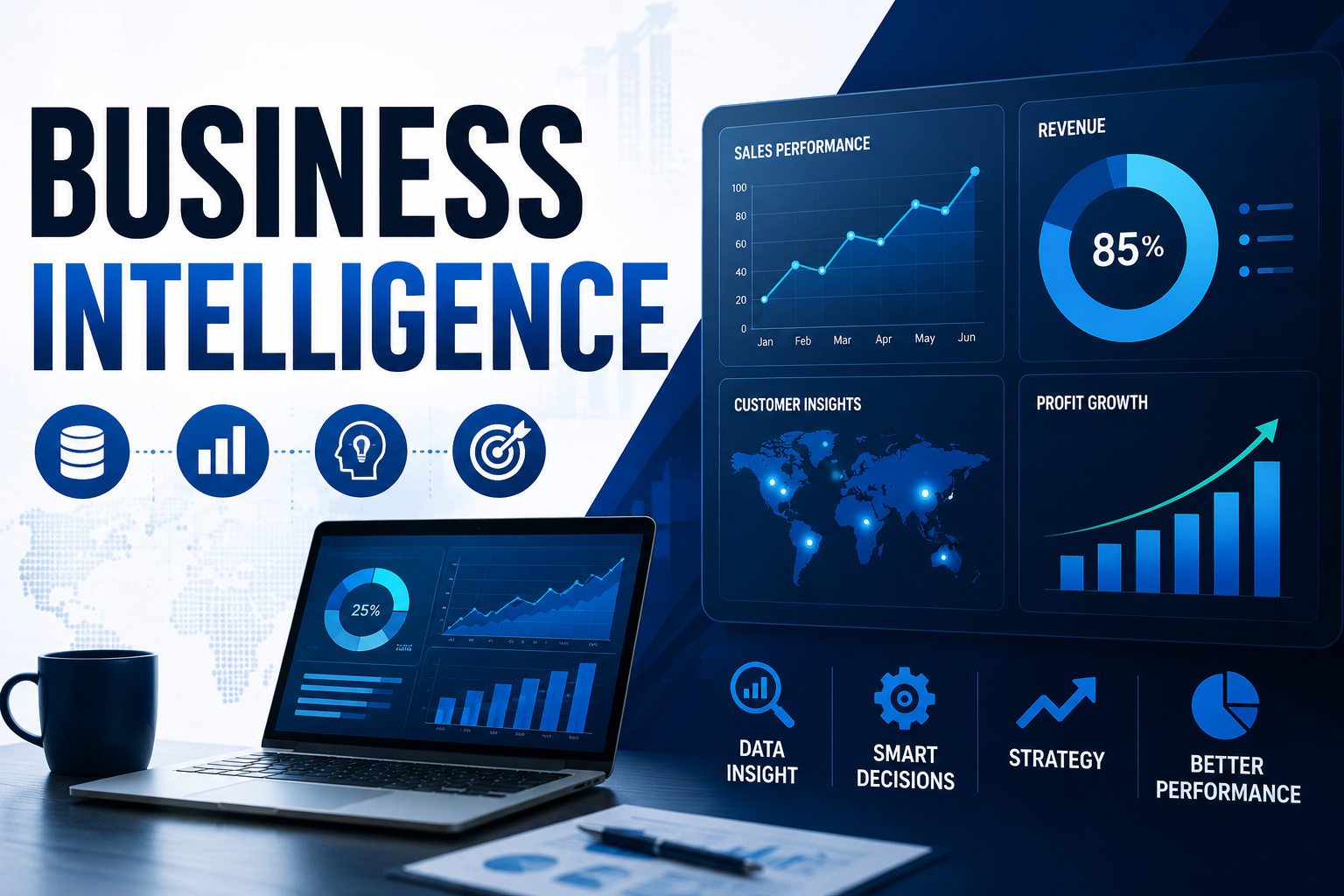
AI Business Intelligence Explained
Business Intelligence (BI) is the process of turning business data into useful information that helps people understand performance and make better decisions. AI Business Intelligence combines traditional BI with artificial intelligence to analyze data, identify patterns, generate insights, and help business users investigate questions faster.
For small businesses, this can mean moving beyond spreadsheets and static reports toward a more practical approach where sales, customer, inventory, marketing, and operational data can be analyzed together.
This guide explains what AI Business Intelligence means, how it works, where it can help small businesses, its limitations, and how an MSME can start using it without building an unnecessarily complicated data infrastructure.
What Is Business Intelligence?
Business Intelligence is a collection of processes, technologies, and practices used to collect, organize, analyze, and present business information so people can make informed decisions.
Traditional BI commonly turns existing business data into:
- Reports
- Dashboards
- Charts
- Performance indicators
- Sales summaries
- Financial reports
- Operational analyses
For example, a retail business might use BI to answer questions such as which products sell the most, which days generate the highest sales, which locations perform best, how much inventory remains, and which products are experiencing declining sales.
The important distinction is that BI does not simply store data. Its purpose is to make business data useful for analysis and decision-making.
Business Intelligence vs. Ordinary Reporting
A basic report might tell an owner that sales were $42,000 during a particular month. Business Intelligence can provide additional context by showing how that figure compares with previous periods, which categories contributed to the change, and where the largest differences occurred.
That additional context can make business information considerably more useful for management decisions.
What Is AI Business Intelligence?
AI Business Intelligence refers to the use of artificial intelligence techniques within BI workflows to make data analysis more automated, accessible, predictive, or interactive.
Instead of requiring a business user to manually build every report or query, an AI-assisted BI system may help users analyze large amounts of business data, detect unusual changes, identify relationships between variables, summarize business performance, answer questions using natural language, generate analytical explanations, and support forecasting.
For example, instead of manually filtering a dashboard, a business owner could ask:
Why did sales decline last month?
An AI-assisted BI system could examine available sales data and identify relevant patterns involving product mix, customer volume, locations, sales channels, or other available variables.
However, the quality of the answer depends heavily on data quality, system design, and the reliability of the underlying analysis.
AI does not automatically turn poor business data into reliable intelligence.
How Does AI Business Intelligence Work?
AI Business Intelligence generally combines several stages of the data and decision-making process.
-
Data Collection
The first step is collecting relevant business data. Depending on the company, information may come from point-of-sale systems, e-commerce platforms, accounting software, customer relationship management systems, inventory systems, marketing platforms, spreadsheets, website analytics, customer service systems, and operational databases.
A small business does not necessarily need all of these sources. The goal is to identify the information that is actually relevant to the business question.
-
Data Integration
Data from different systems may use different formats. AI Business Intelligence becomes more useful when relevant datasets can be connected appropriately.
Source Example Information Point-of-sale system Transactions and sales Accounting system Revenue and expenses E-commerce platform Online orders CRM Customer information Inventory system Stock levels Marketing platforms Campaign performance For example, combining sales and inventory information can help a retailer investigate whether a change in sales is related to demand or product availability.
-
Data Preparation
Business data often contains problems such as missing values, duplicate records, incorrect dates, inconsistent product names, incorrect categories, different measurement units, or outdated information.
These issues matter because analytical systems depend on the information they receive. A sophisticated AI model cannot reliably compensate for fundamentally incorrect source data.
-
Data Analysis
Once usable data is available, BI systems can analyze it. Traditional BI commonly focuses on descriptive questions such as:
“What happened?”
AI can extend the workflow toward questions such as:
“Why might it have happened?”
Depending on the system, AI techniques can support:
- Pattern recognition
- Anomaly detection
- Classification
- Forecasting
- Natural-language querying
- Automated summarization
- Predictive analytics
-
Insight Generation
Analytical results can be converted into information that business users can understand. Instead of requiring a manager to interpret a complicated dataset, an AI-assisted system might summarize important changes in plain language.
“Online orders increased while average order value declined. The change was concentrated in the promotional product category.”
The business owner can then investigate whether the pattern requires action.
-
Human Decision-Making
Human judgment remains an important part of the process. AI Business Intelligence should generally support decision-making rather than replace business judgment.
Users still need to determine:
- Whether the pattern is meaningful
- What may have caused it
- Whether the data is complete
- What action makes sense
- What risks are involved
A practical workflow is:
Data → Analysis → Insight → Human Judgment → Action → Measurement
Why Does AI Business Intelligence Matter for Small Businesses?
Large organizations have traditionally had greater access to analysts, data engineers, and sophisticated BI infrastructure. AI can potentially reduce some of the complexity involved in interacting with business data.
A small business owner may not need to become a data scientist to ask useful questions about business operations.
For example:
- A restaurant owner may want to know which menu items perform best on weekends.
- An e-commerce owner may want to identify products experiencing declining sales.
- A professional-services company may want to understand which projects consume the most resources relative to revenue.
These questions can be more useful than simply looking at a single monthly revenue figure.
Key Benefits of AI Business Intelligence
1. Faster Data Analysis
AI can help automate parts of the analytical process. Instead of manually sorting and comparing large spreadsheets, users may be able to ask questions in natural language or use automatically generated insights.
2. Easier Access to Business Data
Traditional BI systems can require users to understand dashboards, filters, database structures, or reporting terminology. Natural-language interfaces can make analytical information easier for non-technical users to explore.
For example, a user could ask:
“Show me the five products with the largest sales decline this quarter.”
The exact capabilities depend on the BI platform and how the underlying data has been configured.
3. Better Pattern Detection
Humans can overlook patterns when datasets become large. AI-assisted systems can help identify unusual sales changes, unexpected customer behavior, inventory anomalies, performance changes, and relationships between variables.
These findings should still be reviewed rather than accepted automatically.
4. More Proactive Decision Support
Traditional BI often answers questions about what already happened. AI and predictive analytics can also support forward-looking analysis.
A historical BI report might show that sales decreased in April. An AI-assisted analysis may help identify related patterns, while predictive analytics may estimate possible future outcomes based on available historical data.
Forecasts remain estimates and should not be treated as guarantees.
5. Reduced Repetitive Reporting
Businesses frequently create recurring reports, including weekly sales reports, monthly revenue summaries, inventory reports, marketing performance reports, and customer reports.
Automating parts of this process can allow employees to spend more time interpreting information and taking action.
AI Business Intelligence Examples
The following examples are hypothetical illustrations of how a business could use AI Business Intelligence. They are not claims about measured results.
Example 1: Retail Store
Business type: Retail Problem: The owner has thousands of transaction records but relies mainly on monthly spreadsheets. How AI is used: An AI-assisted BI system analyzes sales, product, and inventory information. Expected benefit: The owner can identify changing product demand more efficiently. Human oversight required: The owner should verify whether apparent trends are genuine and consider external factors such as promotions, holidays, or supply shortages.
Example 2: Restaurant
Business type: Restaurant Problem: Management knows total sales but wants to understand menu performance. How AI is used: Sales information is analyzed by item, day, time period, and category. Expected benefit: Managers can identify patterns that may help with menu planning, purchasing, and operational decisions. Human oversight required: Food quality, customer preferences, seasonality, and operational constraints should also be considered.
Example 3: E-commerce Business
Business type: Online store Problem: The company has sales, advertising, and customer data in different systems. How AI is used: BI connects relevant datasets and helps analyze relationships between marketing activity and sales. Expected benefit: The business can investigate which channels, products, or customer segments deserve further attention. Human oversight required: Correlation should not automatically be treated as causation. Campaign timing, promotions, pricing, and other factors can affect results.
Example 4: Professional Services
Business type: Consulting or professional-services firm Problem: Managers struggle to understand which projects consume the most resources. How AI is used: Project, billing, and time-tracking data are analyzed together. Expected benefit: Management gains a clearer view of project economics and resource usage. Human oversight required: Financial and operational decisions should consider project complexity, client relationships, strategic value, and data accuracy.
AI Business Intelligence vs. Traditional Business Intelligence
AI Business Intelligence does not necessarily replace traditional BI. Instead, AI can extend conventional BI capabilities.
| Area | Traditional BI | AI Business Intelligence |
| Reporting | Strong | Strong |
| Dashboards | Strong | Strong |
| Historical analysis | Strong | Strong |
| Natural-language questions | Limited in traditional implementations | Can be more accessible |
| Pattern detection | Often requires configuration | Can be AI-assisted |
| Predictive analysis | Possible | Can be enhanced with AI and machine learning |
| Automated summaries | Limited | Can be more capable |
| Human oversight | Required | Required |
The distinction should not be exaggerated. Traditional BI can already perform sophisticated analytics, and not every BI problem requires artificial intelligence.
Business Intelligence, AI, and Machine Learning: What's the Difference?
These terms are related but describe different concepts.
Business Intelligence
Business Intelligence focuses on transforming business data into useful information for analysis and decision-making.
Artificial Intelligence
Artificial intelligence (AI) is a broader field involving systems capable of performing tasks associated with capabilities such as pattern recognition, language processing, prediction, or other forms of intelligent behavior.
Machine Learning
Machine learning (ML) is a branch of AI in which systems learn patterns from data to perform tasks such as prediction or classification.
Generative AI
Generative AI creates content such as text, images, code, or other outputs based on learned patterns.
How These Technologies Can Work Together
A business might use BI to organize and visualize performance, machine learning to identify patterns or generate predictions, and generative AI to explain analytical results in natural language.
Together, these technologies can create a more accessible analytical workflow.
Practical Applications of AI Business Intelligence
Sales
Businesses can analyze:
- Sales trends
- Product performance
- Customer segments
- Sales-channel performance
- Regional performance
AI can help identify unusual changes or summarize important movements.
Marketing
Marketing teams can examine:
- Campaign performance
- Website traffic
- Conversion data
- Customer acquisition patterns
- Channel performance
The key is connecting marketing data with actual business outcomes rather than optimizing isolated metrics.
Customer Service
Customer-service data can reveal:
- Common customer complaints
- Frequently asked questions
- Changes in support volume
- Product-related problems
AI can help classify and summarize large amounts of customer feedback.
Inventory
Retailers and manufacturers can analyze:
- Stock levels
- Product movement
- Reordering patterns
- Slow-moving products
- Potential stock shortages
Forecasting can be useful here, but predictions should account for factors such as seasonality, promotions, supply disruptions, and unusual events.
Finance
Businesses can use BI to understand:
- Revenue
- Expenses
- Cash-flow patterns
- Profitability
- Budget performance
AI may assist with anomaly detection or summarization, but financial decisions require particularly careful validation.
How a Small Business Can Start Using AI Business Intelligence
A small business does not need to transform its entire operation at once. A focused implementation is often easier to evaluate.
-
Identify One Business Question
Start with a specific problem. For example, “Why did sales decline last month?” provides a much clearer starting point than simply deciding that the business needs AI.
-
Identify the Required Data
Determine what information is needed to answer the question. For a sales analysis, this might include transaction date, product, quantity, revenue, sales channel, and location.
-
Check Data Quality
Inspect whether records are duplicated, important fields are missing, dates are correct, product names are consistent, categories are standardized, and the information is recent enough.
-
Choose the Simplest Appropriate Solution
Not every business needs an advanced AI platform. Depending on the problem, a well-structured spreadsheet, conventional BI dashboard, basic analytics system, automated reporting workflow, BI platform with AI features, or machine-learning solution may be appropriate.
-
Test a Small Workflow
Start with one department, dataset, or recurring report. For example, monthly sales analysis can provide a manageable starting point.
-
Validate the Results
Compare important findings with the underlying data. Do not assume an AI-generated explanation is automatically correct.
-
Add Human Oversight
Define which decisions require human approval. AI can identify an unusual expense or summarize relevant information, while a manager investigates the situation and decides whether corrective action is necessary.
-
Measure the Business Value
Evaluate whether the implementation actually helps the organization. Useful measures may include time saved creating reports, reduced manual analysis, faster identification of problems, improved visibility, more consistent reporting, or employee productivity.
Common Mistakes When Implementing AI Business Intelligence
Starting With Technology Instead of a Problem
Buying an AI-enabled BI system before defining the business problem can create unnecessary complexity. Start by asking what decision the business is trying to improve.
Assuming More Data Means Better Intelligence
More data is not automatically better. Irrelevant, inaccurate, or poorly structured data can make analysis more complicated.
Treating AI Output as Fact
AI systems can produce incorrect interpretations or summaries. Important findings should be checked against source data and appropriate business context.
Ignoring Data Privacy
Business datasets may contain sensitive information. Before sending data to an external AI service, businesses should understand what information is processed, where it is processed, how it is stored, who can access it, and what protections apply.
Automating Decisions That Require Judgment
Some decisions involve factors that are difficult to represent in structured data. Examples can include hiring, major investments, strategic partnerships, and important customer relationships.
AI can provide information, but humans may need to retain final authority over consequential decisions.
Limitations and Risks of AI Business Intelligence
AI Business Intelligence has significant potential, but it is not a universal solution.
- Data quality: Poor data can produce unreliable analysis.
- AI errors: AI systems can generate incorrect interpretations or summaries.
- Bias: Historical business data can contain biases that influence analytical results.
- Privacy: Sensitive business and customer information requires appropriate safeguards.
- Security: Integrating multiple data systems can increase the number of systems that need to be secured.
- Cost: Advanced BI infrastructure may require software subscriptions, integration work, data engineering, and employee training.
- Complexity: Connecting multiple business systems can be technically difficult.
- Over-reliance: Managers may become overly dependent on automated recommendations.
For these reasons, AI Business Intelligence should be treated as a decision-support capability, not an infallible business advisor.
When Traditional BI May Be Better Than AI
AI is not always necessary. Traditional BI may be sufficient when a business needs straightforward sales dashboards, fixed monthly reports, basic financial summaries, simple inventory monitoring, or standard performance indicators.
If a simple dashboard answers the business question reliably, adding AI may provide little additional value.
Use the simplest technology that solves the problem reliably.
Best Practices for AI Business Intelligence
- Keep the initial scope small: Start with one business problem rather than attempting to analyze the entire company.
- Establish trustworthy data: Invest time in data consistency and appropriate data governance.
- Make insights understandable: Users should be able to understand where important conclusions come from.
- Keep humans involved: Human review is especially important when decisions have significant financial, operational, employment, legal, or customer consequences.
- Protect sensitive information: Limit access and avoid exposing unnecessary personal or confidential information.
- Review performance regularly: AI and analytical systems should be evaluated as business conditions and data sources change.
- Connect insights to action: A dashboard is valuable when its information helps someone make a better decision.
How AI Business Intelligence Fits Into an AI-Powered Small Business
AI Business Intelligence is one component of a broader AI strategy. A small business might eventually combine several capabilities across data analysis, decision support, and workflow automation.
- Business Data
- Business Intelligence
- AI Analysis
- Business Insights
- Decision Making
- AI Automation
- Business Action
For example, BI might identify that customer inquiries are increasing. AI could help analyze the questions customers are asking, while an automation system could handle routine inquiries. A manager could then monitor the results and make decisions about staffing or processes.
This is where AI automation for small businesses can complement Business Intelligence. BI primarily helps businesses understand information, while automation focuses on performing tasks or workflows.
Similarly, AI decision making can build on insights produced through BI.
For broader context, the AI for MSMEs hub provides additional information about applying artificial intelligence to small-business use cases.
Frequently Asked Questions
What is AI Business Intelligence?
AI Business Intelligence combines business intelligence with artificial intelligence to help organizations analyze data, identify patterns, generate insights, and interact with business information more efficiently. It can support reporting, anomaly detection, forecasting, natural-language analysis, and decision support. However, AI-generated insights still need appropriate validation, especially when decisions involve significant financial or operational consequences.
Is Business Intelligence the same as artificial intelligence?
No. Business Intelligence focuses on using business data to understand performance and support decisions. Artificial intelligence is a broader field involving systems that perform tasks associated with capabilities such as pattern recognition, language processing, prediction, and other intelligent behavior. AI can be incorporated into BI systems, but traditional BI does not necessarily require artificial intelligence.
Can small businesses use AI Business Intelligence?
Yes. Small businesses can use AI-assisted BI for areas such as sales analysis, inventory monitoring, marketing performance, customer-service analysis, and financial reporting. The appropriate solution depends on the company's data, budget, technical capabilities, and business questions. A small business does not necessarily need an advanced enterprise system to begin exploring data-driven decision support.
Does AI Business Intelligence replace human decision-making?
Generally, it should not be treated as a replacement for human judgment. AI can analyze information and identify patterns, but people still need to evaluate whether the data is accurate, whether the interpretation makes sense, and what action is appropriate. Human oversight is particularly important for high-impact financial, operational, employment, legal, or customer decisions.
What data does AI Business Intelligence need?
The required data depends on the business question. A retailer might need transaction, product, inventory, and customer information, while a professional-services company might need project, time, billing, and client data. The most important principle is relevance and quality. A smaller, accurate dataset can be more useful than a much larger dataset containing inconsistent or unreliable information.
Is AI Business Intelligence expensive?
Costs vary considerably. A business may start with existing spreadsheets and basic analytics, while more advanced implementations can require BI software, data integration, cloud infrastructure, specialized expertise, and employee training. The best approach is to evaluate the business problem first and then select the simplest solution that can address it reliably.
Can AI Business Intelligence predict future sales?
AI-assisted BI can support forecasting when sufficient historical and relevant data is available. However, forecasts are estimates rather than guarantees. Changes in pricing, competition, customer behavior, supply conditions, seasonality, economic conditions, and other factors can affect actual results. Businesses should therefore treat forecasts as decision-support information rather than certainty.
Conclusion: Is AI Business Intelligence Worth It for a Small Business?
AI Business Intelligence can help small businesses turn scattered business data into clearer, more actionable information. Its value comes from improving how businesses understand sales, customers, inventory, marketing, finances, and operations—not simply from adding an AI feature.
The most practical approach is to begin with a specific business question, identify the necessary data, improve its quality, choose an appropriately simple analytical solution, and validate the results.
AI can accelerate analysis and help uncover patterns, but it does not eliminate the need for context, critical thinking, privacy protection, or human judgment.
For an MSME considering AI adoption, the best starting point is therefore not:
“Where can we use AI?”
A better question is:
“Which business decision would become easier, faster, or more accurate if we had better access to our data?”
That question provides a stronger foundation for using Business Intelligence and AI responsibly.