What Is Generative AI and Why It Matters to Small Businesses | Beritaja

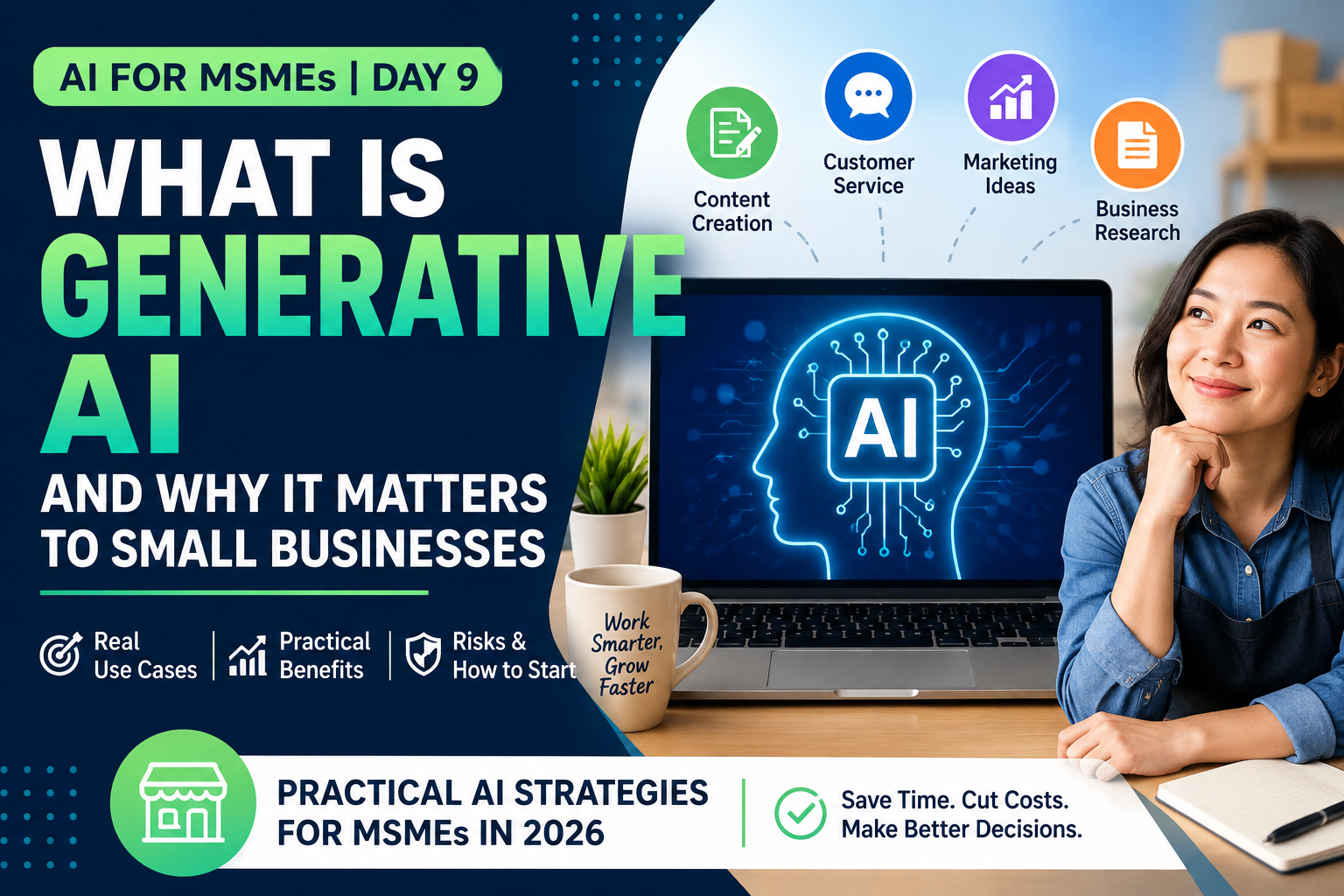
Generative AI has quickly become one of the most important developments in modern artificial intelligence. For small businesses and SMEs, it is no longer simply a technology discussed by large technology companies. Generative AI can now help with everyday tasks such as writing, marketing, customer communication, research, brainstorming, documentation, and productivity.
But what exactly is Generative AI, and why does it matter to small businesses?
In simple terms, Generative AI is a type of artificial intelligence that can create new content based on instructions provided by a user. Depending on the system, it can generate text, images, audio, video, software code, summaries, ideas, and other forms of digital content.
For a small business operating with limited employees, time, and budget, this capability can be particularly valuable. Instead of treating AI as a replacement for human expertise, businesses can use it as a productivity tool that helps people complete certain tasks faster and focus more attention on higher-value work.
This guide explains what Generative AI is, how it works, how small businesses can use it, its benefits and risks, how to identify suitable AI use cases, and how to introduce it into an SME workflow responsibly.
What Is Generative AI?
Generative AI is artificial intelligence designed to generate new content from a user's instructions, commonly called a prompt.
Traditional software usually performs predefined operations. A calculator calculates numbers. Accounting software records transactions. A database retrieves stored information.
Generative AI is different because it can produce new outputs based on patterns learned during the model's training process.
For example, a small-business owner could ask an AI system to:
- Write a product description.
- Create a customer email.
- Summarize meeting notes.
- Generate blog ideas.
- Brainstorm marketing campaigns.
- Rewrite website copy.
- Explain a complicated business concept.
- Create a social media content calendar.
- Draft a business proposal.
- Generate or explain software code.
The important point is that Generative AI does not simply retrieve one predetermined answer. It generates an output based on the instructions, context, and capabilities of the underlying AI model.
This also means that the output should not automatically be treated as correct. Generative AI can produce useful drafts and explanations while still making factual, logical, or contextual mistakes.
How Does Generative AI Work?
Small-business owners do not need to understand the mathematics behind machine learning to use Generative AI effectively. However, understanding the basic concept can help set realistic expectations.
AI Models Learn Patterns
Generative AI systems are built using machine-learning models trained on large datasets. Language models, for example, learn patterns involving words, phrases, concepts, and relationships between pieces of information.
When a user provides a prompt, the model processes the instructions and available context and generates a response that statistically fits that context.
This explains why two prompts asking for essentially the same task can produce very different results.
The Quality of the Prompt Matters
A vague prompt such as “Write something about my business” provides very little useful direction.
A more detailed prompt might say:
“Write a 150-word product description for a reusable stainless-steel water bottle aimed at environmentally conscious consumers. Use a professional but friendly tone and emphasize durability, portability, and sustainability.”
The second prompt gives the AI more context about the audience, purpose, product, tone, and desired result.
This is one reason prompt quality has become an important practical skill for businesses adopting Generative AI. However, better prompting does not eliminate the need for human review.
Generative AI vs. Artificial Intelligence
Generative AI is a part of the broader field of artificial intelligence.
If you are new to the subject, our complete guide to AI for MSMEs provides the broader foundation before exploring specialized technologies such as Generative AI.
Artificial intelligence can be used for many different purposes, including prediction, classification, recommendation, pattern recognition, automation, and analysis.
Generative AI focuses specifically on producing new content.
| Technology | Primary Purpose | Example for a Small Business |
| Artificial Intelligence | Broad intelligent automation and analysis | Automating business processes |
| Machine Learning | Learning patterns from data | Sales forecasting |
| Predictive AI | Making predictions | Predicting customer demand |
| Generative AI | Creating new content | Writing product descriptions |
Understanding this distinction is useful because not every AI problem requires Generative AI. A forecasting problem, for example, may require a different type of AI system than a task involving text generation.
Why Does Generative AI Matter to Small Businesses?
Small businesses frequently operate with fewer employees and fewer specialized resources than large organizations. One person may be responsible for marketing, customer service, administration, sales, and content creation.
Generative AI can help reduce the amount of time required for some of these activities.
The technology can therefore act as a productivity layer between a person and a repetitive task.
Current small-business guidance and resources increasingly discuss practical applications of AI across areas such as marketing, customer research, content generation, and productivity.
However, the goal should not be to use AI everywhere.
A better question is:
Which tasks can Generative AI help a small business perform faster, more consistently, or more efficiently without creating unacceptable risks?
This problem-first approach is important because an AI tool is only useful when it improves an actual business workflow.
How Small Businesses Can Use Generative AI
1. Content Creation
Content creation is one of the most obvious applications of Generative AI.
Small businesses can use AI to create initial drafts for:
- Blog posts.
- Product descriptions.
- Website pages.
- Email newsletters.
- Social media posts.
- Advertising concepts.
- Video scripts.
- Frequently asked questions.
The key word is draft.
Businesses should not assume that the first AI-generated response is automatically ready for publication. Human review is still necessary to check accuracy, brand voice, originality, usefulness, and whether the content accurately represents the business.
2. Marketing
Generative AI can help small businesses brainstorm marketing ideas without requiring a large marketing department.
A business owner might ask AI to create:
- Campaign concepts.
- Customer personas.
- Email subject lines.
- Social media ideas.
- Promotional messages.
- Landing-page headlines.
- Product positioning ideas.
This can make experimentation faster because the business can evaluate multiple ideas before deciding which ones deserve further development.
For a broader look at why businesses adopt AI, see our guide to the benefits of AI for small businesses.
3. Customer Service
Generative AI can assist customer-service teams by drafting responses to common questions.
For example, an AI system could help prepare responses concerning:
- Opening hours.
- Delivery information.
- Return policies.
- Appointment procedures.
- Basic product information.
- Frequently asked questions.
Human review becomes especially important when a customer has a complaint or when the conversation involves refunds, financial information, legal issues, or sensitive personal information.
4. Business Research
Business owners constantly encounter unfamiliar subjects.
Generative AI can help explain terminology, organize research questions, summarize user-provided documents, compare concepts, and identify areas that require additional investigation.
However, AI-generated research should not automatically be considered authoritative. Important claims should be checked against reliable primary or authoritative sources before they are used in business decisions.
5. Administrative Work
Administrative work can consume a significant amount of time in a small organization.
Generative AI can help draft:
- Meeting summaries.
- Internal announcements.
- Standard operating procedures.
- Checklists.
- Agendas.
- Business reports.
- Project documentation.
The employee remains responsible for reviewing the output, correcting errors, and deciding whether the document accurately represents the business.
6. Sales Support
Sales teams can use Generative AI to prepare initial drafts of outreach emails, sales proposals, product explanations, follow-up messages, and meeting summaries.
AI can also help salespeople generate different versions of a message for different customer segments.
The human salesperson should still personalize the communication because customer relationships depend on context that an AI model may not fully understand.
Generative AI and AI Software: What's the Connection?
Generative AI is usually experienced through software applications.
If you are unfamiliar with the broader category, our guide What Is AI Software? A Beginner's Guide for SMEs explains how AI-powered software fits into the modern business environment.
Generative AI tools can appear as standalone applications, features inside productivity software, customer-service platforms, marketing systems, design applications, coding environments, or business-management tools.
This distinction is important because businesses do not necessarily need to build their own AI models.
For many SMEs, the practical approach is to select an existing AI-powered software product that solves a specific business problem.
Benefits of Generative AI for Small Businesses
Save Time
Generative AI can accelerate tasks that traditionally require significant manual effort, particularly first drafts, summaries, brainstorming, and content variations.
Improve Productivity
Employees can spend less time performing repetitive work and more time on tasks that require human judgment and direct interaction with customers.
Increase Creative Capacity
A small team can generate more ideas and experiment with more approaches when AI helps with brainstorming and early-stage content development.
Support Small Teams
A business without dedicated specialists in every department can use AI to assist with certain tasks across marketing, administration, research, sales, and customer communication.
Accelerate Experimentation
AI makes it easier to generate multiple variations of headlines, messages, concepts, and drafts before selecting an approach for further development.
These benefits should be evaluated against actual business outcomes rather than the number of AI-generated outputs produced.
What Are the Risks of Generative AI?
The benefits of Generative AI come with important risks. Responsible adoption requires businesses to understand both sides.
AI Hallucinations
Generative AI can produce information that sounds convincing but is inaccurate.
This is one of the most important limitations for business owners to understand.
An AI-generated answer should therefore not automatically be treated as a verified fact.
This is also why our article on common AI myths business owners should stop believing is an important companion to this guide.
Privacy and Confidential Information
Businesses should be cautious when entering confidential customer information, proprietary business data, passwords, financial records, or sensitive documents into external AI systems.
Before using an AI service for business information, review the provider's privacy, security, data-retention, and organizational controls.
Intellectual Property
AI-generated content can create questions concerning copyright, licensing, trademarks, and ownership.
Businesses should review important commercial content carefully and avoid assuming that AI-generated material is automatically free of legal or intellectual-property concerns.
Overreliance on AI
One of the biggest strategic mistakes is treating AI output as a substitute for expertise.
AI can produce a draft. It cannot automatically understand every customer relationship, business constraint, market condition, or strategic objective.
Security and Access
As AI tools become connected to business systems, businesses also need to think about permissions, authentication, data access, and the consequences of allowing automated systems to interact with business information.
This becomes particularly important as AI systems move toward more agentic workflows.
When Should a Small Business Use Generative AI?
Not every business task is a good candidate for Generative AI. A simple way to evaluate a potential use case is to consider four questions.
Is the Task Repetitive?
Tasks performed frequently and according to a recognizable process may provide a practical starting point for AI assistance.
Is the Output Easy to Review?
A good early use case should allow a person to inspect the AI output and identify important errors before it is used.
Is the Risk Manageable?
Businesses should be more cautious when an AI error could cause significant financial, legal, operational, privacy, or reputational consequences.
Can the Result Be Measured?
A useful AI workflow should have a practical way to determine whether it creates value. Depending on the task, this could involve measuring time saved, response speed, cost, output volume, or another relevant business metric.
If the answer to these questions is generally yes, the task may be a reasonable candidate for an initial Generative AI experiment.
Generative AI and the Challenges of AI Adoption
Introducing Generative AI into a business is not simply a technology decision.
Employees need to understand how the technology should be used. Managers need to define acceptable use. Business owners need to consider privacy, security, accuracy, costs, and accountability.
Our guide to the challenges of AI adoption explores these issues in greater detail.
A useful starting point is to introduce AI into low-risk workflows before applying it to high-impact processes.
For example, drafting a social media post is generally easier to review than allowing an AI system to make an important financial or legal decision.
How to Start Using Generative AI in a Small Business
Step 1: Find a Repetitive Task
Start by identifying a task that happens frequently and follows a recognizable pattern.
Good candidates include drafting emails, summarizing documents, creating content outlines, and organizing notes.
Step 2: Choose a Low-Risk Workflow
A first AI experiment should be easy for a human to review.
Avoid starting with tasks where a single AI error could create serious financial, legal, operational, or reputational consequences.
Step 3: Give the AI Context
Provide relevant information about the audience, objective, tone, format, constraints, and desired outcome.
Better context generally produces more useful results, although additional context does not guarantee accuracy.
Step 4: Review Every Important Output
Human review should remain part of the workflow, especially when AI-generated material will be published externally or used for important decisions.
Step 5: Measure the Result
Do not measure success simply by whether employees enjoyed using the AI tool.
Measure practical outcomes such as:
- Time saved.
- Cost reduction.
- Faster response times.
- Higher content output.
- Improved customer experience.
- Reduced repetitive work.
If the AI workflow does not produce measurable value, it may not be the right use case.
A Simple Generative AI Workflow for a Small Business
A practical way to introduce Generative AI is to treat it as an assistant inside an existing workflow rather than as an autonomous decision-maker.
- Identify the task. Choose a repetitive task that already has a clear process.
- Define the input. Decide what information the AI needs and remove unnecessary confidential information.
- Give the model context. Explain the audience, objective, constraints, tone, and expected format.
- Generate a first draft. Use the AI output as an initial working version rather than a final answer.
- Review the output. Check facts, calculations, claims, tone, privacy, and business relevance.
- Approve or revise. A responsible person makes the final decision before the output is used externally or in an important business process.
- Measure the result. Compare the workflow with the previous process using practical measures such as time, cost, response speed, or output quality.
This workflow keeps the human decision-maker inside the process while using AI where it can reduce repetitive work.
Example: Using Generative AI for Customer Email Drafts
Consider a small business that receives the same types of customer questions every day.
Before AI: an employee reads each message, finds the relevant information, writes a response, checks it, and sends it.
With AI assistance: the employee can provide the customer question and approved business information to an AI system, ask it to prepare a draft response, review the draft, correct anything necessary, and then send the final message.
The AI does not make the customer-service decision. It helps reduce the time required to prepare the first draft while keeping the employee responsible for the final response.
This distinction is important. The objective is not to remove the employee from the workflow but to reduce repetitive effort while retaining human judgment.
Generative AI Trends Small Businesses Should Watch in 2026
Generative AI continues to evolve quickly, making it important for small businesses to focus on practical developments rather than hype.
Our guide to the AI trends small businesses should watch in 2026 provides a broader look at the changing AI landscape.
Multimodal AI
AI systems increasingly work with more than text. Modern applications can process combinations of text, images, audio, and other data types.
For a small business, this can create workflows in which one AI system helps analyze information and produce multiple types of content.
AI Agents
AI is increasingly moving from simple question-and-answer interactions toward systems capable of completing sequences of tasks.
For SMEs, this could make AI useful for more complex workflows involving business applications, information retrieval, and routine operations.
Because greater automation can also introduce greater risk, businesses should pay close attention to access controls, permissions, monitoring, and human oversight.
AI Embedded in Business Software
Instead of using a separate chatbot for every task, businesses are increasingly encountering AI features directly inside software they already use.
This could make AI adoption easier because employees can access AI capabilities within familiar workflows.
For small businesses, the practical question is not simply whether software contains AI. It is whether the AI feature solves a real problem without introducing unnecessary complexity or risk.
Generative AI and the Future of Small Business
Generative AI is likely to become increasingly integrated into everyday business software and workflows.
That does not necessarily mean every small business will become heavily automated.
Instead, AI may increasingly function as an invisible productivity layer that assists employees with routine tasks.
Our article on the future of AI for small businesses explores this broader direction.
The businesses that create meaningful value from AI will need to focus on useful problems rather than simply adopting the largest number of tools.
That means evaluating where AI can improve an existing workflow, where human judgment remains necessary, and how the result can be measured.
Generative AI Does Not Replace Human Expertise
The most important principle for small businesses is simple: Generative AI should support human expertise, not eliminate human responsibility.
An AI model can create a marketing draft, but a business owner understands the brand.
An AI model can summarize customer feedback, but an employee understands the customer relationship.
An AI model can propose a strategy, but leadership remains responsible for deciding whether that strategy makes sense.
Human oversight is particularly important because trustworthy AI requires organizations to consider accuracy, security, privacy, accountability, and other risks throughout the AI lifecycle.
NIST's AI Risk Management Framework and its Generative AI Profile provide structured guidance for organizations thinking about these risks and managing them throughout the AI lifecycle.
Practical Examples of Generative AI for Different SMEs
Retail Businesses
Retailers can use Generative AI for product descriptions, promotional campaigns, customer FAQs, email marketing, and social media content.
A practical workflow could involve generating a first product-description draft from approved product specifications, followed by human verification before publication.
Restaurants
Restaurants can use AI to draft menu descriptions, promotional campaigns, customer responses, event announcements, and seasonal marketing ideas.
Staff can then review the content to ensure that prices, ingredients, availability, and other operational details are accurate.
Professional Services
Consultants, agencies, accountants, and other professional-service firms can use Generative AI to organize notes, draft documents, summarize research, and prepare client communications.
Because professional services can involve confidential information, businesses should establish appropriate rules for what information may be entered into external AI systems.
E-Commerce Businesses
Online sellers can use AI to create product-content variations, organize customer questions, brainstorm campaigns, and prepare marketing drafts.
Human review remains important for product specifications, pricing, claims, policies, and customer-facing information.
Local Service Businesses
Contractors, repair businesses, cleaning companies, and other local service providers can use AI to draft customer communications, service descriptions, FAQs, and promotional materials.
AI can provide a starting point, while the business remains responsible for making sure the final information reflects the actual services it provides.
How to Use Generative AI Responsibly
A small business does not need a complicated AI governance department to begin using Generative AI responsibly.
It can start with several practical principles:
- Verify important information before using it.
- Keep humans responsible for important decisions.
- Protect confidential business and customer information.
- Review AI-generated customer communications.
- Establish clear rules for acceptable AI use.
- Measure the business impact of AI workflows.
- Give employees basic AI literacy training.
- Document important AI-assisted processes.
NIST describes AI risk management through functions including Govern, Map, Measure, and Manage, reinforcing the idea that responsible AI should be treated as an ongoing process rather than a one-time checklist.
For a small business, this does not have to begin with a complex governance program. A simple written policy covering approved use cases, confidential information, human review, and escalation procedures can provide a practical starting point.
Frequently Asked Questions About Generative AI
What is Generative AI in simple terms?
Generative AI is artificial intelligence that creates new content such as text, images, audio, video, code, and other outputs based on user instructions.
How can Generative AI help a small business?
It can help with content creation, marketing, customer-service drafts, research, administration, sales support, brainstorming, and other repetitive or information-heavy tasks.
Is Generative AI expensive for small businesses?
The cost varies by provider, product, features, usage limits, and business requirements. Some tools provide free or low-cost access, while advanced business plans may require paid subscriptions. Businesses should compare the cost of an AI tool with the measurable value it creates.
Can Generative AI replace employees?
Generative AI can automate or accelerate certain tasks, but human judgment, expertise, accountability, creativity, and customer relationships remain important. In many cases, AI is more useful as an employee productivity tool than as a complete replacement for employees.
Is Generative AI always accurate?
No. Generative AI can produce incorrect or misleading information. Important facts should be independently verified before being used in business decisions or published to customers.
What is the best way for an SME to start using Generative AI?
Start with one repetitive, low-risk task that is easy for a human to review. Measure the time, cost, or productivity improvement before expanding the workflow.
What is the difference between AI and Generative AI?
Artificial intelligence is the broader field. Generative AI is a category of AI focused on producing new content such as text, images, audio, video, and code.
Why is Generative AI important in 2026?
Generative AI is becoming increasingly accessible through consumer and business software. For SMEs, its importance comes from its potential to improve productivity, accelerate content and information workflows, and support employees across multiple business functions.
Final Takeaway
Generative AI matters to small businesses because it can help turn limited time and resources into greater productivity.
It can help an SME create content, support customers, organize information, develop marketing ideas, assist sales teams, summarize documents, and handle other repetitive tasks.
But successful AI adoption requires more than simply choosing an AI tool.
Businesses need to understand the technology, identify useful applications, protect sensitive information, verify important outputs, and keep humans accountable for important decisions.
The most effective approach is therefore not to ask, “How can we use AI everywhere?”
Instead, ask:
“Which business problem can Generative AI help us solve better, faster, or more efficiently?”
That shift from technology-first thinking to problem-first thinking can turn Generative AI from a technology trend into a practical productivity tool for small businesses.
The strongest starting point is usually simple: choose one repetitive, low-risk workflow, introduce AI as an assistant, keep a human review step, and measure what actually changes. If the workflow creates measurable value, the business can then decide whether expanding its use of Generative AI makes sense.