AI Glossary: Essential Artificial Intelligence Terms for Small Businesses | Beritaja

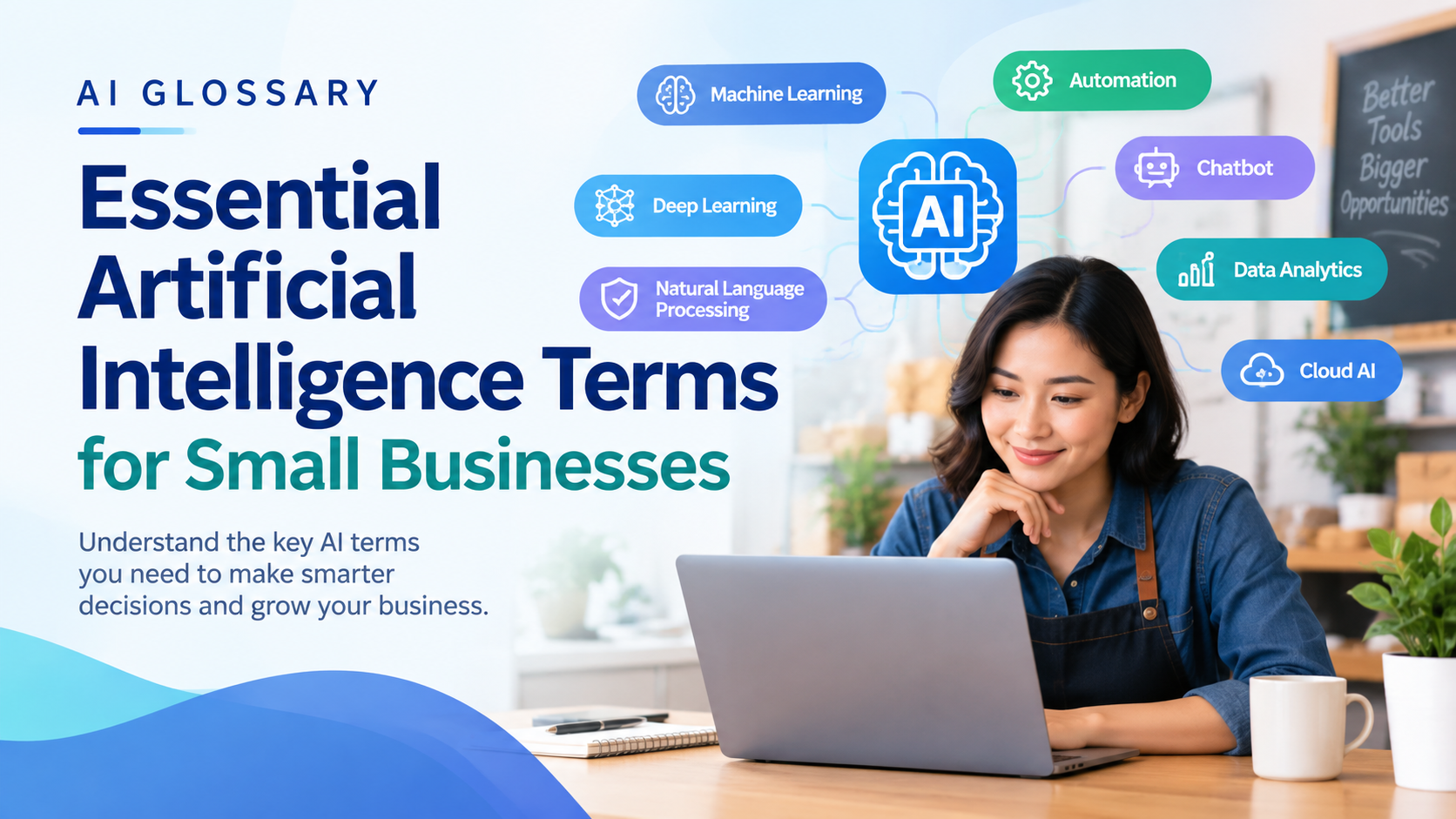
AI becomes much easier to evaluate once you understand the vocabulary. The problem is that artificial intelligence discussions often mix together terms that describe very different things: models, data, automation, generative AI, agents, governance, privacy, and business metrics.
This AI glossary gives small-business owners a practical map of those terms. It focuses on what each term means, how the concepts relate to one another, and why the distinction matters when you are evaluating or implementing AI.
You do not need to memorize every technical term. The useful goal is to recognize the language well enough to ask better questions, compare solutions, understand vendor claims, and make sensible implementation decisions.
How to Use This AI Glossary
Think of this glossary as a map rather than a dictionary. A dictionary tells you what a word means. A useful business glossary also tells you where that word fits in the larger system.
For example, machine learning, generative AI, and large language models are related, but they are not interchangeable. Similarly, AI automation and AI agents describe different approaches to using AI inside workflows.
The definitions below therefore emphasize three things:
- what the term means in plain language,
- how it relates to other AI concepts, and
- why a small business might care about it.
When a term deserves a deeper treatment, the glossary provides context without attempting to replace a dedicated guide.
AI Fundamentals: The Vocabulary Behind Artificial Intelligence
Artificial Intelligence (AI)
Definition: Artificial intelligence is a broad field of computing concerned with creating systems that perform tasks that normally require forms of human intelligence, such as recognizing patterns, understanding language, generating content, making predictions, or supporting decisions.
In simple terms: AI is the broad category. Machine learning, generative AI, and many other technologies fit within that larger field.
Why it matters for small businesses: Thinking of AI as a broad category prevents a common mistake: treating every AI product as if it works the same way. A forecasting system, an AI writing assistant, and an image-generation system may all use AI while solving very different problems.
If you are new to the subject, start with understanding artificial intelligence in a small-business context.
Machine Learning (ML)
Definition: Machine learning is a branch of AI in which computer systems learn patterns from data and use those patterns to produce predictions, classifications, recommendations, or other outputs.
In simple terms: Instead of specifying every rule manually, a machine-learning system can learn relationships from examples.
Business example: A retailer could use historical sales information to estimate future demand. The quality of the result depends heavily on the data, the model, the task, and how the prediction is evaluated.
Machine learning is broader than the conversational AI tools that many people associate with AI today. See machine learning for small businesses for a deeper explanation.
Deep Learning
Definition: Deep learning is a type of machine learning that uses neural networks with multiple layers to learn complex patterns from data.
Why it matters: Deep learning is associated with many modern applications involving language, images, audio, and other complex data. However, a business does not need to understand the architecture of a neural network to decide whether an AI application is useful.
Algorithm
Definition: An algorithm is a defined procedure or set of computational steps for solving a problem or producing an output.
Common confusion: An algorithm is not synonymous with AI. Algorithms existed long before modern AI systems. AI systems use algorithms, but many algorithms have nothing to do with AI.
Model
Definition: An AI or machine-learning model is a computational system that has been developed to recognize patterns, generate outputs, make predictions, classify information, or perform another defined task.
In simple terms: If an algorithm describes a method, a trained model can be thought of as the resulting learned system used to process new inputs.
For a business owner, the important questions are usually less about the model's internal mathematics and more about what it can reliably do, what information it needs, what it costs, and how its outputs should be checked.
Training
Definition: Training is the process through which a machine-learning model learns patterns or parameters from data.
Training should not be confused with using a model after it has already been trained. A business may use an existing AI model without training a model from scratch.
Training Data
Definition: Training data is information used during the development or training of a machine-learning model.
Why it matters: Data quality can influence model behavior. Poor, incomplete, biased, outdated, or inappropriate data can create problems even when the underlying technology is sophisticated.
Inference
Definition: Inference is the process of using a trained model to produce an output from new input.
Simple distinction: Training is about learning from data. Inference is about using the resulting model.
This distinction becomes useful when discussing AI costs because training and inference can involve different technical requirements and cost structures.
Generative AI and Language Models
Generative AI
Definition: Generative AI refers to AI systems designed to generate new content or outputs, such as text, images, audio, video, code, or other forms of media.
Business example: A small company might use generative AI to create a first draft of a product description, summarize internal material, brainstorm marketing ideas, or transform information into another format.
The important distinction is that generating an output does not automatically mean the output is correct. Human review remains important whenever errors could affect customers, finances, legal obligations, reputation, or other consequential decisions.
Large Language Model (LLM)
Definition: A large language model is a type of AI model designed to process and generate language. LLMs can perform tasks such as text generation, summarization, classification, extraction, transformation, and conversational interaction.
In simple terms: An LLM is a language-focused model. Generative AI is the broader category of technology that can generate different types of content.
Read the deeper guide to large language models when you need more detail about how LLMs work and where they fit into business applications.
Foundation Model
Definition: A foundation model is a broadly trained model that can serve as a base for multiple downstream applications or tasks.
Why it matters: Businesses generally interact with products or applications built on top of models rather than building foundation models themselves. Understanding the term helps when reading technical documentation or vendor descriptions.
Prompt
Definition: A prompt is the instruction, question, context, or input provided to an AI system to guide its response.
Business example: Instead of asking an AI system to “write an email,” a business might specify the audience, objective, tone, relevant facts, constraints, and desired format.
A better prompt can improve usefulness, but prompting is not a substitute for reliable data, sound workflows, or human review.
Prompt Engineering
Definition: Prompt engineering is the practice of designing and refining instructions or inputs to obtain more useful and consistent outputs from an AI system.
For small businesses, prompt engineering is most useful when a task is repeated frequently and consistency matters. It becomes less useful to obsess over elaborate prompts when the underlying business process itself is unclear.
Token
Definition: A token is a unit of text processed by a language model. Tokens do not always correspond exactly to whole words.
Why it matters: Token usage can affect how much information a language model can process and, depending on the service, may also be relevant to pricing.
Context Window
Definition: A context window is the amount of information an AI model can consider within a particular interaction or processing context.
Business implication: A system's ability to process a large document or collection of information depends on the model and application. A larger context does not automatically guarantee better reasoning or accurate outputs.
Multimodal AI
Definition: Multimodal AI refers to systems that can work with more than one type of information, such as text, images, audio, or other data formats.
A business might use a multimodal system to analyze a document containing both text and images, for example. The exact capabilities depend on the specific system.
AI Applications in Business
AI Automation
Definition: AI automation uses AI capabilities as part of an automated business workflow.
The important word is workflow. AI automation is not simply “using an AI tool.” It means AI has been incorporated into a process that moves information or work from one stage to another.
Illustrative scenario: A business receives customer inquiries through a shared inbox. An AI system could classify incoming messages, extract key information, draft a response, and route the request for human approval.
The automation may reduce repetitive work, but it also creates new requirements around quality control and exception handling.
Workflow Automation
Definition: Workflow automation is the use of software to move work between predefined steps with less manual intervention.
Not all workflow automation requires AI. A rule such as “when a customer completes a form, send a confirmation email” can be automated without artificial intelligence.
This distinction matters because a simpler rule-based automation may sometimes be easier to maintain than an AI-based system.
AI Assistant
Definition: An AI assistant is a system designed to help a person perform tasks through natural-language or other interactions.
Examples include drafting text, summarizing information, answering questions, generating ideas, or helping organize information.
An assistant generally supports a human rather than independently owning an entire business process.
AI Agent
Definition: An AI agent is a system designed to pursue a task or objective by interpreting information and, depending on its design, selecting or executing actions using available tools.
Why the distinction matters: An assistant may respond to a request. An agent may be designed to carry out multiple steps toward a goal.
Greater autonomy can also introduce greater operational risk. The more authority a system has to act, the more important permissions, monitoring, testing, exception handling, and human oversight become.
Recommendation System
Definition: A recommendation system predicts or selects items that may be relevant to a user based on available information.
Recommendation systems can appear in e-commerce, content platforms, product catalogs, and other environments where users must choose among many options.
Predictive Analytics
Definition: Predictive analytics uses historical or other available data to estimate likely future outcomes or patterns.
Predictions are not guarantees. Their usefulness depends on the data, modeling approach, changing conditions, and the way predictions are interpreted.
Business Intelligence (BI)
Definition: Business intelligence refers broadly to processes and technologies used to organize, analyze, and present business information to support decision-making.
AI and BI can overlap, but they are not identical. A dashboard showing monthly sales is business intelligence even if no AI is involved.
AI Implementation and Adoption Terms
AI Implementation
Definition: AI implementation is the process of putting an AI capability into an actual business workflow, system, or operating process.
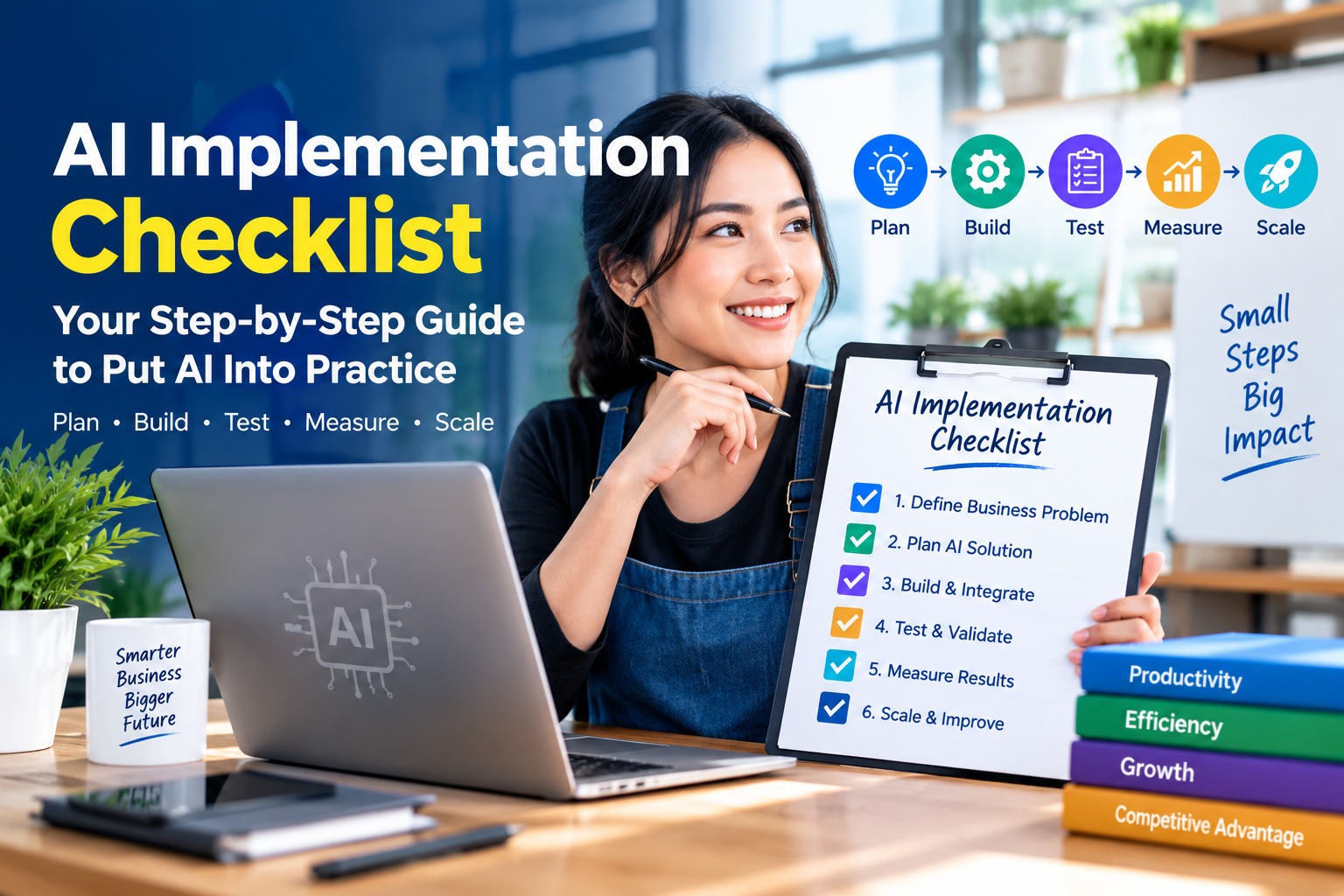
Implementation involves more than selecting a tool. It can include defining the problem, preparing inputs, testing the workflow, establishing oversight, training users, measuring results, and maintaining the process.
For the broader implementation process, see the AI implementation guide.
AI Adoption
Definition: AI adoption describes how people and organizations begin using AI in actual work.
A company can purchase an AI system without achieving meaningful adoption. If employees do not understand the workflow, trust the output, or know when human review is required, the technology may remain underused.
AI Workflow
Definition: An AI workflow is a business process in which one or more AI capabilities perform or assist with defined tasks.
A useful AI workflow identifies inputs, processing steps, outputs, human responsibilities, exceptions, and success measures.
Human-in-the-Loop
Definition: Human-in-the-loop describes a workflow in which people review, approve, correct, or otherwise participate in decisions or outputs produced with AI.
This is especially useful when errors have meaningful consequences or when the AI system cannot reliably handle every possible situation.
Human Oversight
Definition: Human oversight means maintaining appropriate human responsibility and supervision over an AI-supported process.
Oversight might include checking outputs, approving sensitive decisions, reviewing exceptions, monitoring quality, or changing the workflow when conditions change.
Human oversight does not mean manually checking everything forever. The appropriate level depends on the risk and the reliability of the process.
AI Governance
Definition: AI governance is the collection of policies, responsibilities, controls, processes, and decision rules used to manage how AI is developed, purchased, deployed, and used.
For a small business, governance does not necessarily mean creating a large corporate bureaucracy. It can begin with practical questions such as who may use AI, what information may be entered, which outputs require approval, and who owns the workflow.
These questions fit within Beritaja's broader AI governance and strategy coverage.
AI Policy
Definition: An AI policy is a documented set of rules or expectations governing the acceptable use of AI within an organization.
A policy might address approved tools, confidential information, customer data, human review, intellectual property, and employee responsibilities.
Change Management
Definition: Change management refers to the structured process of helping people and organizations adopt changes to systems, workflows, roles, or procedures.
AI adoption can create changes in how employees perform their jobs. Technical deployment therefore does not necessarily solve the organizational part of implementation.
AI Risk, Data, Privacy, and Security Terms
AI Hallucination
Definition: An AI hallucination is an output that appears plausible but contains information that is inaccurate, unsupported, or invented.
Why it matters: Fluent language can make an incorrect answer sound convincing. A business should therefore determine which AI outputs require verification rather than assuming confident wording means factual accuracy.
AI Bias
Definition: AI bias refers to systematic patterns in an AI system or its outputs that can produce unfair, inaccurate, or otherwise problematic results for certain people, groups, or situations.
Potential sources include data, model design, assumptions, measurement choices, and how a system is deployed.
Data Privacy
Definition: Data privacy concerns how information about people is collected, used, stored, shared, and protected.
For small businesses, privacy considerations become particularly important when AI tools process customer information, employee information, financial information, or other sensitive data.
Data Security
Definition: Data security refers to measures designed to protect information and systems against unauthorized access, alteration, disclosure, loss, or other threats.
Privacy and security overlap but are not identical. Privacy concerns appropriate handling of information, while security focuses heavily on protecting information and systems.
Personally Identifiable Information (PII)
Definition: Personally identifiable information is information that can identify an individual, either directly or in combination with other information.
The precise legal definition can vary by jurisdiction and context, so businesses should not assume that one universal definition applies everywhere.
Data Governance
Definition: Data governance is the framework of responsibilities, rules, processes, and controls used to manage data quality, access, ownership, usage, and protection.
Good AI governance often depends on good data governance because AI systems are only as useful as the information and controls surrounding their use.
Model Risk
Definition: Model risk is the possibility that decisions or outcomes are negatively affected because a model is incorrect, poorly designed, poorly implemented, misunderstood, or used outside appropriate conditions.
For a small business, the practical response is not necessarily to eliminate model risk. It is to understand where the risk matters and design appropriate controls.
AI Economics: Cost, Budget, and Return
AI Cost
Definition: AI cost includes the expenses associated with acquiring, using, implementing, maintaining, and governing an AI capability.
The cost may include software subscriptions, usage charges, integration work, employee time, training, monitoring, data preparation, and maintenance.
Looking only at the advertised subscription price can therefore produce an incomplete picture of the economics.
AI Budget
Definition: An AI budget is the amount of money and resources a business plans to allocate to AI-related activities.
A sensible budget should consider not only the technology itself but also implementation and ongoing operating requirements.
AI ROI
Definition: AI return on investment measures the relationship between the financial benefit generated by an AI initiative and the investment required to produce that benefit.
A simplified ROI calculation can be expressed as:
ROI = (Net Benefit ÷ Investment Cost) × 100
For example, if an illustrative AI project costs $2,000 and produces an estimated net benefit of $3,000 over the chosen measurement period, the simplified ROI would be 150%.
This is a hypothetical calculation, not a prediction of what an AI project will achieve. The quality of the result depends on the baseline, measurement period, assumptions, and whether the claimed benefits can actually be attributed to the project.
Once you understand the basic meaning of AI ROI, you can apply the concept to a specific business scenario with Beritaja's ROI Calculator. A calculator can help structure the numbers, but the usefulness of the result still depends on realistic assumptions about costs, benefits, and the measurement period.
Total Cost of Ownership (TCO)
Definition: Total cost of ownership is an approach to evaluating the full cost of owning or operating a solution rather than looking only at its purchase price.
For AI, TCO may include software, usage, integration, maintenance, employee time, training, security, monitoring, and other relevant costs.
Productivity
Definition: Productivity describes the relationship between outputs and the resources required to produce them.
AI may improve productivity in some workflows by reducing repetitive work or accelerating information processing. However, time saved on one task is not automatically equivalent to financial value. The business still needs to determine how the recovered capacity is used.
Commonly Confused AI Terms
Some AI terminology becomes confusing because related concepts overlap. The distinctions below are useful when evaluating tools or discussing implementation.
| Terms | Key distinction | Why it matters |
|---|---|---|
| AI vs. Machine Learning | AI is the broader field; machine learning is one approach within AI. | Prevents treating the terms as exact synonyms. |
| Generative AI vs. AI | Generative AI focuses on producing new content or outputs; AI is the broader category. | Clarifies what a particular system is designed to do. |
| LLM vs. Generative AI | An LLM is a language model; generative AI is a broader category that includes systems generating different kinds of content. | Helps interpret product and technical descriptions. |
| Algorithm vs. Model | An algorithm is a computational procedure; a trained model is a learned computational system used for a task. | Useful when discussing how AI systems are built and used. |
| Automation vs. AI Automation | Automation can use fixed rules; AI automation incorporates AI capabilities into the workflow. | A simpler non-AI automation may sometimes be sufficient. |
| AI Assistant vs. AI Agent | An assistant generally helps with tasks; an agent may be designed to pursue objectives through multiple actions. | Greater autonomy can require stronger controls. |
| Training vs. Inference | Training develops a model; inference uses a trained model to process new inputs. | Important for understanding AI system architecture and economics. |
| Privacy vs. Security | Privacy concerns appropriate handling of information; security concerns protecting information and systems. | Both need attention but address different questions. |
The practical lesson is simple: when evaluating an AI product, ask what the system actually does rather than relying on the label attached to it.
How AI Vocabulary Improves Business Decisions
Knowing the terminology is valuable because language shapes the questions you ask.
Consider a vendor claiming that its product provides “AI automation.” Instead of immediately asking whether the product is powerful, a business owner can ask:
- What part of the workflow is automated?
- Where does AI enter the process?
- What information does the system use?
- What does it produce?
- What happens when the output is wrong?
- Does a person review the result?
- What actions can the system take automatically?
- How is performance measured?
- What happens when the business process changes?
That is a much more useful conversation than asking whether a product is simply “AI-powered.”
A Five-Question Vocabulary Test
When you encounter an unfamiliar AI term, use five questions:
- What is it? Identify the basic concept.
- What does it do? Translate the terminology into an actual capability.
- What does it need? Identify data, permissions, inputs, infrastructure, or human involvement.
- What can go wrong? Identify limitations and failure conditions.
- Where does it fit? Determine how the concept connects to the business workflow.
This prevents terminology from becoming a substitute for analysis.
A sophisticated-sounding term is not automatically evidence that a product solves a meaningful business problem.
The Most Useful AI Terms Are the Ones Connected to a Workflow
A glossary becomes much more useful when terminology is connected to something the business actually does.
Imagine a small online retailer wants to reduce the time employees spend responding to routine customer questions.
The relevant vocabulary might include:
- LLM: the language technology used to process and generate responses.
- Prompt: the instructions and context supplied to guide the response.
- AI assistant: the interface employees use to generate or improve replies.
- Workflow automation: the broader process that moves a customer inquiry through the system.
- Human-in-the-loop: the employee who reviews responses before they are sent when required.
- AI hallucination: a potential failure mode if the system invents product information.
- Data privacy: a consideration if customer information enters the system.
- Measurement: the process of determining whether response time, quality, or another relevant outcome actually improved.
Notice what happened: the terms became useful only when connected to a real workflow.
This is the mental model worth keeping. AI terminology describes components and behaviors; business value comes from how those components are used within a process.
What Small Businesses Should Not Assume From AI Terminology
“AI-Powered” Does Not Explain the Business Value
A product can use AI without solving an important problem. The relevant question is what the technology changes in the workflow.
“Automated” Does Not Mean “Fully Autonomous”
A workflow can automate one step while leaving several other steps under human control. Ask exactly what is automated and where responsibility remains.
“Predictive” Does Not Mean “Certain”
A prediction is an estimate based on information and assumptions. Changing market conditions, incomplete data, and unexpected events can affect its usefulness.
“Intelligent” Does Not Mean “Correct”
AI systems can produce fluent, useful, and incorrect outputs. Reliability should be evaluated against the actual task rather than inferred from marketing language.
“AI Agent” Does Not Mean “No Human Responsibility”
Giving an AI system more ability to act can increase the importance of permissions, monitoring, testing, and exception handling.
These distinctions are particularly important for small businesses because limited budgets and small teams leave less room for expensive implementation mistakes.
A Practical AI Vocabulary Checklist for Business Owners
Before adopting an AI product or adding AI to a workflow, you do not need to understand every technical term. You do need enough vocabulary to identify what the system is doing and where the risks sit.
| Question | Terms that may help | What to determine |
|---|---|---|
| What technology is involved? | AI, ML, generative AI, LLM, model | What the system actually does. |
| What enters the system? | Input, data, prompt, context | What information the system needs. |
| What comes out? | Prediction, generation, classification, recommendation | What the output represents. |
| Where does it fit? | Workflow, automation, assistant, agent | How the technology interacts with work. |
| Who remains responsible? | Human-in-the-loop, human oversight, governance | Where human judgment is required. |
| What could go wrong? | Hallucination, bias, privacy, security, model risk | Potential failure modes. |
| How much does it really cost? | AI cost, budget, TCO, ROI | Whether the economics make sense. |
| How will we know it worked? | Baseline, productivity, quality, error rate, ROI | How success will be measured. |
This checklist is not a replacement for an implementation plan. Its purpose is to make the vocabulary behind the plan easier to understand.
Where to Go Next
You do not need to learn every AI term before using AI. Start with the vocabulary connected to the problem you are actually trying to solve.
If you are still learning the fundamentals, explore AI for small businesses and the broader AI-for-MSMEs knowledge base.
If you are evaluating the financial side of an AI initiative, review the concepts of AI cost, AI budget, AI ROI, and total cost of ownership. You can then use the ROI Calculator to apply the basic ROI concept to your own assumptions.
The objective is not to become fluent in AI jargon for its own sake. The objective is to understand enough of the language to ask better questions about technology, workflows, risk, cost, and business value.
Frequently Asked Questions
What is an AI glossary?
An AI glossary is a reference that explains terminology used in artificial intelligence. A business-focused glossary should also explain how terms relate to one another and why the distinctions matter in practical situations.
What AI terms should small-business owners know first?
Start with artificial intelligence, machine learning, generative AI, large language models, prompts, AI automation, AI assistants, AI agents, AI implementation, human oversight, AI governance, data privacy, AI hallucinations, AI cost, and AI ROI.
Is machine learning the same as AI?
No. Artificial intelligence is the broader field, while machine learning is one approach used within AI. The terms are related but should not be treated as exact synonyms.
What is the difference between generative AI and an LLM?
Generative AI is a broad category of systems that generate content or other outputs. A large language model is a type of model designed primarily to process and generate language.
What is the difference between an AI assistant and an AI agent?
An AI assistant generally helps a person perform tasks, while an AI agent may be designed to pursue a task or objective through multiple actions and tools. The exact capabilities depend on the system.
Why do AI terms matter to small businesses?
Understanding the terminology helps business owners ask better questions about capabilities, data, workflow design, risk, human responsibility, cost, and measurement instead of relying on vague claims such as “AI-powered.”
Do I need to understand the technical side of AI before adopting it?
No. You do not need to understand every technical detail. You do need enough understanding to identify what the system does, what information it uses, how it fits into the workflow, what can go wrong, and where human responsibility remains.
What should I learn after reading an AI glossary?
Choose the concept that relates most directly to your business problem. For example, you might study AI implementation, machine learning, large language models, AI governance, AI risk, or AI ROI rather than trying to learn every AI concept at once.