What Is Artificial Intelligence for Small Businesses? A Beginner's Guide (2026)


What Is Artificial Intelligence for Small Businesses? A Beginner's Guide (2026)
Artificial Intelligence (AI) is no longer a futuristic concept reserved for large technology companies or research laboratories. Today, AI has become one of the most practical and accessible technologies for businesses of every size. From automating repetitive tasks to improving customer experiences and generating valuable business insights, AI is reshaping how organizations operate in nearly every industry.
For small businesses, the rise of affordable AI tools presents an opportunity that simply didn't exist a decade ago. Entrepreneurs can now automate customer support, create marketing content, analyze sales data, predict demand, and even manage daily operations using AI-powered software—often without hiring a technical team.
If you've heard terms like machine learning, generative AI, ChatGPT, or AI automation but aren't entirely sure what they mean, you're in the right place. This guide explains Artificial Intelligence in clear, beginner-friendly language while focusing on how it applies to small businesses in 2026.
Whether you're a local retailer, freelancer, startup founder, online seller, consultant, or growing business owner, understanding AI is becoming an essential digital skill rather than an optional advantage.
If you're specifically looking to understand how AI can transform micro, small, and medium-sized enterprises, be sure to read our comprehensive guide:
Related:What Is AI for MSMEs? The Complete Guide (2026)
Why Artificial Intelligence Matters More Than Ever
Artificial Intelligence has quietly become part of everyday life. Every time you receive personalized movie recommendations, ask a voice assistant for directions, translate text instantly, or receive spam filtering in your email inbox, AI is working behind the scenes.
Businesses are adopting AI at an unprecedented pace because it helps solve real operational problems. Instead of spending hours analyzing spreadsheets or responding to repetitive customer inquiries, employees can focus on higher-value work while AI handles routine tasks.
For small businesses with limited staff and tight budgets, this productivity boost can create a significant competitive advantage.
Today's AI platforms are also easier to use than ever before. Most modern AI applications require no programming knowledge, allowing business owners to integrate intelligent tools into their daily workflow within minutes.
Some of the most common AI-powered activities include:
- Writing marketing copy
- Generating product descriptions
- Answering customer questions
- Predicting inventory demand
- Analyzing sales performance
- Creating business reports
- Translating multiple languages
- Scheduling appointments
- Detecting fraud
- Automating repetitive administrative work
As AI technology becomes increasingly affordable, even solo entrepreneurs can benefit from capabilities that were previously available only to large enterprises.
What Is Artificial Intelligence?
Artificial Intelligence, commonly abbreviated as AI, refers to computer systems designed to perform tasks that typically require human intelligence.
These tasks may include understanding language, recognizing images, making decisions, solving problems, learning from experience, identifying patterns, and generating new content.
Unlike traditional software that follows rigid instructions, AI systems are capable of adapting based on data. Instead of relying entirely on manually programmed rules, AI analyzes information, identifies relationships, and improves its performance over time.
A simple definition is:
Artificial Intelligence is technology that enables computers to simulate aspects of human thinking and decision-making to solve real-world problems.
Although AI may appear intelligent, it's important to understand that today's systems do not "think" the way humans do. Instead, they recognize patterns, calculate probabilities, and generate responses based on enormous amounts of data.
This distinction helps explain both the remarkable capabilities and the limitations of modern AI systems.
A Brief History of Artificial Intelligence
While AI has become mainstream only in recent years, the idea itself has existed for decades.
Researchers first began exploring whether machines could imitate human intelligence during the 1950s. Early computers were extremely limited, making meaningful AI development difficult.
Several periods of slow progress—often referred to as "AI winters"—occurred because computing power and available data were insufficient to support ambitious research goals.
Everything changed as three major technological advances converged:
- Massive increases in computing power
- Explosion of digital data
- Breakthroughs in machine learning algorithms
These developments enabled AI systems to solve increasingly complex problems with impressive accuracy.
The launch of modern generative AI applications further accelerated public interest by allowing ordinary users to interact naturally with AI through conversations, images, programming assistance, and creative content generation.
Today, AI is considered one of the most transformative technologies since the emergence of the internet.
Why AI Is Different from Traditional Software
Many people assume AI is simply another type of software. While AI is indeed software, it behaves differently from traditional computer programs.
Traditional software follows explicit instructions written by developers. Every possible situation must be anticipated in advance.
Artificial Intelligence, however, learns patterns from data instead of relying exclusively on fixed rules.
| Traditional Software | Artificial Intelligence |
| Rule-based programming | Learns from data |
| Static behavior | Can improve with training |
| Limited flexibility | Recognizes complex patterns |
| Requires manual updates | Continuously adapts through new information |
| Predictable outputs | Generates context-aware responses |
This ability to learn from data is what makes AI uniquely powerful for business applications ranging from customer support to predictive analytics.
Examples of Artificial Intelligence You Already Use
One of the biggest misconceptions about AI is that it's something only technology companies use. In reality, millions of people interact with AI every day without even realizing it.
Here are just a few familiar examples:
- Voice assistants answering spoken questions.
- Email spam filters identifying unwanted messages.
- Streaming services recommending movies and TV shows.
- Online stores suggesting products based on browsing behavior.
- Navigation apps predicting traffic conditions.
- Banking systems detecting unusual transactions.
- Social media platforms organizing personalized news feeds.
- AI chatbots answering customer questions instantly.
- Writing assistants improving grammar and content quality.
- Image generators creating illustrations from text prompts.
These examples demonstrate that AI isn't a single product—it's a collection of technologies solving different types of problems across countless industries.
Why Small Businesses Should Learn AI Today
Artificial Intelligence is no longer reserved for multinational corporations. Cloud computing, subscription-based software, and user-friendly AI platforms have dramatically reduced the barriers to adoption.
Small businesses now have access to intelligent tools that can help improve productivity, reduce operational costs, and enhance customer satisfaction without requiring large technology investments.
Learning the fundamentals of AI doesn't mean becoming a data scientist. Instead, it helps business owners understand what AI can realistically do, where it provides value, and how to adopt it responsibly.
Organizations that develop AI literacy today are likely to make better technology decisions in the years ahead while avoiding unrealistic expectations and common misconceptions.
In the next section, we'll explore exactly how Artificial Intelligence works, including machine learning, neural networks, training data, and the technologies powering today's smartest AI applications.
How Does Artificial Intelligence Work?
Artificial Intelligence may seem incredibly complex, but its core principle is surprisingly straightforward. AI systems learn by processing enormous amounts of data, identifying patterns, and using those patterns to make predictions or decisions.
Think of AI as a student rather than a traditional computer program. Instead of following only predefined rules, the system "studies" examples until it recognizes relationships between different pieces of information. Once trained, it can apply what it has learned to new situations.
For example, an AI system trained on thousands of customer emails can learn to identify common support requests automatically. Likewise, an AI trained on millions of images can distinguish between different products, animals, or objects with impressive accuracy.
Although modern AI appears intelligent, it doesn't possess human consciousness or emotions. It relies on mathematics, statistics, algorithms, and data to calculate the most likely response based on previous learning.
The Five Basic Components of Artificial Intelligence
Most AI systems rely on five fundamental building blocks. Understanding these components makes it much easier to see how AI generates useful results.
1. Data
Data is the foundation of every AI system. Without high-quality data, AI cannot learn effectively.
Examples of data include:
- Customer purchase history
- Product images
- Email conversations
- Sales reports
- Medical records
- Website traffic
- Financial transactions
- Voice recordings
Generally speaking, larger and more accurate datasets enable AI models to make better predictions and recommendations.
2. Algorithms
Algorithms are sets of mathematical instructions that help AI analyze information and identify patterns. They determine how data is processed, how relationships are discovered, and how predictions are generated.
Different AI tasks require different algorithms depending on whether the goal is recognizing images, translating languages, forecasting demand, or recommending products.
3. Training
Training is the learning process where AI analyzes examples repeatedly until it can recognize patterns with acceptable accuracy.
During training, the system continually compares its predictions with known answers and adjusts itself to reduce errors.
4. Models
After training is complete, the knowledge acquired by the AI is stored inside a trained model. This model can then be deployed to answer questions, generate content, classify images, or perform many other tasks.
5. Inference
Inference is the stage where AI applies everything it has learned to new information. Every time you ask an AI chatbot a question or receive a personalized recommendation, the model is performing inference.
How AI Learns from Data
Unlike conventional software that follows fixed instructions, AI continuously improves by analyzing examples.
Imagine teaching a child to recognize cats. Instead of explaining every physical characteristic, you simply show thousands of pictures labeled "cat." Eventually, the child begins recognizing cats independently.
Artificial Intelligence learns in a similar way.
For instance, if an AI system analyzes millions of online shopping transactions, it may discover patterns such as:
- Customers who purchase coffee often buy filters.
- Weekend shoppers spend more than weekday shoppers.
- Holiday sales increase demand for specific products.
- Returning customers respond well to personalized discounts.
Once these patterns are identified, AI can make predictions that help businesses improve decision-making and customer experiences.
Machine Learning: The Engine Behind Modern AI
One of the most important technologies powering today's AI applications is Machine Learning (ML).
Machine Learning enables computers to improve their performance through experience rather than explicit programming.
Instead of writing thousands of detailed instructions, developers provide examples, and the algorithm learns the underlying relationships independently.
Machine Learning powers many everyday applications, including:
- Email spam detection
- Product recommendations
- Fraud detection
- Language translation
- Medical diagnosis support
- Sales forecasting
- Customer segmentation
- Search engine ranking
Most modern business AI tools—including marketing automation, predictive analytics, and recommendation systems—rely heavily on Machine Learning models.
What Is Deep Learning?
Deep Learning is a specialized branch of Machine Learning that uses artificial neural networks inspired by the structure of the human brain.
These neural networks contain multiple interconnected layers that allow AI to recognize extremely complex patterns in large datasets.
Deep Learning has significantly improved AI performance in areas such as:
- Speech recognition
- Image classification
- Medical imaging
- Language translation
- Autonomous vehicles
- Generative AI
- Facial recognition
- Video analysis
Although Deep Learning requires substantial computing resources, it enables many of today's most advanced AI capabilities.
What Are Neural Networks?
Artificial neural networks are computational models inspired by how neurons communicate within the human brain.
Rather than storing fixed answers, neural networks learn relationships between different pieces of information through repeated training.
Each layer processes information before passing it to the next layer, gradually extracting increasingly sophisticated patterns.
For example, an image recognition AI might first identify simple edges, then shapes, then objects, and finally recognize an entire product or person.
Large neural networks containing billions of parameters are responsible for many modern AI breakthroughs, including advanced conversational assistants and image-generation systems.
Supervised, Unsupervised, and Reinforcement Learning
Machine Learning can be divided into three primary learning approaches.
Supervised Learning
The AI learns using labeled examples where the correct answers are already known.
Example:
- Identifying whether an email is spam.
- Predicting customer churn.
- Classifying product categories.
Unsupervised Learning
Here, AI receives unlabeled data and discovers hidden relationships without predefined answers.
Common business uses include:
- Customer segmentation
- Market basket analysis
- Behavioral clustering
- Anomaly detection
Reinforcement Learning
Reinforcement Learning allows AI to improve through trial and error. The system receives rewards for successful actions and penalties for poor decisions.
This technique is commonly used in robotics, autonomous vehicles, industrial automation, logistics optimization, and advanced game-playing AI.
What Is Generative AI?
One of the fastest-growing areas of Artificial Intelligence is Generative AI.
Unlike traditional AI systems that primarily analyze existing information, Generative AI creates entirely new content based on user prompts.
Examples include:
- Writing blog articles
- Generating marketing emails
- Creating social media posts
- Designing illustrations
- Writing software code
- Producing business reports
- Summarizing lengthy documents
- Translating multiple languages
Generative AI has rapidly become one of the most valuable technologies for entrepreneurs because it helps reduce repetitive work while increasing productivity.
Many small businesses now use Generative AI to accelerate content creation, customer communication, and operational efficiency without significantly increasing staffing costs.
How Businesses Benefit from AI Learning Models
Understanding how AI learns helps business owners recognize why the technology delivers measurable value.
Instead of manually analyzing thousands of records, AI can detect trends in seconds, identify opportunities, forecast future demand, and automate repetitive workflows.
Examples include:
- Predicting future inventory requirements.
- Identifying customers most likely to purchase.
- Recommending personalized products.
- Detecting fraudulent transactions.
- Automating invoice processing.
- Improving digital advertising performance.
- Optimizing delivery routes.
- Forecasting seasonal sales trends.
These capabilities enable businesses to make faster, data-driven decisions while reducing operational costs.
Coming Up Next
Now that you understand how Artificial Intelligence works, the next step is exploring the different categories of AI and the technologies behind today's intelligent applications.
In Part 3, we'll compare Artificial Intelligence, Machine Learning, and Deep Learning, examine the various types of AI, and explore real-world business applications across multiple industries.
You'll also learn how small businesses are already using AI to improve customer service, marketing, inventory management, accounting, sales forecasting, and daily operations.
Artificial Intelligence vs. Machine Learning vs. Deep Learning
One of the biggest sources of confusion for beginners is the relationship between Artificial Intelligence (AI), Machine Learning (ML), and Deep Learning (DL). These terms are often used interchangeably, but they are not the same.
The easiest way to understand them is to think of them as a hierarchy. Artificial Intelligence is the broadest concept, Machine Learning is a subset of AI, and Deep Learning is a specialized branch of Machine Learning.
| Technology | Definition | Business Example |
| Artificial Intelligence | Technology that enables machines to simulate human intelligence. | AI chatbots, recommendation systems, virtual assistants. |
| Machine Learning | A method that allows AI to learn from data instead of explicit programming. | Sales forecasting, fraud detection, customer segmentation. |
| Deep Learning | A specialized Machine Learning technique using neural networks. | Image recognition, speech recognition, generative AI. |
Understanding these differences helps business owners choose the right AI solution without becoming overwhelmed by technical terminology.
The Three Main Types of Artificial Intelligence
AI systems are generally categorized according to their capabilities rather than the specific technologies they use. Although researchers continue to develop more advanced systems, today's AI is still far from matching the flexibility of the human brain.
1. Narrow AI (Artificial Narrow Intelligence)
Narrow AI is the only form of Artificial Intelligence currently available in commercial products.
These systems are designed to perform one specific task extremely well. While they may appear intelligent, they cannot perform unrelated activities outside their training.
Examples include:
- Virtual assistants
- AI customer service chatbots
- Spam email filters
- Recommendation engines
- Image recognition software
- Language translation tools
- AI writing assistants
Nearly every AI application used by small businesses today falls into this category.
2. General AI (Artificial General Intelligence)
Artificial General Intelligence (AGI) refers to a hypothetical AI capable of performing any intellectual task that a human can accomplish.
Unlike Narrow AI, AGI would understand context across multiple domains, reason independently, adapt to unfamiliar situations, and transfer knowledge from one task to another.
As of 2026, AGI remains a research goal rather than a commercially available technology.
3. Super AI
Super AI describes a theoretical future where machine intelligence surpasses human intelligence across virtually every field.
This concept is frequently discussed in science fiction and academic research but has not been achieved.
While fascinating, Super AI should not be confused with today's practical AI tools used in business.
Core AI Technologies Powering Modern Business
Artificial Intelligence is not a single technology. Instead, it combines multiple specialized technologies that work together to solve different business challenges.
Machine Learning
Machine Learning analyzes historical data to identify trends, predict future outcomes, and improve decision-making.
Natural Language Processing (NLP)
Natural Language Processing enables computers to understand, interpret, and generate human language.
Businesses use NLP for:
- AI chatbots
- Language translation
- Email classification
- Customer sentiment analysis
- Document summarization
Computer Vision
Computer Vision allows AI to interpret images and videos similarly to how humans recognize visual information.
Applications include:
- Quality inspection
- Medical imaging
- Facial recognition
- Retail inventory monitoring
- Autonomous vehicles
Speech Recognition
Speech recognition converts spoken language into text and allows voice-controlled interactions.
Examples include customer service phone automation, smart assistants, voice search, and meeting transcription.
Robotics
Robotics combines AI with physical machines capable of performing repetitive or hazardous tasks in manufacturing, logistics, healthcare, and warehousing.
Generative AI
Generative AI creates new content rather than simply analyzing existing information. Businesses increasingly use it to produce articles, images, software code, marketing campaigns, presentations, and product descriptions.
Real-World Applications of Artificial Intelligence
Artificial Intelligence is already transforming nearly every major industry. Organizations use AI to improve productivity, reduce costs, and make more informed decisions.
Healthcare
- Medical image analysis
- Disease prediction
- Drug discovery
- Virtual health assistants
Finance
- Fraud detection
- Risk assessment
- Credit scoring
- Algorithmic trading
Retail
- Demand forecasting
- Product recommendations
- Dynamic pricing
- Inventory optimization
Manufacturing
- Predictive maintenance
- Quality control
- Production scheduling
- Supply chain optimization
Transportation
- Route optimization
- Fleet management
- Autonomous driving research
- Traffic prediction
Education
- Personalized learning
- AI tutoring
- Automated grading
- Learning analytics
Agriculture
- Crop monitoring
- Weather prediction
- Pest detection
- Precision farming
Marketing
- Audience targeting
- Campaign optimization
- Content generation
- Customer segmentation
These examples demonstrate that AI is no longer limited to technology companies. It has become an essential business capability across industries of every size.
How Small Businesses Are Using Artificial Intelligence
Many entrepreneurs assume AI is too expensive or complicated for smaller organizations. In reality, cloud-based AI services have made advanced capabilities affordable for businesses with limited budgets.
Here are some of the most common ways small businesses are adopting AI in 2026.
Customer Support
AI chatbots answer frequently asked questions 24/7, reducing response times while allowing employees to focus on more complex customer needs.
Content Marketing
Businesses use Generative AI to create blog articles, email campaigns, product descriptions, advertisements, and social media content much faster than traditional workflows.
Email Marketing
AI helps personalize subject lines, optimize send times, and improve campaign performance through predictive analytics.
Sales Forecasting
Machine Learning analyzes historical sales data to predict future demand and identify seasonal trends.
Inventory Management
Retailers use AI to forecast stock requirements, reduce waste, and prevent inventory shortages.
Accounting
Modern accounting software uses AI to categorize expenses, detect anomalies, automate invoice processing, and simplify bookkeeping.
Customer Relationship Management (CRM)
AI-powered CRM systems identify high-value leads, recommend follow-up actions, and estimate conversion probability.
Digital Advertising
Advertising platforms increasingly rely on AI to optimize bidding strategies, audience targeting, and campaign performance automatically.
Businesses interested in practical implementation should also read our complete guide on AI for MSMEs, which explains how organizations can integrate AI into daily operations regardless of company size.
Common Myths About Artificial Intelligence
Despite its growing popularity, AI is still surrounded by misconceptions that discourage some business owners from adopting the technology.
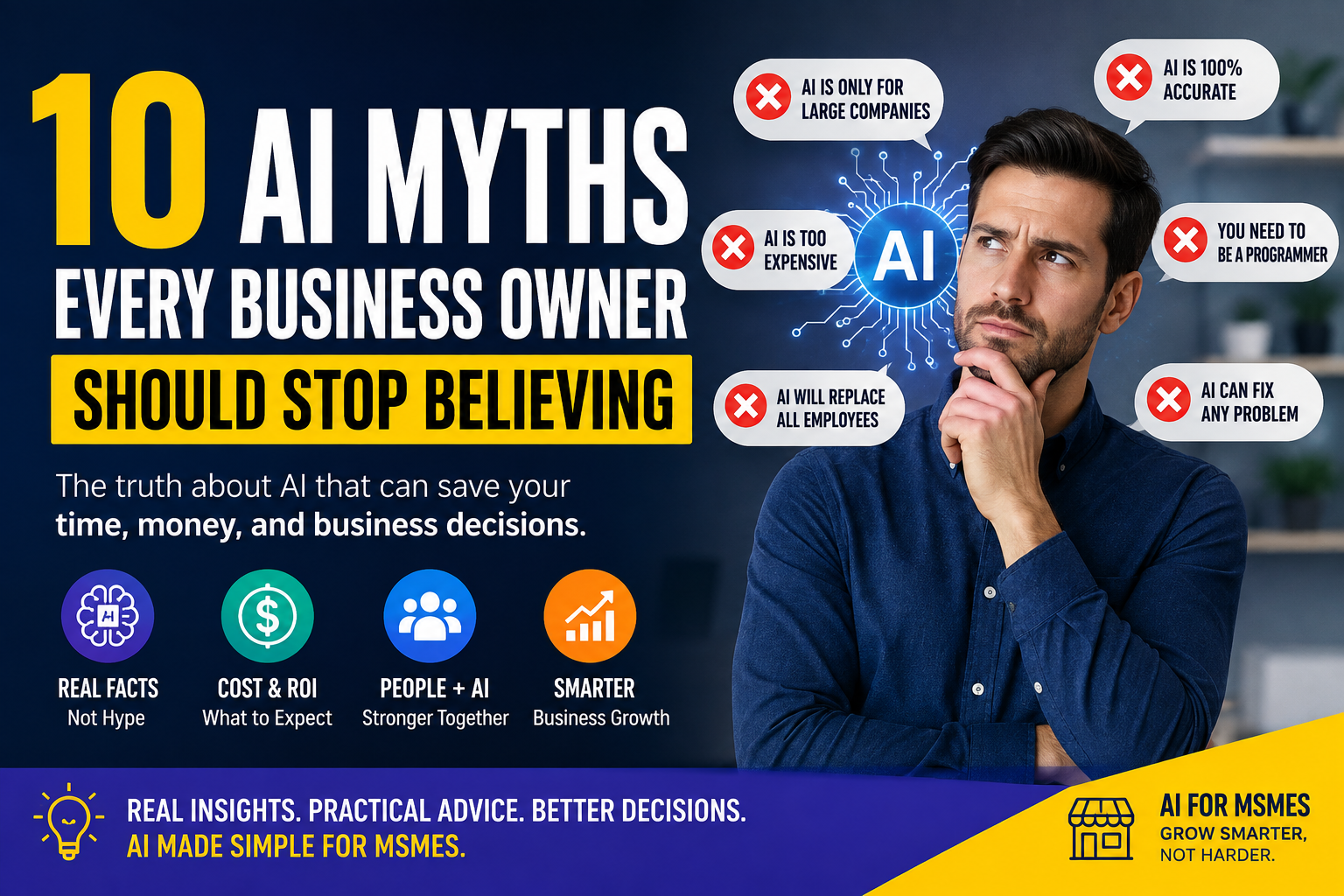
Myth 1: AI Will Replace Every Job
AI automates tasks rather than entire professions. In most cases, employees become more productive by working alongside AI instead of being replaced by it.
Myth 2: AI Is Only for Large Corporations
Subscription-based AI platforms now allow freelancers, startups, and local businesses to access enterprise-grade capabilities at affordable prices.
Myth 3: AI Always Gives Perfect Answers
AI can make mistakes, misunderstand context, or generate inaccurate information. Human review remains essential, particularly for legal, financial, and medical content.
Myth 4: AI Requires Programming Skills
Many modern AI tools offer intuitive interfaces that require little or no coding experience.
Myth 5: AI Is Too Expensive
Many AI applications are available through low-cost monthly subscriptions or even free plans, making adoption practical for small businesses.
Preparing Your Business for AI Adoption
Successful AI implementation begins with clear business objectives rather than simply adopting the latest technology.
Business owners should start by identifying repetitive tasks that consume significant time or resources. These processes often provide the quickest return on investment when automated with AI.
Good preparation includes:
- Defining measurable business goals.
- Organizing accurate business data.
- Training employees to work alongside AI.
- Selecting reliable AI software.
- Monitoring performance continuously.
- Maintaining human oversight for important decisions.
Organizations that treat AI as a long-term business strategy rather than a short-term trend are generally better positioned to achieve sustainable growth.
Next Up: Benefits, Challenges, and the Future of AI
Now that you've explored the technologies behind Artificial Intelligence and its practical business applications, it's time to examine the advantages and limitations of AI adoption.