AI Budget for Small Business: How to Plan AI Spending, Costs and ROI | Beritaja

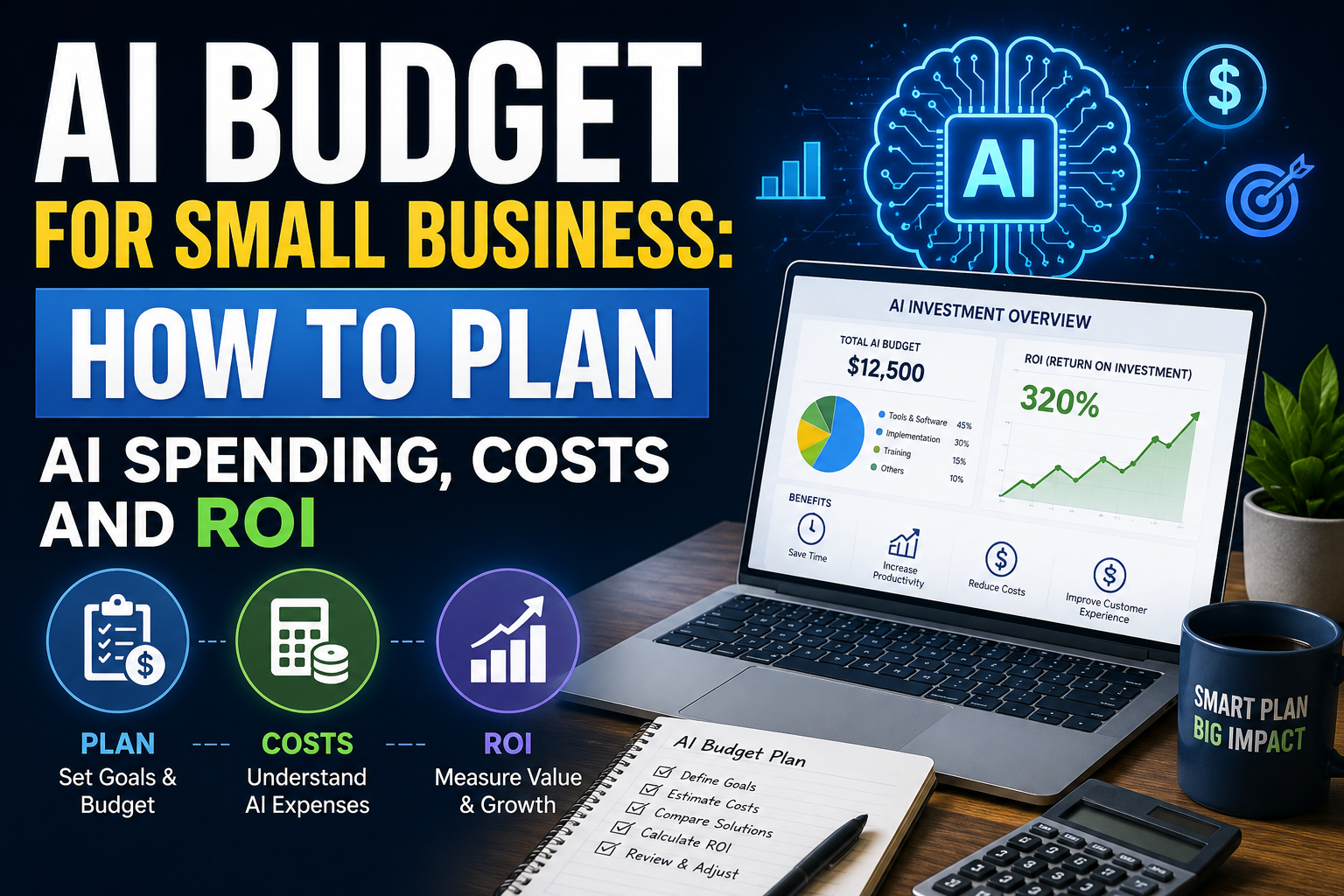
An AI budget is a planned allocation of money, people, time, and other resources for adopting, operating, evaluating, and governing artificial intelligence in a business. For a small business, an effective AI budget does not mean spending as much as possible on AI. It means funding the AI use cases that solve meaningful business problems while keeping costs, risks, and human oversight under control.
Small businesses can use AI for marketing, customer service, sales, administration, data analysis, content workflows, forecasting, and other repetitive or information-heavy tasks. But buying several AI subscriptions without a clear business objective can quickly create unnecessary spending.
This guide explains how to create an AI budget, what costs to consider, how to prioritize AI investments, how to estimate potential return on investment (ROI), and how to decide whether an AI project is ready to scale.
What Is an AI Budget?
An AI budget is a financial and operational plan that determines how much a business is prepared to invest in artificial intelligence and where that investment should be used. It can include software subscriptions, API usage, implementation, employee training, data preparation, integration, security, monitoring, and ongoing management.
The important distinction is that an AI budget should be connected to a business outcome, not simply to the number of AI tools a company wants to purchase.
For example, a retailer might budget for an AI-assisted customer-service workflow because reducing repetitive support work is a business objective. A professional-services firm might budget for AI document analysis because its employees spend substantial time reviewing information. A restaurant may decide that an expensive AI system is unnecessary if its current operational problems can be solved more effectively with conventional software.
In other words, an AI budget answers five practical questions:
- What business problem are we trying to solve?
- How much will the AI solution actually cost?
- What internal resources will it require?
- What risks and controls need to be funded?
- What evidence would justify continuing or expanding the investment?
Why Does AI Budgeting Matter for Small Businesses?
AI budgeting matters because small businesses usually have less room for wasted spending than large organizations. A business can subscribe to multiple AI services, experiment with automation, and still fail to create meaningful business value if those activities are not connected to measurable priorities.
A structured budget creates a boundary around experimentation. It allows a business to try useful AI applications without treating every new tool or technology announcement as something that must be purchased.
It also makes AI adoption easier to discuss internally. Owners, managers, finance teams, and employees can evaluate an AI project using the same questions: what does it cost, what does it improve, what could go wrong, and what evidence will determine whether the project continues?
AI budgeting is not only about software prices
One of the most common mistakes is treating the subscription price as the complete cost of AI. A low-cost application can still require significant employee time, process changes, training, integration, data preparation, or review.
The opposite can also be true. A paid AI service may be financially sensible when it replaces a repetitive manual process or helps employees complete valuable work more efficiently.
What Should an AI Budget Include?
A practical AI budget should include both visible and hidden costs. The exact categories depend on the business and the AI use case, but most organizations should consider at least the following areas.
| Budget category | What it may include | Why it matters |
| AI software | Subscriptions, business plans, specialized applications | Provides access to AI capabilities |
| API usage | Model usage, automated requests, processing volume | Costs can change as usage grows |
| Implementation | Configuration, workflow design, integration | Turns a tool into a usable business process |
| Data preparation | Cleaning, organizing, structuring, or reviewing data | AI quality depends heavily on the information it receives |
| Training | Employee education, documentation, process training | Employees need to understand appropriate use |
| Security and privacy | Access controls, policies, reviews, monitoring | Protects business and customer information |
| Human review | Quality checks, approval, corrections, escalation | Reduces the risk of inappropriate automation |
| Monitoring | Performance reviews, usage analysis, incident handling | AI workflows can change as inputs and requirements change |
Not every business needs a large budget in every category. The purpose of the list is to prevent decision-makers from evaluating an AI project using only its advertised subscription price.
How to Build an AI Budget Step by Step
Step 1 — Start with business problems, not AI tools
Begin by identifying tasks that consume significant time, create avoidable errors, delay customer responses, or require repetitive analysis. Do not begin by asking which AI application should the business buy.
A useful starting question is: Which business process would become meaningfully better if part of it were assisted by AI?
Potential candidates include customer-service responses, document classification, sales follow-up, marketing drafts, internal knowledge search, data summarization, forecasting support, and repetitive administrative work.
Step 2 — Define the desired outcome
Turn the problem into an outcome that can be evaluated. "Use AI for marketing" is too broad. "Reduce the time required to prepare a first draft of weekly campaign content" is more useful because the workflow and expected improvement can be evaluated.
The outcome does not have to be expressed only in money. Time saved, faster response, fewer manual steps, improved consistency, or better access to business information can also be relevant.
Step 3 — Estimate the total cost
Estimate recurring and one-time costs separately. A simple AI budget can be organized into:
- Initial setup cost
- Monthly or annual software cost
- Usage-based costs
- Integration costs
- Employee training time
- Data preparation
- Security and privacy controls
- Ongoing human review
- Monitoring and maintenance
If the business cannot estimate a cost accurately, record the uncertainty instead of pretending the number is precise. A range is often more useful than a false exact figure.
Step 4 — Separate experimentation from production
An AI experiment should not automatically receive the same budget as a production system.
During experimentation, the goal is to learn whether the use case is valuable and workable. Production requires stronger attention to reliability, access, data handling, monitoring, documentation, and ongoing operating costs.
This distinction helps prevent a common problem: committing to long-term spending before the business has evidence that the workflow is useful.
Step 5 — Assign an owner
Every AI budget should have someone responsible for the business outcome. This does not necessarily mean hiring an AI specialist. Depending on the project, the owner could be an operations manager, marketing manager, finance lead, business owner, or another employee familiar with the workflow.
The owner should know why the AI system exists, what success looks like, who can use it, when human review is required, and when the project should be reconsidered.
Step 6 — Define a review point
Do not allow AI spending to become permanent simply because a subscription renews automatically. Establish a review point where the business evaluates usage, cost, quality, risks, and business value.
A review can lead to three outcomes: continue, change, or stop.
How Much Should a Small Business Budget for AI?
There is no universal AI budget that every small business should follow. The appropriate amount depends on the business problem, the complexity of the workflow, existing technology, usage volume, risk level, and expected value.
Instead of selecting an arbitrary percentage of revenue, a more defensible approach is to budget around specific use cases and their expected economics.
| AI budget approach | Best suited for | Main question |
| Small experiment budget | Businesses exploring AI for the first time | Is this use case actually useful? |
| Department budget | Businesses with several validated use cases | Which team receives the most value? |
| Project-based budget | Specific automation or integration projects | Does this project justify its total cost? |
| Strategic AI budget | Businesses making AI part of long-term operations | How should AI support the wider business strategy? |
The key principle is simple: budget according to the business case, not according to the excitement surrounding AI.
How to Estimate AI ROI
AI return on investment (ROI) compares the value generated by an AI initiative with the cost required to operate it. For a small business, ROI should be considered alongside quality, risk, employee adoption, and strategic value rather than treated as the only decision criterion.
A simple starting formula is:
ROI = (Value generated − Total AI cost) ÷ Total AI cost × 100
The difficult part is defining "value generated." For example, if an AI-assisted process saves employee time, the business can estimate the economic value of that time. If AI helps improve sales or reduce errors, the business can evaluate the relevant financial impact when reliable measurement is available.
Avoid assuming that every minute saved automatically becomes profit. Time savings may instead create capacity for employees to handle additional work, improve service, or focus on higher-value activities.
Businesses can also use the ROI calculator as a starting point when evaluating a potential investment.
AI Budget Examples for Different Small Businesses
Example 1 — Retail business
Business type: Small retail business
Problem: Staff spend considerable time preparing product descriptions and responding to common customer questions.
How AI is used: Generative AI assists with first drafts of product information and customer-service responses.
Expected benefit: Less repetitive writing and faster preparation of routine responses.
Human oversight required: Employees should check product specifications, prices, availability, policies, and other factual information before publication or sending.
Example 2 — Professional services firm
Business type: Small consulting or professional-services firm
Problem: Employees spend time organizing and summarizing large amounts of business information.
How AI is used: An approved AI workflow assists with document summarization and information extraction.
Expected benefit: Faster initial review and organization of information.
Human oversight required: Sensitive information should be handled according to company policies, and important conclusions should be verified by qualified employees.
Example 3 — E-commerce business
Business type: Online store
Problem: Marketing teams need to create and adapt content for multiple campaigns.
How AI is used: AI assists with brainstorming, draft variations, product copy, and content repurposing.
Expected benefit: Greater content production capacity without automatically increasing manual drafting work.
Human oversight required: Brand claims, product information, promotional conditions, and customer-facing statements should be reviewed.
Example 4 — Restaurant
Business type: Independent restaurant
Problem: Management needs help organizing customer feedback and identifying recurring themes.
How AI is used: AI summarizes feedback and groups recurring topics for management review.
Expected benefit: Easier identification of recurring customer concerns.
Human oversight required: Management should review the underlying feedback rather than treating an AI summary as the final interpretation.
What Should Be Prioritized in an AI Budget?
When resources are limited, prioritize AI projects that have a clear business problem, manageable implementation requirements, measurable value, and an acceptable risk profile.
| Priority factor | Question to ask |
| Business impact | Does the problem materially affect revenue, cost, service, or productivity? |
| Frequency | Does the workflow occur often enough to justify investment? |
| Feasibility | Can the business implement the workflow with its current resources? |
| Data readiness | Is the necessary information available and usable? |
| Risk | What could happen if the AI produces an incorrect result? |
| Human review | Can an employee reasonably review important outputs? |
| Scalability | Will the solution remain practical if usage increases? |
A project with moderate financial value and very low risk may be easier to adopt than a theoretically high-value project that requires sensitive data, complex integration, or substantial operational change.
AI Budgeting and AI Governance
Budgeting and governance should work together. The cost of responsible AI use is not limited to buying technology; businesses may also need policies, access controls, review processes, documentation, monitoring, and employee training.
The NIST AI Risk Management Framework organizes AI risk management around four functions: Govern, Map, Measure, and Manage. NIST describes governance as a cross-cutting function that should inform the other risk-management activities throughout the AI lifecycle.
For a small business, this does not mean creating a large compliance department. It means matching the level of governance to the importance and risk of the use case.
For example, an AI tool used to brainstorm internal marketing ideas may require a different control environment from an AI system that influences customer eligibility, financial decisions, employment decisions, or other high-impact processes.
Businesses can explore the broader AI governance and strategy guide when building policies around responsible AI adoption.
How to Control AI Costs as Usage Grows
AI costs can become harder to predict when usage grows, especially when services use consumption-based pricing or when employees adopt multiple tools independently. Cost control therefore needs to be part of the AI workflow rather than something reviewed only after a bill arrives.
- Inventory AI tools. Know which services employees are using and why.
- Remove redundant subscriptions. Multiple tools may provide overlapping capabilities.
- Monitor usage. Review usage patterns and unusual increases where usage-based costs apply.
- Set approval rules. Establish who can purchase or connect new AI services.
- Review inactive tools. Cancel services that are rarely used or no longer solve a meaningful problem.
- Separate experimentation from production. Experimental use should have clear limits.
- Measure value. Keep funding workflows that demonstrate useful outcomes.
A cost-control policy does not have to prohibit employees from experimenting. It should make experimentation visible and bounded.
When AI May Not Be Worth the Budget
AI is not automatically the best solution to every business problem. Sometimes a conventional software feature, spreadsheet, database query, documented procedure, or simple process change can solve the problem more cheaply and predictably.
AI may not be worth funding when:
- The problem happens too rarely to justify implementation.
- The workflow is already simple and efficient.
- The required data is unreliable or unavailable.
- The cost of human review would eliminate the expected benefit.
- The consequences of incorrect outputs are too high for the available controls.
- The business cannot clearly explain why AI is needed.
- A conventional technology would solve the same problem more reliably.
The strongest AI strategy is therefore not "use AI everywhere." It is use AI where the economics, workflow, data, and risk make sense.
Common AI Budgeting Mistakes
Buying tools before defining the problem
A subscription is not a strategy. Start with a business problem and determine whether AI is an appropriate solution.
Ignoring employee time
Configuration, testing, training, review, and process redesign all consume time. These resources belong in the business case even when they do not appear on a software invoice.
Assuming a successful experiment will automatically scale
A workflow that works for a few employees may require different controls, costs, or infrastructure at larger volumes.
Measuring only financial ROI
Financial return is important, but quality, reliability, customer experience, employee adoption, and risk can also influence whether an AI initiative should continue.
Forgetting to budget for governance
Responsible AI use can require documentation, access management, review procedures, monitoring, and training. NIST's AI RMF emphasizes that risk management should continue across the AI lifecycle rather than being treated as a one-time activity.
Allowing subscriptions to accumulate
AI adoption can create tool sprawl when different employees independently purchase similar services. A basic inventory and periodic review can reduce unnecessary duplication.
A Simple AI Budget Framework for MSMEs
A small business can use the following framework for each proposed AI initiative.
- Problem: What business problem are we solving?
- Workflow: Where exactly will AI be introduced?
- Outcome: What should improve?
- Cost: What will the complete initiative require?
- Risk: What could go wrong?
- Control: What human review or safeguards are required?
- Measurement: How will we determine whether it works?
- Decision: What evidence will justify continuing, changing, or stopping the project?
This framework can be applied to a single AI subscription or a larger automation project. The more consequential the use case, the more carefully the business should evaluate data, security, human oversight, and governance.
How AI Budgeting Fits Into an AI Adoption Roadmap
AI budgeting should not exist separately from business strategy. It should support a broader adoption roadmap that identifies which use cases should be tested, improved, standardized, and eventually scaled.
After establishing an initial budget, businesses can develop a structured AI adoption roadmap that connects experiments with longer-term operational priorities.
The roadmap should also reflect the organization's readiness. A business with limited data practices or unclear internal processes may benefit from improving its foundations before investing heavily in complex AI automation.
For a broader assessment, see AI readiness for small businesses.
Practical AI Budget Checklist
- Have we identified a specific business problem?
- Is AI actually appropriate for that problem?
- Have we estimated both recurring and one-time costs?
- Have we included employee time and training?
- Do we know what data the workflow requires?
- Have we considered privacy and security?
- Is a person responsible for the workflow?
- Do important outputs receive appropriate human review?
- Have we defined how success will be measured?
- Have we established a review date?
- Do we know what would cause us to stop the project?
- Is the proposed spending consistent with the wider AI strategy?
Frequently Asked Questions About AI Budgeting
What is an AI budget for a small business?
An AI budget is a plan for the money and operational resources a small business will use to adopt, operate, evaluate, and govern AI. It can include software, usage fees, implementation, training, data preparation, security, human review, and monitoring. The appropriate budget depends on the business problem and expected value rather than a universal spending percentage.
How much should a small business spend on AI?
There is no single amount that fits every small business. A better approach is to start with a specific use case, estimate its total cost, define the expected business outcome, and run a controlled experiment. Spending can increase when evidence shows that the AI workflow provides enough value to justify its costs and risks.
What costs should be included in an AI budget?
Include software subscriptions, usage-based charges, implementation, integration, employee training, data preparation, security and privacy controls, human review, monitoring, and maintenance. Some projects will require only a few of these categories. The important point is to avoid evaluating an AI initiative using only the advertised software price.
How can a small business calculate AI ROI?
Start by estimating the value created by the AI workflow and comparing it with its total cost. Value may come from time savings, increased capacity, reduced errors, improved service, or additional revenue when that impact can be reliably measured. Avoid treating every theoretical time saving as immediate profit.
Should AI experiments have their own budget?
Yes. Separating experimentation from production can help a business limit financial exposure while learning whether a use case is valuable. An experiment should have a defined objective, spending boundary, evaluation criteria, and decision point. If the evidence is weak, the business can stop before committing to larger ongoing costs.
Should AI governance be included in the AI budget?
Yes, when governance activities are relevant to the use case. Governance can include policies, access controls, documentation, employee training, monitoring, testing, risk assessment, and human review. Higher-risk AI applications generally require more careful controls than low-risk experimentation.
Can AI be too expensive for a small business?
Yes. AI can become economically unattractive when software, usage, integration, training, and review costs exceed the value produced. A small business should compare AI with simpler alternatives and should not adopt an AI system merely because competitors or technology companies are promoting it.
What is the first step in creating an AI budget?
Start by identifying one specific business problem where AI might provide meaningful assistance. Define the desired outcome, estimate the complete cost, consider risks, and establish how success will be measured. This creates a stronger foundation than starting with a list of AI subscriptions.
Conclusion: Build an AI Budget Around Business Value
An AI budget should help a small business make better investment decisions, not simply increase AI spending. The strongest approach is to start with a real business problem, define the desired outcome, estimate the complete cost, evaluate risks, test the workflow, and measure what actually happens.
Small businesses do not need to adopt every AI capability available. They need to identify the applications that fit their processes, resources, data, risk tolerance, and strategic priorities.
The practical next step is to select one AI use case, create a small controlled budget, define success criteria, and review the results before scaling. When the evidence supports the investment, the business can expand the workflow as part of a broader AI for MSMEs strategy.