AI Readiness: How Small Businesses Can Prepare for AI and Use It Responsibly | Beritaja

AI readiness is a business's ability to adopt, use, manage, and scale artificial intelligence effectively. It is not simply about buying an AI tool. A business is more AI-ready when it has clear business goals, usable data, suitable workflows, people who understand how to work with AI, appropriate safeguards, and a practical way to measure results.
For small businesses, AI readiness matters because successful adoption usually depends less on having the most advanced technology and more on choosing the right problems, preparing the organization, and keeping human judgment where it matters. This guide explains what AI readiness means, how to assess it, what to prepare before adopting AI, and how a small business can build an achievable AI-readiness roadmap.
In short: AI readiness means being prepared to use AI for useful business outcomes while managing its operational, privacy, security, financial, and human risks.
What Is AI Readiness?
AI readiness is the degree to which a business is prepared to adopt and use artificial intelligence in a practical, responsible, and sustainable way. It includes more than technology. It covers business strategy, people, processes, data, technology, governance, security, and measurement.
A business can have access to powerful generative AI tools and still have low AI readiness. For example, employees may use AI independently without clear policies, sensitive information may be entered into inappropriate systems, or the business may automate a workflow before determining whether the workflow itself is well designed.
AI readiness therefore asks a broader question:
Is the business prepared to use AI safely and effectively to solve real business problems?
This distinction is particularly important for small businesses because limited budgets and smaller teams leave less room for expensive experimentation, failed implementations, or poorly controlled automation.
Why AI Readiness Matters for Small Businesses
AI can support many business activities, including content creation, customer service, data analysis, marketing, sales support, administrative work, forecasting, research, and workflow automation. But the value depends on how effectively the business integrates AI into its existing operations.
AI readiness helps a business move from random experimentation to deliberate adoption. Instead of asking "Which AI tool should we buy?", an AI-ready business starts with questions such as:
- Which business problem are we trying to solve?
- How much time or effort does the current process require?
- What information does the process depend on?
- Could AI realistically improve the workflow?
- What could go wrong?
- Where should a person review the output?
- How will we know whether the implementation worked?
This approach can reduce unnecessary tool purchases and help businesses prioritize AI projects that have a clear connection to business objectives.
The 7 Core Areas of AI Readiness
There is no single universal checklist that makes a business "AI ready." However, a practical assessment can examine seven connected areas: strategy, processes, data, technology, people, governance and risk, and measurement.
| Readiness area | Key question | What good preparation looks like |
| Strategy | Why should we use AI? | AI projects are connected to specific business objectives. |
| Processes | Where can AI actually help? | Workflows are understood before automation is introduced. |
| Data | Does AI have reliable information to work with? | Important business data is accessible, relevant, and appropriately managed. |
| Technology | Can our systems support the intended use? | Tools, integrations, accounts, and access controls are appropriate. |
| People | Can employees use AI effectively? | Staff understand the tools, limitations, and responsibilities involved. |
| Governance | How will AI use be controlled? | Policies exist for privacy, security, review, and acceptable use. |
| Measurement | Is AI creating meaningful value? | Projects have defined outcomes and are reviewed after implementation. |
1. AI Strategy Readiness
AI strategy readiness means knowing what the business wants AI to accomplish before choosing specific tools. The goal is not to introduce AI everywhere. The goal is to identify opportunities where AI can reasonably improve productivity, customer experience, decision making, revenue, cost management, or another meaningful business outcome.
Start by identifying three to five business priorities. These might include reducing administrative work, responding to customer inquiries faster, improving marketing production, analyzing sales data, or supporting employees with repetitive research tasks.
Questions to ask
- What is the most expensive repetitive task in the business?
- Where do employees spend time copying, summarizing, classifying, or searching for information?
- Which customer-facing processes have avoidable delays?
- Which decisions require analysis of large amounts of information?
- Which tasks require human judgment and should not be fully automated?
A useful starting point is the AI adoption roadmap for small businesses, which can help turn broad interest in AI into a more structured implementation plan.
2. Process Readiness
AI works best when the underlying business process is understood. Automating a confusing or inconsistent process can make the problem harder to manage rather than solving it.
Before applying AI, document the current workflow. Identify the starting point, inputs, decisions, outputs, people involved, and common exceptions.
Example: customer support
- A customer sends a question.
- The request is categorized.
- Relevant customer information is retrieved.
- A response is drafted.
- An employee reviews the response when necessary.
- The answer is sent to the customer.
- The interaction is recorded for future reference.
AI could assist with classification, information retrieval, drafting, and summarization. That does not automatically mean every step should be automated.
3. Data Readiness
Data readiness means having information that is sufficiently relevant, accessible, organized, and appropriately protected for the intended AI use. AI cannot reliably compensate for missing, outdated, inconsistent, or poorly governed business information.
A retailer considering AI forecasting, for example, may need sales history, inventory information, product data, seasonality information, and other relevant business context. If those records are incomplete or inconsistent, the resulting analysis may also be unreliable.
Data-readiness checklist
- Identify what data the AI workflow requires.
- Determine where the data currently lives.
- Check whether important information is missing or duplicated.
- Define who can access sensitive information.
- Determine what information should never be entered into external AI services.
- Establish retention and deletion practices where appropriate.
Data readiness is closely connected to AI for MSMEs because small businesses often have useful information distributed across spreadsheets, accounting systems, customer platforms, email, documents, and other tools.
4. Technology Readiness
Technology readiness does not mean having an expensive technology stack. It means having the technical foundation required for the AI use case the business actually wants to implement.
A simple generative AI workflow may require little technical infrastructure. A more advanced AI system integrated with customer records, inventory, payments, or internal applications may require considerably more planning.
Consider these factors
- Existing software and business systems
- Available integrations and APIs
- User accounts and permissions
- Data storage and access
- Security controls
- Vendor reliability
- Ongoing subscription or infrastructure costs
- Technical support requirements
Avoid adopting technology simply because it is described as "AI powered." The technology should have a clear role within the workflow.
5. People and AI Literacy
AI readiness is also a people issue. Employees need to understand what AI can do, what it cannot reliably do, and how they are expected to use it.
AI literacy does not mean every employee needs to become a machine-learning engineer. For many small businesses, practical AI literacy means understanding prompting, output verification, privacy, security, appropriate use, and when human review is necessary.
This is increasingly relevant from a regulatory perspective. For organizations covered by the European Union AI Act, Article 4 on AI literacy entered application on February 2, 2025, and the European Commission states that providers and deployers must take measures to support AI literacy among relevant staff and people operating AI systems on their behalf.
Requirements can differ by jurisdiction, role, sector, and type of AI system, so businesses should not assume that one general AI policy satisfies every legal obligation.
6. AI Governance and Risk Readiness
AI governance defines how a business controls AI use, manages risks, assigns responsibility, and reviews important decisions. It becomes increasingly important as AI moves from experimentation into customer-facing or business-critical workflows.
The NIST AI Risk Management Framework provides a voluntary framework for organizations of different sizes and sectors to manage AI risks and promote trustworthy and responsible AI. Its core approach organizes risk-management activities around four functions: Govern, Map, Measure, and Manage.
A simple small-business AI policy can cover
- Approved AI tools
- Prohibited or restricted information
- Privacy and confidential information
- Human review requirements
- Customer disclosure where appropriate
- Security responsibilities
- Output verification
- Incident reporting
- Vendor and account management
- Periodic review of AI systems
Governance does not have to begin with a large compliance department. A small business can start with a short written policy that clearly defines acceptable and unacceptable AI use.
7. Measurement Readiness
An AI project should have a way to determine whether it actually improved the business. Without measurement, a company may continue paying for tools simply because employees enjoy using them.
Useful measures depend on the workflow. Examples include time saved, processing time, error rates, response time, customer satisfaction, conversion rate, operating cost, or employee capacity.
Financial outcomes can also be evaluated with practical business tools such as a ROI calculator when an AI project has identifiable costs and measurable financial benefits.
Example measurement framework
| Question | Example measurement |
| Does AI save time? | Average processing time before and after implementation |
| Does AI improve quality? | Error rate or review corrections |
| Does AI improve customer service? | Response time or customer satisfaction |
| Does AI improve financial performance? | Incremental revenue or avoided cost compared with implementation cost |
How to Assess Your Business's AI Readiness
A practical AI-readiness assessment does not need to be complicated. Score each of the seven areas from 1 to 5, where 1 means "not prepared" and 5 means "well prepared."
| Area | Score 1 | Score 3 | Score 5 |
| Strategy | No clear AI objective | Some potential use cases identified | AI priorities are linked to business goals |
| Processes | Workflows are unclear | Important processes are documented | Processes are optimized and ready for selective automation |
| Data | Data is fragmented or unreliable | Key information is reasonably organized | Relevant data is accessible and governed |
| Technology | No suitable technical foundation | Basic tools are available | Systems and integrations support planned AI workflows |
| People | Employees have little AI knowledge | Some employees are experimenting | Relevant employees understand effective and responsible AI use |
| Governance | No AI rules | Basic safeguards exist | AI use is governed and periodically reviewed |
| Measurement | No defined outcomes | Some metrics are tracked | AI projects have clear success criteria |
The score itself is less important than identifying the weakest areas. A business with strong technology but weak governance may need controls before scaling. A business with good governance but poor data may need to improve its information systems first.
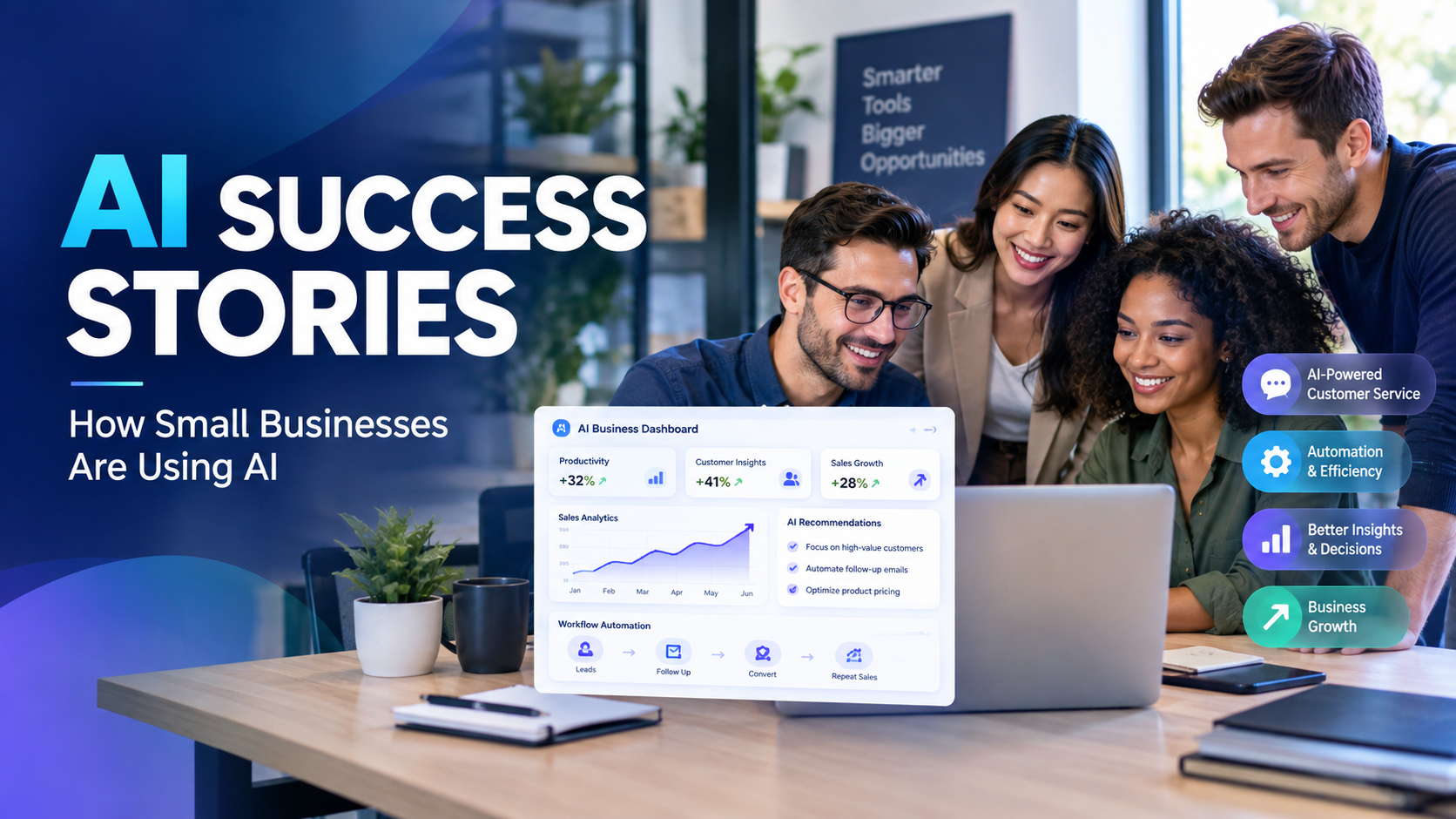
Realistic AI Readiness Examples for Small Businesses
Example 1: Retail Business
Business type: Retail store
Problem: Employees spend significant time preparing product descriptions and responding to common questions.
How AI is used: Generative AI drafts product descriptions and customer-response templates.
Expected benefit: Less repetitive writing and faster preparation of routine communications.
Human oversight: Employees verify product specifications, prices, availability, and claims before publication.
Example 2: Professional Services Firm
Business type: Consulting or professional services
Problem: Staff spend substantial time summarizing documents and preparing meeting notes.
How AI is used: AI assists with summarization and organizes action items.
Expected benefit: Faster administrative work and easier information retrieval.
Human oversight: Staff verify important facts and ensure confidential information is handled appropriately.
Example 3: Restaurant
Business type: Restaurant
Problem: Marketing content and customer responses require repetitive manual work.
How AI is used: AI generates initial promotional drafts, social captions, and responses to routine questions.
Expected benefit: More efficient content production.
Human oversight: A manager checks pricing, promotions, operating hours, allergens, and other customer-facing details.
Example 4: E-commerce Business
Business type: Online retailer
Problem: Large numbers of customer questions and product-related requests.
How AI is used: AI supports customer-service classification and drafts responses based on approved information.
Expected benefit: Faster handling of routine inquiries.
Human oversight: Complex complaints, refunds, sensitive cases, and unusual requests are escalated to people.
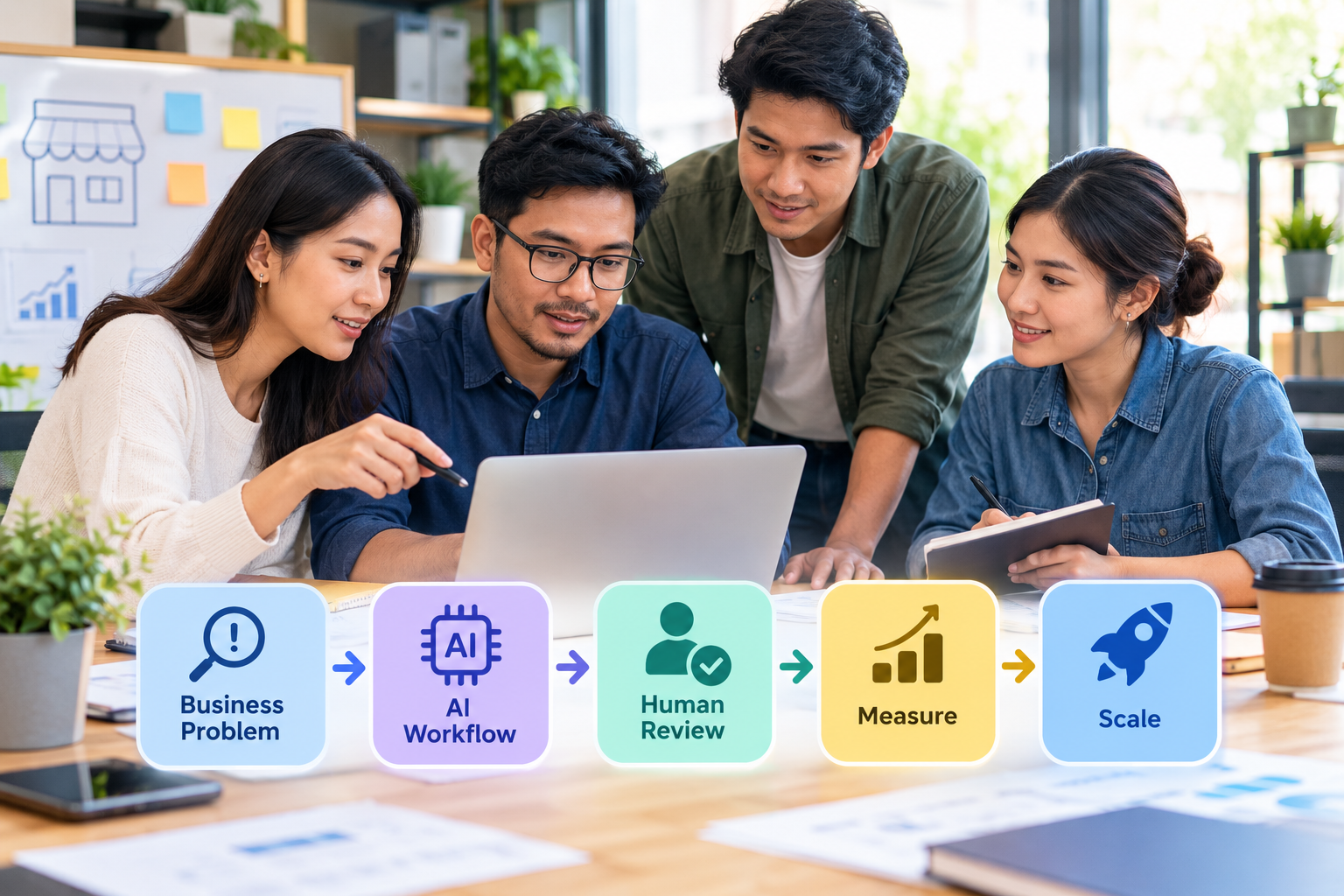
How to Build an AI Readiness Roadmap
Small businesses should generally avoid attempting a complete AI transformation at once. A phased roadmap makes it easier to learn, control risk, and decide whether additional investment is justified.
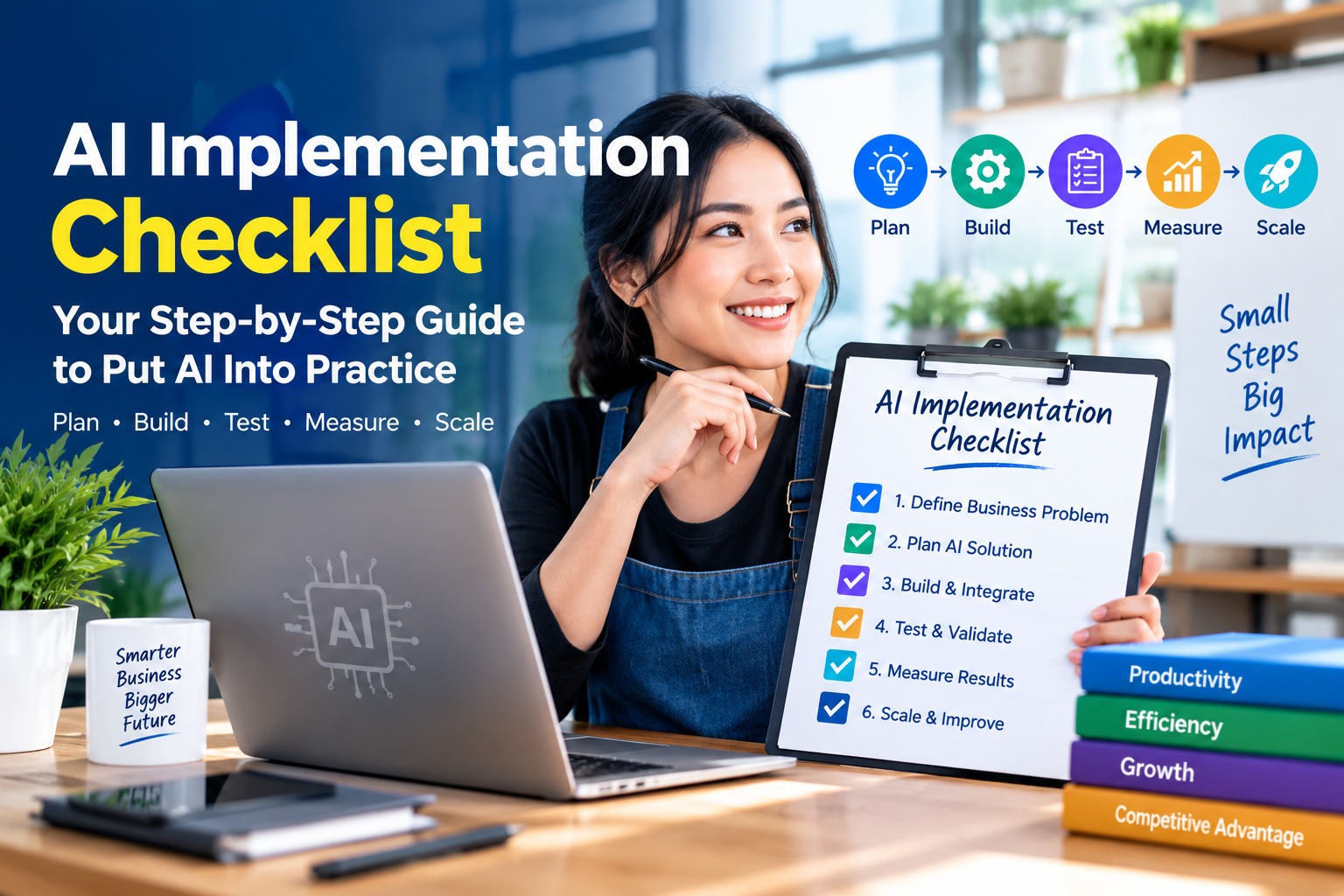
Step 1 — Identify business problems
List repetitive, time-consuming, data-heavy, or customer-facing processes. Prioritize problems rather than technologies.
Step 2 — Select one practical use case
Choose a workflow where the potential benefit is understandable and the consequences of failure can be controlled.
Step 3 — Establish data and privacy boundaries
Determine what information the AI system needs and what information employees are allowed to provide to it.
Step 4 — Choose the appropriate AI approach
The solution could involve generative AI, machine learning, predictive analytics, automation, business intelligence, or simply better use of existing software. AI is not automatically the right answer.
Step 5 — Run a controlled pilot
Test the workflow with a limited scope. Document what works, what fails, how much review is required, and what employees learn from the experiment.
Step 6 — Add human oversight
Define which outputs can be accepted automatically and which require human verification.
Step 7 — Measure the outcome
Compare the pilot against the original objective. If the result does not justify the cost, complexity, or risk, do not scale merely because the technology is interesting.
Step 8 — Scale selectively
Expand successful workflows gradually. Update policies, employee training, integrations, and monitoring as AI becomes more deeply embedded in the business.
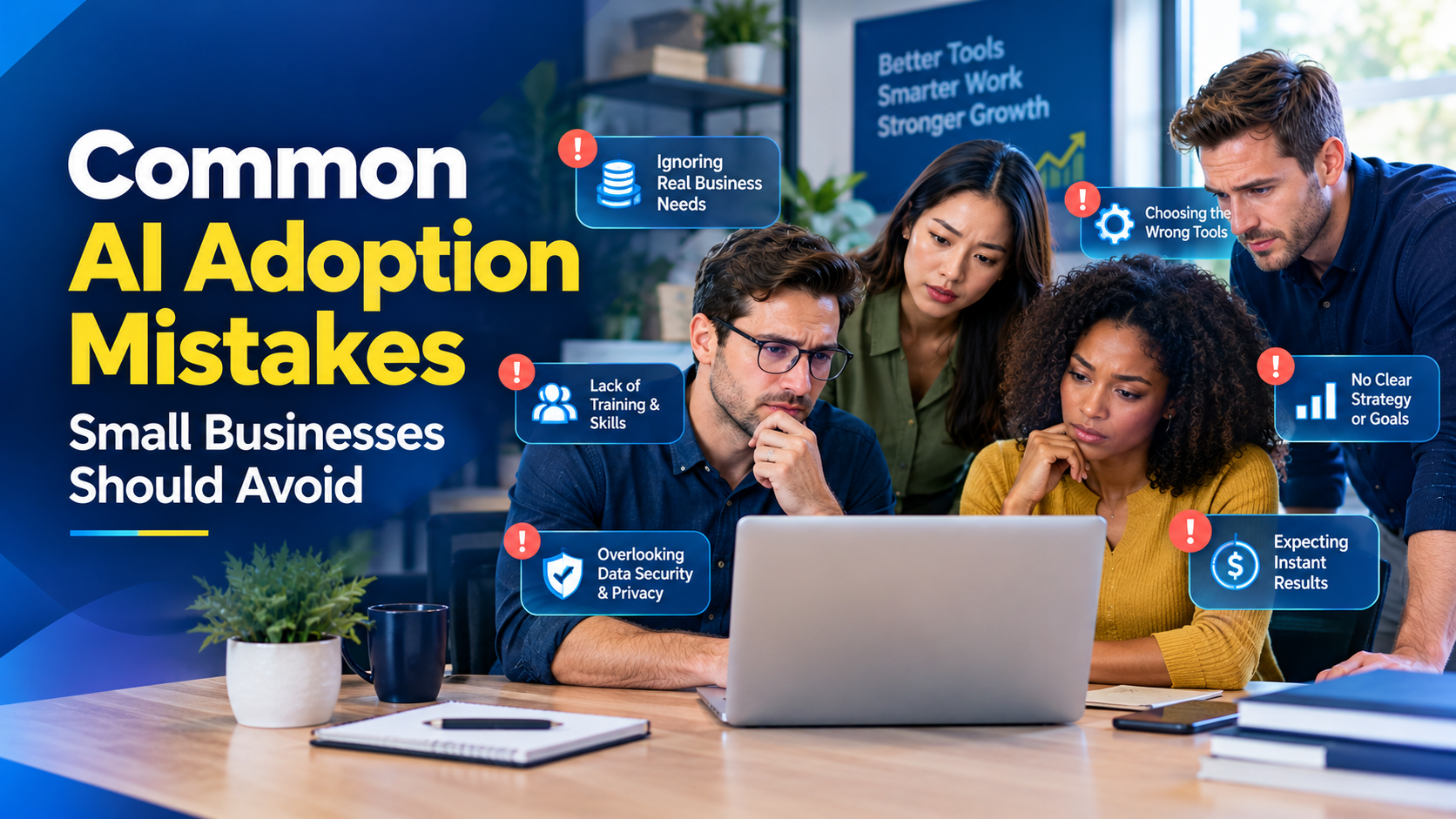
Common AI Readiness Mistakes
Choosing tools before identifying problems
Buying multiple AI subscriptions without a defined business purpose can create unnecessary costs and fragmented workflows.
Assuming AI output is automatically accurate
Generative AI can produce convincing but incorrect information. Important business outputs should be reviewed according to their potential consequences.
Ignoring data privacy
Employees may unintentionally expose confidential, personal, financial, or proprietary information when using AI tools. Businesses should establish clear rules before widespread adoption.
Automating an inefficient process
Automation does not automatically improve a workflow. If the underlying process contains unnecessary steps, unclear responsibilities, or unreliable information, those problems should be addressed first.
Measuring activity instead of outcomes
The number of AI prompts, generated documents, or employees using an AI application does not necessarily demonstrate business value. Measure outcomes that matter to the organization.
Removing humans from important decisions too quickly
Some decisions involve context, accountability, empathy, or consequences that require human judgment. AI should support decision making where appropriate rather than automatically replacing it.
AI Readiness vs. AI Adoption
AI readiness and AI adoption are related but different. AI readiness is preparation; AI adoption is actual implementation.
| AI readiness | AI adoption |
| Identifies business objectives | Implements an AI workflow |
| Reviews data and processes | Connects AI to operational work |
| Defines policies and responsibilities | Employees use AI in practice |
| Assesses risks | Monitors real-world performance |
| Defines success criteria | Measures actual outcomes |
A business can therefore begin becoming AI-ready before deploying sophisticated AI systems. In many cases, preparation is what makes later adoption more successful.
When a Business Is Not Ready for AI
Not every business problem needs AI, and not every business is ready to deploy it immediately. Delaying implementation can be sensible when the underlying process is poorly understood, data quality is inadequate, privacy risks have not been addressed, or the expected benefit is too small to justify the cost.
Traditional software, spreadsheets, standard automation, or a simple process redesign may sometimes solve a problem more effectively than an AI system.
AI readiness should therefore include the ability to say "not yet" or "AI is not necessary here." Good technology strategy is about selecting the appropriate solution, not maximizing AI usage.
AI Readiness and Responsible AI
Responsible AI should be treated as part of readiness rather than as a separate activity that happens after deployment. Businesses should consider reliability, privacy, security, fairness, accountability, transparency, and human oversight according to the use case.
NIST's AI Risk Management Framework is designed as a voluntary, flexible resource for organizations of different sizes and sectors. Its structure emphasizes governing, mapping, measuring, and managing AI risks rather than treating AI risk as a one-time checklist.
For generative AI specifically, NIST also provides a Generative AI Profile that identifies risks and considerations associated with generative AI systems.
Small businesses do not necessarily need to reproduce an enterprise-scale governance program. They can adapt relevant principles to their size, industry, resources, and specific AI use cases.
Frequently Asked Questions About AI Readiness
What does AI readiness mean for a small business?
AI readiness means having the strategy, processes, data, technology, people, governance, and measurement capabilities needed to use artificial intelligence effectively and responsibly. A small business does not need advanced AI infrastructure to be ready. It needs a clear problem to solve, appropriate information, suitable tools, basic safeguards, and a way to evaluate whether AI creates meaningful value.
How can a small business become AI ready?
Start by identifying repetitive or data-heavy business processes, then select one practical use case. Review the required data, choose an appropriate AI solution, establish privacy and security boundaries, train relevant employees, test the workflow on a small scale, measure the results, and expand only when the benefits justify the cost and risk.
Does a small business need an AI strategy?
A formal enterprise-style strategy is not always necessary, but a small business benefits from having clear AI priorities. The strategy can be a simple document explaining which business problems AI may address, which tools are approved, what information requires protection, who is responsible for review, and how results will be measured.
What data does a business need to be AI ready?
The required data depends on the use case. A marketing workflow may need customer and campaign information, while forecasting may require historical sales and operational data. AI readiness does not require collecting every possible data point. It requires identifying the information necessary for a specific workflow and managing that information appropriately.
Can a business use AI without technical employees?
Yes. Many business AI applications can be used without building machine-learning systems from scratch. However, employees still need practical AI literacy, including understanding limitations, verifying outputs, protecting sensitive information, and knowing when human judgment is required. More technically complex integrations may require specialist support.
What is the biggest AI readiness mistake?
One of the most common mistakes is starting with the technology rather than the business problem. A company may adopt several AI tools without improving a meaningful business outcome. Starting with a clearly defined problem makes it easier to select an appropriate solution, establish success criteria, and decide whether AI is actually worthwhile.
Is AI readiness the same as AI adoption?
No. AI readiness is the preparation required to use AI effectively, while AI adoption is the actual implementation and use of AI in business operations. A company can improve its AI readiness before deploying an AI system, and continuing readiness work is useful after adoption because technology, risks, processes, and regulations can change.
Should every small business adopt AI?
No. AI can be useful for many businesses, but adoption should depend on the problem, expected value, available data, implementation cost, risk, and operational requirements. Sometimes conventional software, process redesign, or simple automation is a better solution. The goal of AI readiness is better decision making, not AI adoption for its own sake.
Conclusion: AI Readiness Starts With the Business, Not the Tool
AI readiness is the foundation that allows a business to adopt artificial intelligence with purpose rather than simply experimenting with technology. For small businesses, the most important preparation is understanding business problems, documenting workflows, organizing relevant data, developing practical AI literacy, establishing reasonable safeguards, and defining how success will be measured.
The best starting point is usually small. Choose one meaningful workflow, define the desired outcome, test an appropriate AI approach, keep human oversight where necessary, and measure what changes.
If the experiment creates genuine value, the business can expand gradually. If it does not, the business has learned something valuable without committing excessive resources.
That is the practical meaning of AI readiness: being prepared to recognize where AI can help, where it cannot, and how to use it responsibly when it does.
For the next step, explore related guidance on building an AI strategy for your business.