Common AI Adoption Mistakes Small Businesses Should Avoid | Beritaja

Small businesses can gain real value from AI, but adopting AI without a clear business problem, workflow, measurement plan, or human oversight can create unnecessary cost and operational risk. This guide explains the most common AI adoption mistakes, how to recognize them, and a practical framework for testing AI safely before scaling it.
What Are the Most Common AI Adoption Mistakes?
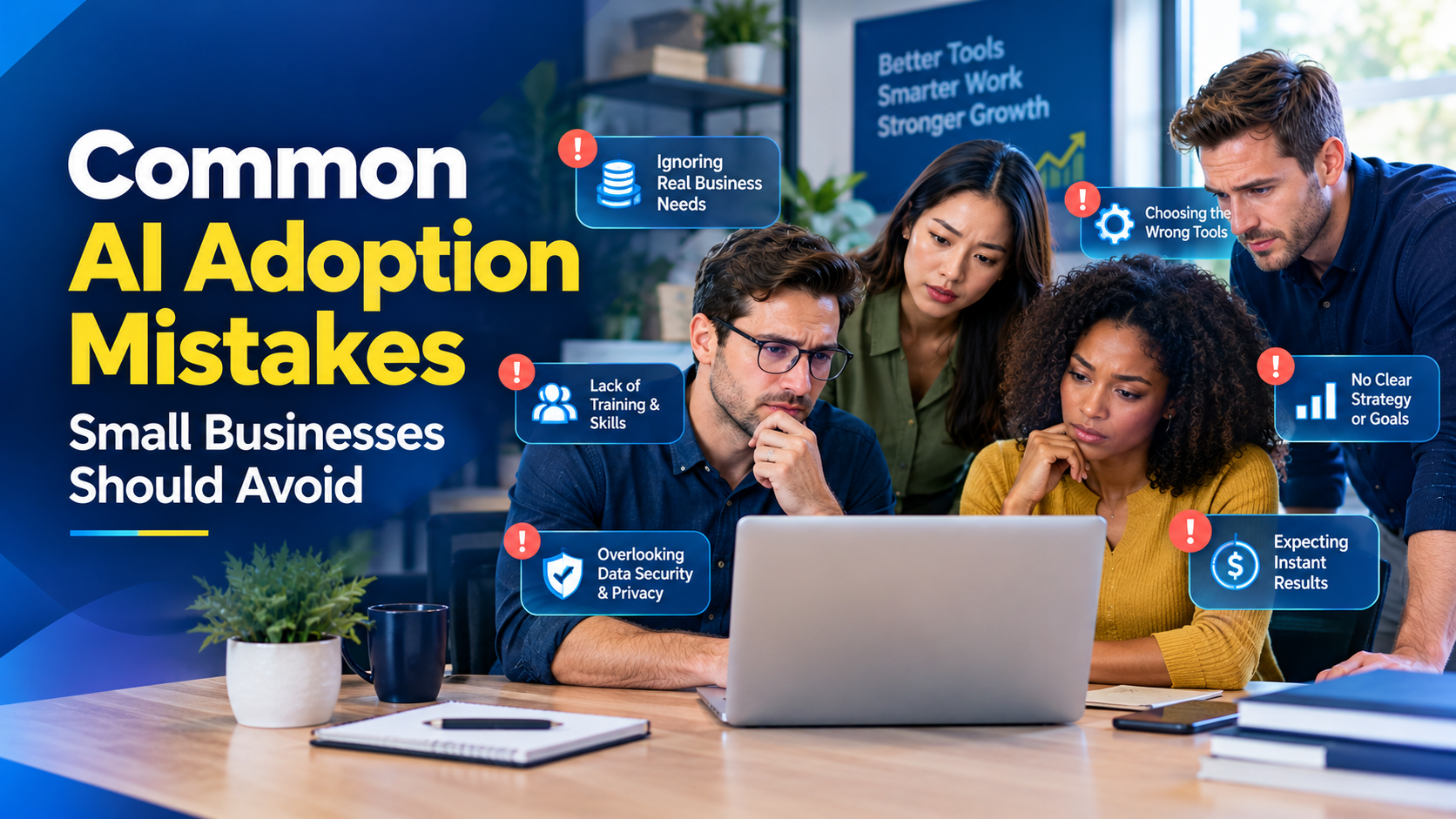
The most common AI adoption mistakes happen when a business starts with the technology instead of the business problem. Small businesses may purchase several AI tools, automate poorly understood processes, trust AI-generated output without adequate review, ignore data risks, or measure activity instead of meaningful business outcomes.
The most important mistakes to avoid are:
| Mistake | Why It Matters |
|---|---|
| Starting with AI instead of a business problem | The technology may solve a problem the business does not actually have. |
| Buying tools before understanding the workflow | The business may pay for capabilities that do not fit the actual process. |
| Automating a bad process | Automation can make an inefficient workflow faster without making it better. |
| Trusting AI output without human review | AI-generated information can contain errors or require contextual judgment. |
| Using poor-quality business data | Unreliable inputs can produce unreliable outputs and decisions. |
| Ignoring privacy and sensitive information | AI workflows can introduce unnecessary data and security risks. |
| Buying too many AI tools | Tool sprawl can increase cost, complexity, and training requirements. |
| Measuring AI activity instead of business outcomes | More prompts, content, or AI usage do not automatically create business value. |
| Ignoring the people who operate the workflow | A technically capable system can fail if employees cannot or will not use it. |
| Scaling before the pilot is proven | Scaling an unvalidated workflow can multiply cost and operational problems. |
The 5-P AI Adoption Check
Before adopting an AI system, a small business can use a simple five-question framework to determine whether the proposed use case is ready for experimentation.
What specific business problem are you trying to solve?
Which existing workflow will AI support or improve?
Who will use the system, review its output, and own the result?
What privacy, security, data-quality, and operational risks need to be controlled?
What measurable evidence will determine whether the AI workflow actually works?
If these five questions cannot be answered clearly, the project may need more planning before implementation.
1. Adopting AI Before Defining the Business Problem
One of the most common AI adoption mistakes is starting with a tool instead of a business problem.
A business may see an AI writing assistant, chatbot, image generator, automation platform, or analytics system and immediately look for ways to use it. The problem is that technology availability does not automatically mean there is a valuable use case.
A stronger approach starts with an operational problem.
- Which task takes too much employee time?
- Which process creates unnecessary repetitive work?
- Where are delays occurring?
- Where do employees repeatedly search for information?
- Where are avoidable errors or rework occurring?
- Which activity could benefit from better information or faster processing?
Only after identifying the problem should the business determine whether AI is an appropriate solution.
2. Buying AI Tools Before Understanding the Workflow
Another common mistake is purchasing an AI product before documenting how the relevant business process currently works.
Every workflow has inputs, actions, decisions, outputs, people, dependencies, and quality checks. AI may improve one part of the process without being appropriate for every step.
Before buying a tool, document:
- the current input;
- the people involved;
- the repetitive tasks;
- the decision points;
- the output;
- the current time and cost;
- the quality-control process.
This prevents the business from choosing technology simply because it has an attractive feature list.
3. Automating a Bad Process
Automation does not automatically fix an inefficient workflow.
If a process contains unnecessary steps, duplicate work, unclear responsibilities, or poor information flows, adding AI may simply make the existing process operate faster without addressing its underlying problems.
A useful sequence is:
- Document the existing process.
- Remove unnecessary steps.
- Clarify ownership.
- Improve the quality of the inputs.
- Identify where AI can provide useful assistance.
- Test the revised workflow.
4. Trusting AI Output Without Human Review
AI output should not automatically be treated as correct simply because it sounds confident or appears professionally written.
Depending on the application, AI-generated output may require fact checking, contextual review, formatting checks, or approval before being used in a business process.
Human oversight is particularly important when the output affects:
- customers;
- financial decisions;
- legal or compliance matters;
- business-critical operations;
- confidential information;
- important communications.
The goal is not to prevent automation. The goal is to determine which decisions can safely be assisted by AI and which decisions still require human responsibility.
5. Feeding AI Poor-Quality Information
AI cannot compensate for every problem caused by inaccurate, incomplete, outdated, or poorly structured information.
Before introducing AI into a workflow, evaluate the quality of the information that the system will use.
- Is the information accurate?
- Is it current?
- Is it complete enough for the task?
- Are duplicate records present?
- Are important fields missing?
- Is there a clear source of truth?
Better data does not guarantee perfect AI output, but poor data can make the resulting workflow substantially less reliable.
6. Ignoring Privacy and Sensitive Information
AI adoption should include a basic review of what information is being processed, where it goes, who can access it, and how it is retained.
Businesses should be particularly careful with sensitive customer, employee, financial, authentication, or confidential business data.
Before using an AI service, review its relevant privacy, security, retention, and data-handling documentation and establish internal rules for what employees may enter into AI systems.
AI adoption should therefore be treated as both a technology decision and a data-governance decision.
7. Buying Too Many AI Tools
Small businesses can quickly accumulate AI subscriptions.
One tool may be used for writing, another for research, another for automation, another for images, another for customer support, and another for analytics.
The result can be tool sprawl.
Tool sprawl can increase:
- monthly expenses;
- training requirements;
- workflow complexity;
- security considerations;
- duplicate functionality;
- administrative overhead.
A better approach is to establish a small technology stack around clearly defined business workflows.
8. Measuring AI Activity Instead of Business Outcomes
AI usage is not the same thing as business value.
A company might measure the number of prompts submitted, documents generated, chatbot interactions, or AI-assisted tasks completed. Those numbers can be useful operational indicators, but they do not automatically demonstrate financial or strategic value.
Better measurements are connected to the original business problem.
| AI Activity Metric | More Useful Business Metric |
|---|---|
| Number of AI-generated documents | Processing time, quality, or completed transactions |
| Number of chatbot responses | Resolution time, customer satisfaction, or human workload |
| Number of automated tasks | Cost per transaction or cycle time |
| Number of AI users | Adoption of the target workflow and resulting outcomes |
9. Ignoring the People Who Actually Use the Workflow
AI implementation is not only a technology project.
Employees need to understand how the new workflow works, when AI should be used, when human review is required, and who is responsible for the final result.
A workflow can technically function while still failing operationally because employees find it confusing, inconvenient, unreliable, or difficult to integrate into their daily work.
Before scaling, ask:
- Who owns the workflow?
- Who operates the AI system?
- Who reviews the output?
- Who handles exceptions?
- Who measures the results?
- Who is responsible if the process fails?
10. Scaling Before the Experiment Is Proven
Another common mistake is expanding an AI workflow before the business has enough evidence to show that it works.
A pilot should establish whether the workflow delivers its intended outcome at an acceptable cost and quality level.
Scaling should normally come after the business has evaluated:
- measured benefits;
- actual operating costs;
- quality;
- employee adoption;
- privacy and security considerations;
- workflow reliability;
- business relevance.
Scaling is not the objective of every AI experiment. If the evidence does not support expansion, stopping or redesigning the workflow can also be a valid business outcome.
Why Small Businesses Are Particularly Vulnerable to AI Adoption Mistakes
Small businesses often operate with limited budgets, smaller teams, fewer specialized technology resources, and less capacity to absorb unsuccessful experiments.
This does not mean small businesses should avoid AI. It means the adoption process should be proportionate to the available resources.
A small company may benefit more from improving one repetitive workflow than from attempting a large company-wide AI transformation.
A focused pilot also makes it easier to identify costs, assign responsibility, measure results, and correct problems before they spread to other areas of the business.
Practical Examples of AI Adoption Mistakes
Example 1: Retail Product Descriptions
A small online retailer wants to use AI to create product descriptions. The business generates hundreds of descriptions but does not check product specifications before publishing them.
The problem is not necessarily the use of AI. The problem is the absence of a reliable review process.
A better workflow would be:
- Provide structured product information.
- Generate a draft using AI.
- Check product facts against the source information.
- Review the language and claims.
- Publish only after human approval.
Example 2: Professional Services
A small professional-services firm wants to use AI to draft routine client communications.
If the firm allows the AI output to be sent automatically without review, an incorrect statement could create unnecessary customer or operational problems.
A safer workflow may use AI for drafting while keeping final approval with an employee.
Example 3: Restaurant Marketing
A restaurant uses AI to create social media content and promotional campaigns.
Measuring the number of posts produced would not necessarily show whether the system is helping the business.
More useful measurements could include:
- customer inquiries;
- campaign conversions;
- reservations attributable to campaigns;
- marketing production time;
- campaign cost;
- revenue associated with the campaign.
AI Adoption Red Flags: When to Slow Down
A proposed AI project deserves additional scrutiny when several of the following conditions exist:
- No clearly defined business problem
- No process owner
- No human review where review is necessary
- Unclear data handling
- No baseline measurement
- No success metric
- Too many tools solving overlapping problems
- No clear implementation cost
- No plan for employee adoption
- Scaling before the pilot is validated
A Simple AI Adoption Decision Framework
Before implementing an AI workflow, move through these questions in sequence.
Practical AI Adoption Workflow for Small Businesses
A practical implementation process can be kept relatively simple.
- Identify one business problem. Choose a specific workflow rather than attempting to transform the entire organization.
- Document the current process. Record the people, tools, inputs, outputs, time, costs, and quality requirements.
- Define the AI role. Decide exactly where AI will assist and where human responsibility remains.
- Identify risks. Review privacy, security, data quality, accuracy, and operational considerations.
- Establish a baseline. Measure the existing process before introducing the AI workflow.
- Run a pilot. Start with a manageable scope.
- Measure results. Compare the pilot with the original baseline.
- Decide what happens next. Continue, modify, stop, or scale based on evidence.
Businesses that need a broader implementation structure can also review the AI adoption roadmap before expanding individual workflows.
How to Measure Whether AI Adoption Is Working
Measurement should begin with the original business problem. Different AI use cases require different metrics.
| Objective | Potential Metrics |
|---|---|
| Reduce operating cost | Cost per transaction, labor hours, processing cost |
| Save employee time | Minutes per task, hours recovered, cycle time |
| Improve customer service | Response time, resolution time, customer satisfaction |
| Improve sales | Qualified leads, conversion rate, revenue, contribution margin |
| Improve quality | Error rate, rework, review rate, customer complaints |
| Improve productivity | Completed work, throughput, processing time, capacity |
Avoid measuring AI activity simply because it is easy to count. The most useful metrics are the ones connected to the original business objective.
Using Business Metrics to Evaluate AI Adoption
Once the baseline and expected benefits are defined, a business ROI calculator can help organize the basic calculation.
The result should still be evaluated using realistic assumptions about implementation costs, operating costs, employee time, measurable benefits, and the measurement period.
ROI should not be calculated for "AI" as a whole. It is more useful to calculate the economics of a specific AI initiative or workflow.
For a deeper explanation of the calculation itself, see AI ROI for Small Businesses: How to Calculate the Return on Investment .
Consider Break-Even as Well as ROI
ROI is not the only financial measurement that can help evaluate an AI initiative.
If an AI project involves a meaningful upfront or recurring cost, a break-even point calculator can help estimate the sales volume required to cover relevant costs.
This can be particularly useful when AI is expected to support a revenue-generating workflow, reduce operating costs, or change the economics of a specific product or service.
Check the Effect on Profitability
An AI workflow may affect pricing, operating costs, production costs, or the amount of work required to deliver a product or service.
The profit margin calculator can provide a useful starting point for understanding the underlying business numbers.
The purpose is not to assume that AI automatically improves margins. Instead, the calculator can help organize the financial inputs that should be examined before and after implementation.
Model Revenue Scenarios When AI Affects Sales
Some AI use cases are intended to support sales, marketing, customer acquisition, or revenue-generating activities.
In those situations, a revenue calculator can help model simple scenarios using price, sales volume, and transaction assumptions.
Revenue estimates should remain separate from actual measured results. A scenario is useful for planning, but it should not be presented as evidence that an AI project has already generated that revenue.
Consider Cost and ROI Together
AI adoption decisions should consider the complete cost of the initiative rather than only the visible subscription price.
Costs can include:
- software subscriptions;
- API or usage fees;
- implementation;
- integration;
- employee training;
- data preparation;
- human review;
- maintenance;
- security and governance.
A business evaluating how much it can realistically allocate to AI can also review the AI budget guide for small businesses .
A budget answers how much the business can or intends to spend, while ROI evaluates whether a particular investment produces sufficient measurable value.
AI Adoption Risks and Limitations
Financial return alone does not determine whether an AI deployment is appropriate.
A business should also consider:
- data quality;
- privacy;
- security;
- accuracy;
- human oversight;
- employee adoption;
- workflow reliability;
- vendor dependency;
- ongoing operating costs.
A financially attractive project may still require redesign if the operational or data risks are not acceptable.
Best Practices for Responsible AI Adoption
- Start with a measurable business problem.
- Understand the existing workflow before automating it.
- Keep human responsibility clear.
- Protect sensitive information.
- Improve data quality before relying heavily on AI outputs.
- Start with a focused pilot.
- Establish a baseline.
- Measure outcomes rather than AI activity alone.
- Document assumptions and costs.
- Scale only after the evidence supports expansion.
Businesses can also use the AI governance and strategy guide to develop a broader framework for responsible AI adoption.
What is the biggest AI adoption mistake for a small business?
One major mistake is starting with the technology instead of defining the business problem. A clear problem makes it easier to choose an appropriate use case, define the workflow, measure results, and determine whether AI is actually useful.
Should small businesses avoid AI if they have limited budgets?
Limited budgets do not necessarily mean a business should avoid AI. They make focused experimentation more important. A small business can start with one measurable workflow instead of purchasing multiple tools or attempting a broad transformation.
Why is human oversight important when using AI?
AI-generated output can require factual, contextual, quality, or business review. Human oversight helps determine whether an output is suitable for the intended use and establishes clear responsibility for important decisions.
Should businesses automate every repetitive task?
No. Repetitive work may be a good candidate for automation, but the business should first understand the process, evaluate risks, and determine whether automation produces meaningful value.
How can a business tell whether an AI project is working?
Start with a baseline and compare measurable results after implementation. Depending on the use case, relevant metrics may include cost, time, quality, error rate, revenue, customer response time, or employee capacity.
Why should businesses avoid buying too many AI tools?
Multiple overlapping tools can increase costs, complexity, training requirements, and administrative overhead. A smaller technology stack organized around clear workflows can be easier to manage.
When should an AI pilot be scaled?
Scaling should be considered after the business has enough evidence about measurable benefits, costs, quality, risks, reliability, and employee adoption. A pilot that does not produce the expected result may need to be redesigned or stopped rather than automatically scaled.
Can AI adoption fail even if the technology works?
Yes. A technically functional AI system can still fail to deliver business value if it does not fit the workflow, employees do not use it effectively, costs are too high, output quality is inadequate, or the project does not address an important business problem.
Conclusion
Successful AI adoption is not about using the largest number of AI tools. It is about identifying meaningful business problems and using appropriate technology to improve specific workflows.
The most important mistakes to avoid are adopting AI without a defined problem, buying tools before understanding workflows, automating poor processes, trusting AI output without appropriate review, ignoring data and privacy considerations, measuring activity instead of outcomes, and scaling before a pilot is proven.
A practical approach is to use the 5-P AI Adoption Check: Problem, Process, People, Protection, and Proof.
Start with one workflow. Establish a baseline. Define the expected outcome. Test the AI solution at an appropriate scale. Measure actual results. Review quality, cost, and risk. Then decide whether to improve, continue, stop, or scale the initiative.
For the financial side of the evaluation, business calculators such as ROI, break-even, profit margin, and revenue tools can help organize the underlying numbers. But the calculations should support business judgment rather than replace it.
The goal of AI adoption is not simply to use AI. The goal is to create measurable, sustainable value while keeping human oversight, responsible data practices, and business objectives at the center of the implementation.
Sources and Further Reading
- NIST — Artificial Intelligence Risk Management Framework (AI RMF)
- NIST — AI RMF Playbook
- IBM — AI ROI and business value resources