AI ROI for Small Businesses: How to Calculate the Return on Investment | Beritaja

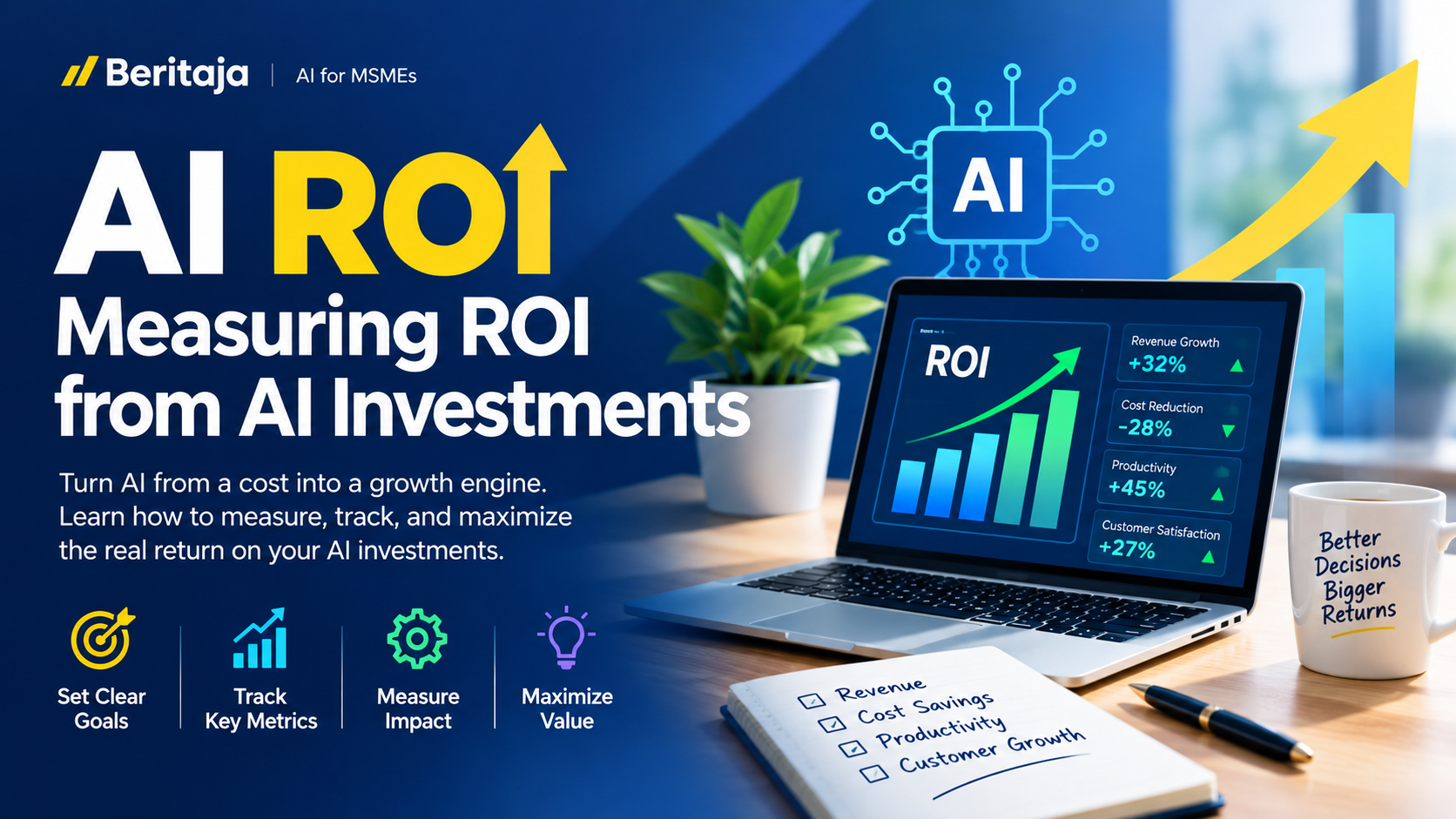
AI ROI measures whether an artificial intelligence investment creates enough measurable financial or operational value to justify its total cost. For a small business, calculating AI ROI means comparing the benefits of a specific AI initiative with the costs required to implement, operate, maintain, and manage it. The objective is not to assume that AI is profitable, but to determine which use cases create meaningful business value and which do not.
This guide explains how small businesses can calculate AI ROI, establish a reliable baseline, identify measurable benefits, account for direct and hidden costs, evaluate payback, monitor results after implementation, and make better decisions about whether an AI project should be tested, continued, expanded, or stopped.
The approach in this guide is intentionally practical. It focuses on measurable business outcomes rather than AI adoption for its own sake. A small business can apply the same basic principles to customer service, marketing, sales, document processing, internal knowledge management, forecasting, and other AI-assisted workflows.
What Is AI ROI?
AI ROI is the return a business receives from an artificial intelligence investment relative to the cost of making and operating that investment. The return may come from additional revenue, reduced operating costs, time savings, improved productivity, fewer errors, increased capacity, or other measurable business outcomes.
The basic concept is similar to traditional return on investment analysis. The difference is that AI can create several types of value at the same time. For example, an AI-assisted customer service workflow may reduce the amount of employee time spent answering routine questions while also improving response speed. These are different outcomes and should be measured separately before being converted into a financial estimate.
AI ROI should therefore not be treated as a number produced automatically by an AI tool. It is a business measurement process that begins with a defined use case, establishes a baseline, identifies relevant costs and benefits, and evaluates the results over a consistent period.
Why AI ROI Matters for Small Businesses
Small businesses generally need to make technology investments carefully because financial and operational resources are limited. An AI subscription, implementation project, integration, employee training program, or custom workflow can consume resources that could otherwise be allocated to marketing, inventory, customer service, hiring, product development, or other business priorities.
Measuring AI ROI helps a business owner answer a practical question: Is this particular AI use case creating enough value to justify its total cost?
This question is more useful than asking whether AI is generally "worth it." AI is a broad category of technologies, and different implementations can produce very different economic results.
AI ROI helps prioritize use cases
A business may identify several AI opportunities, such as automated customer responses, document processing, marketing assistance, demand forecasting, sales analysis, or internal knowledge search. ROI analysis provides a structured way to compare these opportunities using the business's own costs, volumes, and objectives.
AI ROI creates a financial baseline
Without a baseline, it is difficult to determine whether an AI project actually improved the business. A useful baseline records what the process costs, how long it takes, how much work it handles, and what quality level it produces before AI is introduced.
Establishing this baseline also makes later comparisons more credible because the business is comparing the AI-assisted process with a documented starting point rather than relying on impressions.
AI ROI supports better investment decisions
A business does not need to adopt AI simply because a technology is popular. A use case with uncertain value may be better suited to a limited pilot. Conversely, a repetitive process with measurable costs and a clear improvement opportunity may justify a more structured implementation.
For businesses developing a broader AI capability, this type of measurement fits naturally within an overall AI for MSMEs strategy, where individual use cases are evaluated according to business needs rather than technology trends alone.
How to Calculate AI ROI
A simple AI ROI calculation can be expressed as:
AI ROI (%) = (Net AI Benefit ÷ Total AI Cost) × 100
Net AI benefit represents the value created by the AI initiative after relevant costs have been accounted for.
A simplified version can also be written as:
AI ROI (%) = ((AI Benefits − AI Costs) ÷ AI Costs) × 100
This formula is useful as a starting point, but the quality of the result depends on the assumptions used to calculate benefits and costs. There is no single universal AI ROI percentage that automatically determines whether every project is a good investment.
Step 1: Define the AI initiative
Start with one specific use case rather than attempting to calculate the ROI of "AI" as a whole.
Examples include:
- AI-assisted customer support
- Automated document classification
- AI-assisted marketing operations
- Sales lead analysis
- Demand forecasting
- Internal knowledge search
A specific use case makes it easier to define the costs, benefits, baseline, responsible employees, and measurement period.
Step 2: Establish the baseline
Measure the existing process before introducing AI whenever practical.
Useful baseline measurements include:
- Hours spent on the process
- Labor cost associated with the process
- Number of transactions handled
- Average processing time
- Error or rework rate
- Conversion rate
- Customer response time
- Revenue or contribution margin associated with the process
The appropriate baseline depends on the use case. For customer service, response time, case volume, quality, and labor hours may be more relevant than direct revenue. For sales analysis, qualified opportunities, conversion rates, and sales capacity may be more useful.
Step 3: Estimate measurable benefits
Determine what changes after AI is introduced. Whenever reasonable, translate improvements into measurable business values.
For example, if an AI-assisted workflow saves employee time, the business can estimate the economic value of that recovered capacity using its actual labor economics. However, saved time should not automatically be classified as cash savings if employees simply use that time for other productive work.
This distinction is important because productivity gains, capacity gains, and direct cost reductions are not necessarily the same financial outcome.
Step 4: Calculate total AI costs
Include more than the software subscription. Depending on the project, costs can include implementation, integration, training, data preparation, monitoring, human review, maintenance, security controls, and additional usage fees.
Step 5: Compare benefits with costs
Once the relevant numbers have been established, calculate the ROI for a defined period such as six or twelve months.
Keep the measurement period consistent. Comparing annual benefits with only one month of costs can create a misleading result.
What Counts as an AI Benefit?
AI benefits can be financial or operational. A stronger ROI analysis separates individual benefits instead of treating every improvement as additional revenue.
| Benefit | Possible Measurement | Example |
| Labor time saved | Hours saved per month | Routine document processing requires less employee time. |
| Revenue increase | Incremental revenue or contribution margin | AI-assisted sales analysis identifies more qualified opportunities. |
| Error reduction | Error or rework cost avoided | AI-assisted classification reduces repetitive manual mistakes. |
| Faster response | Response time or cases handled | Customers receive answers to routine questions more quickly. |
| Higher capacity | Additional transactions handled | The same team can process more requests without proportional staffing increases. |
| Better decision support | Relevant business KPI | Managers receive faster analysis of operational data. |
Some benefits are difficult to convert into money. Better customer experience, faster access to information, or improved employee experience may still be valuable even when there is no reliable dollar estimate.
In such cases, track the operational benefit separately instead of inventing a financial value. This produces a more transparent business case.
What Costs Should You Include in AI ROI?
An AI ROI calculation becomes unreliable when it counts only the obvious subscription fee while ignoring the other resources required to make the system useful.
| Cost Category | What to Consider |
| Software | Subscriptions, licenses, usage fees, or API costs. |
| Implementation | Configuration, workflow design, integration, or professional services. |
| Data preparation | Cleaning, organizing, labeling, or connecting relevant data. |
| Training | Employee training and time spent learning the workflow. |
| Human review | Employee time required to check AI-generated outputs. |
| Maintenance | Monitoring, updating, troubleshooting, and process changes. |
| Security and governance | Controls needed to protect data and manage AI-related risks. |
The total cost should reflect the actual operating model of the AI initiative. A project that appears inexpensive at the software level may require substantial employee time, integration work, monitoring, or human review.
Risk management should also be considered as part of the implementation decision. The NIST AI Risk Management Framework provides a voluntary framework for helping organizations manage AI risks and incorporate considerations related to trustworthy AI.
AI ROI Example for a Small Business
Consider a hypothetical small professional-services business that spends significant employee time answering repetitive customer questions.
The business introduces an AI-assisted workflow to help employees draft responses and retrieve relevant information. The AI does not independently make final decisions; employees review the output before sending important responses.
| Measurement | Hypothetical Value |
| Estimated annual AI-related benefit | $12,000 |
| Annual software and operating cost | $3,000 |
| Other implementation and training costs | $1,000 |
| Total annual cost | $4,000 |
| Net benefit | $8,000 |
Using the simplified formula:
AI ROI = ($12,000 − $4,000) ÷ $4,000 × 100 = 200%
This is a hypothetical example, not a benchmark or expected result. The important point is the method: identify a specific use case, establish a baseline, measure the resulting benefit, include relevant costs, and calculate the difference.
AI Use Cases With Measurable ROI
The easiest AI initiatives to evaluate financially tend to have a clearly defined workflow, measurable baseline, and identifiable business outcome.
Customer service
AI can assist with routine questions, response drafting, information retrieval, and ticket classification. Useful measurements include response time, employee hours, cases handled, quality, and escalation rates.
Marketing operations
AI can support research, content drafts, campaign analysis, and repetitive marketing tasks. ROI should be connected to meaningful business metrics rather than simply counting the number of AI-generated words or assets.
Sales operations
AI may help summarize customer information, prioritize leads, or support sales analysis. Useful measurements can include time spent per lead, qualified opportunities, conversion rates, or sales-team capacity.
Document processing
Businesses that process invoices, forms, contracts, applications, or other structured documents may be able to measure processing time and manual effort before and after an AI-assisted workflow.
Internal knowledge management
An AI-powered internal search or knowledge assistant can reduce the time employees spend locating information. A useful baseline is the average time required to find specific internal information before implementation.
How to Establish an AI ROI Baseline
A baseline is the starting measurement against which the AI-assisted process will be evaluated. Without one, it is easy to mistake normal business variation for an AI benefit.
Record the current process
Document what happens today. Identify the people involved, tools used, average processing time, volume, errors, quality level, and direct costs.
Choose a small number of meaningful metrics
Avoid measuring everything. Select metrics directly connected to the purpose of the AI project.
- Cost per transaction
- Time per transaction
- Number of transactions
- Error rate
- Revenue or contribution margin
- Customer response time
- Employee hours
- Rework rate
Use comparable periods
Compare similar periods and account for seasonal changes when they could influence the result. A retail business, for example, should be careful when comparing a holiday period with an ordinary month.
A reliable baseline should be specific enough to show what changed, but simple enough for a small business to maintain consistently.
AI ROI vs. Payback Period
AI ROI and payback period answer different questions. ROI measures the return relative to investment, while payback period estimates how long it takes to recover the initial investment from the resulting net benefits.
A simplified payback calculation is:
Payback Period = Initial Investment ÷ Periodic Net Benefit
For example, if a hypothetical implementation costs $4,000 and produces an average net benefit of $1,000 per month, the simplified payback period would be four months.
Payback is particularly useful for small businesses because cash flow can matter as much as long-term return. A project can have a positive ROI but still be difficult to justify if the upfront cost is too large for the business's available cash.
ROI and payback should therefore be viewed together when evaluating an AI investment. ROI describes the return, while payback provides additional information about the speed of recovery.
How to Measure AI ROI After Implementation
AI ROI should be monitored after launch rather than calculated once and forgotten.
- Measure the same baseline metrics. Compare the AI-assisted workflow with the original process.
- Track actual costs. Record subscription, usage, training, review, maintenance, and other relevant expenses.
- Separate productivity from cash savings. Time saved is valuable, but it becomes a direct financial saving only under certain business conditions.
- Monitor quality. A faster process is not necessarily better if accuracy or customer experience deteriorates.
- Review the results regularly. AI costs and usage can change as the workflow expands.
This is why AI measurement should include both financial outcomes and operational quality. A system that reduces cost while creating unacceptable errors may not represent a successful business outcome.
A Practical Methodology for Reliable AI ROI
A credible AI ROI analysis should be reproducible. Another person reviewing the project should be able to understand where the numbers came from, what assumptions were made, and how the result was calculated.
Separate actual results from estimates
Before implementation, most ROI numbers are projections. After implementation, some of those projections can be replaced with actual measurements.
Clearly distinguish between:
- Actual historical business data
- Estimated future benefits
- Hypothetical scenarios
- Measured post-implementation results
This distinction prevents a projected business case from being presented as if it were a proven financial result.
Document the assumptions
Write down the assumptions behind every major financial estimate. For example, if an AI workflow is expected to save 20 employee hours per month, explain how that estimate was calculated and how the recovered capacity will be used.
Use the same measurement definition before and after AI
Changing the definition of a metric after implementation can make an AI project appear more successful than it actually is. The baseline and post-implementation measurement should use comparable definitions wherever possible.
Measure quality alongside efficiency
Efficiency alone is not enough. If an AI workflow reduces processing time but increases errors, rework, customer complaints, or review requirements, the apparent benefit may be overstated.
Review the business case periodically
AI pricing, usage levels, workflows, employee behavior, and business volumes can change. A project that produces attractive economics at one usage level may produce different economics after the workflow is expanded.
Common AI ROI Calculation Mistakes
1. Counting every time saving as cash savings
If AI saves two hours of employee time but the employee simply performs other productive work, the business may have gained capacity rather than directly reducing payroll expense. Both outcomes can be valuable, but they should not be described as the same financial benefit.
2. Ignoring implementation costs
A low-cost AI subscription may require significant configuration, training, integration, data preparation, or human review. Excluding these costs can inflate the apparent ROI.
3. Measuring vanity metrics
Producing more content, generating more summaries, or processing more AI requests does not necessarily mean the business created more value. Measurements should be connected to meaningful business outcomes.
4. Ignoring quality
An AI workflow that produces faster but less accurate results may increase rework or customer complaints. Quality should therefore be included in the measurement framework.
5. Assuming projected benefits will happen automatically
Forecasted benefits are assumptions until they are validated. Clearly label estimates, scenarios, and hypothetical outcomes.
6. Calculating ROI for "AI" instead of a use case
AI is a broad technology category. A meaningful ROI calculation should normally focus on a particular workflow, project, or business objective.
7. Mixing different time periods
Comparing twelve months of projected benefits with one month of implementation costs can produce an artificially high ROI. Costs and benefits should be evaluated over the same defined measurement period unless the analysis explicitly accounts for the difference.
AI ROI Limitations and Risks
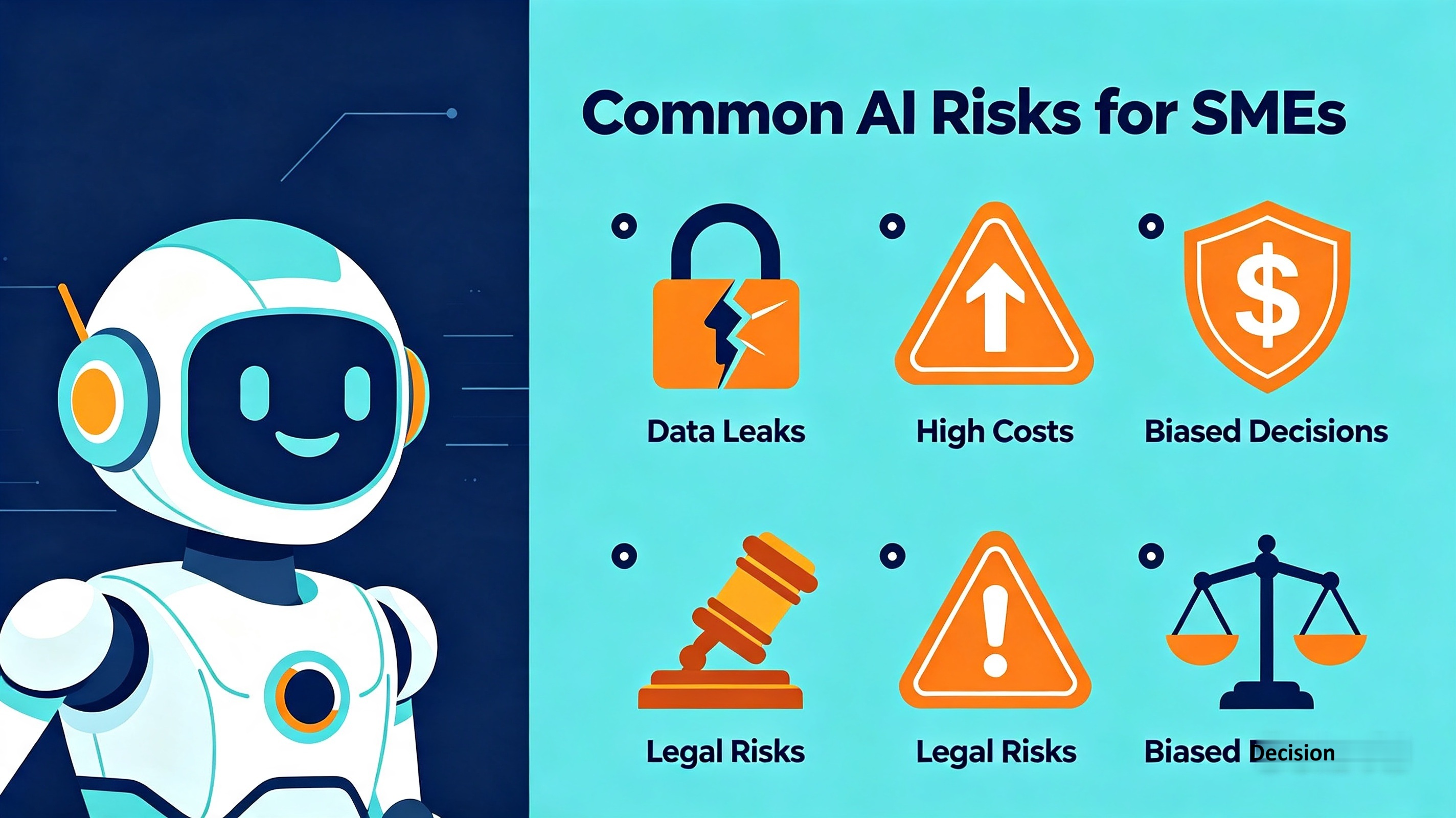
AI ROI should be considered alongside operational, privacy, security, data, and governance considerations. Financial return alone does not determine whether an AI deployment is appropriate for a business.
Data quality
AI systems depend on the quality and suitability of the information provided to them. Poor, incomplete, outdated, or inconsistent data can weaken the usefulness of an AI-assisted workflow.
Incorrect outputs
Generative AI can produce inaccurate or misleading outputs. Human review may therefore remain necessary, particularly for decisions involving customers, finances, legal matters, safety, or sensitive information.
Privacy and security
Businesses should understand what data an AI system receives, how that data is handled, what access controls exist, and what safeguards are available before using sensitive business or customer information.
Integration complexity
An AI tool may appear inexpensive until the business attempts to connect it with existing systems and workflows. Integration effort should be included in the business case.
Human oversight
Automation does not eliminate responsibility. A business should determine which tasks can be assisted by AI and which decisions require human approval.
The NIST AI RMF Playbook organizes practical AI risk-management activities around the functions Govern, Map, Measure, and Manage. Small businesses can use these concepts as a reference when evaluating the non-financial risks associated with an AI initiative.
The NIST framework is voluntary and designed to be adaptable across organizations and use cases. It should be treated as a risk-management reference rather than as a substitute for a business's own legal, security, financial, or operational requirements.
How to Start Measuring AI ROI in a Small Business
A small business does not need a large AI transformation program to begin measuring ROI. A focused pilot is often easier to evaluate because the business can define a narrow objective, establish a baseline, and observe the results within a manageable scope.
- Choose one measurable problem. Start with a process that is repetitive, time-consuming, expensive, or difficult to scale.
- Document the current process. Record time, volume, cost, quality, errors, and other relevant baseline measurements.
- Define the desired outcome. Decide what improvement would make the project worthwhile.
- Estimate the complete cost. Include software, implementation, training, data preparation, human review, maintenance, and other relevant costs.
- Run a controlled pilot. Test the AI workflow on a manageable portion of the process.
- Measure actual results. Compare results against the original baseline.
- Review risks and quality. Confirm that the improvement did not create unacceptable errors, privacy problems, or security concerns.
- Scale only when the evidence supports it. If the economics and operational results are strong, expand the workflow gradually.
Businesses can also use practical financial tools such as the ROI calculator , break-even point calculator , and profit margin calculator to support related calculations.
These calculators are decision-support tools. They do not determine whether an AI project is strategically appropriate, and they should not replace careful assumptions about costs, benefits, risk, and business capacity.
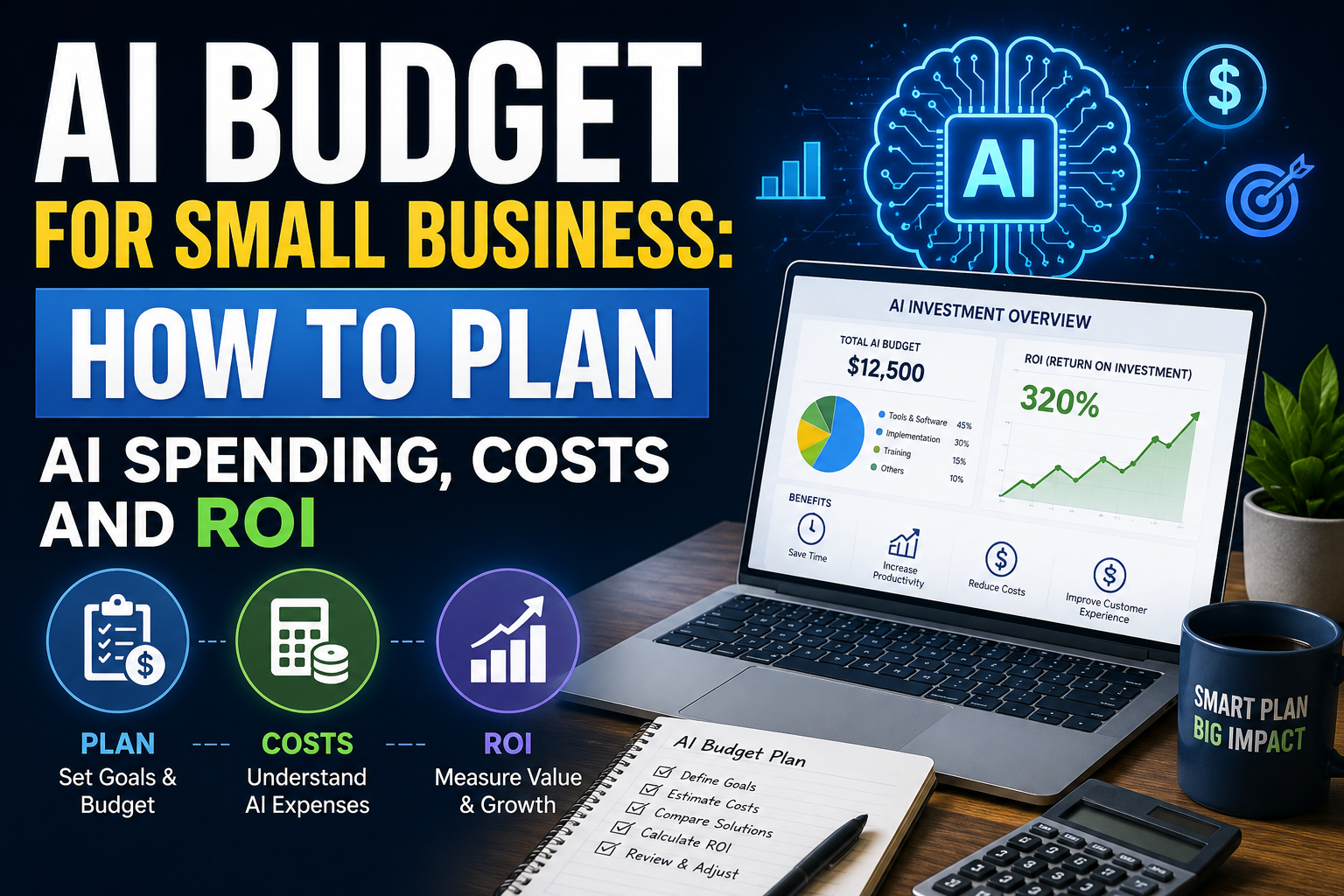
Financial planning should also be considered separately from ROI measurement. Businesses evaluating the amount they can realistically allocate to AI can review guidance on AI budgeting for small businesses . A budget answers how much the business can or intends to spend, while ROI evaluates whether that investment creates sufficient value.
Where AI ROI Fits Into AI Governance and Strategy
AI ROI should not be evaluated separately from business strategy. A project can have an attractive projected return but still be inappropriate if it introduces unacceptable risks, depends on unavailable data, requires excessive human review, or does not support the company's priorities.
ROI is therefore one part of a broader decision-making process. Before comparing AI investments, a small business should understand which business problems matter most, where AI can provide useful assistance, what resources are available, and how the initiative fits into the company's longer-term direction.
Businesses that are defining this broader direction can review a practical guide on building an AI strategy for a small business . Connecting individual AI initiatives with business objectives can help ensure that ROI analysis is used to prioritize meaningful opportunities rather than simply selecting projects with the highest projected percentage.
For broader guidance on governance, risk controls, and strategic decision-making, see the AI governance and strategy for small businesses guide.
Financial planning should also be separated from ROI measurement. The amount a business can afford to spend on AI is a budgeting question, while whether the investment creates sufficient value is an ROI question. Keeping these decisions separate helps prevent a projected return from being confused with an available budget.
ROI should support strategy, not replace it
A financially attractive AI project may still be a poor strategic choice if it solves a low-priority problem while consuming resources needed for more important initiatives.
Conversely, a project with a modest initial ROI may still deserve a controlled pilot if it provides strategic learning, builds internal capability, or addresses an important operational constraint. The key is to make those considerations explicit rather than hiding them inside an optimistic ROI estimate.
Frequently Asked Questions About AI ROI
What is AI ROI?
AI ROI is the return a business receives from an artificial intelligence investment relative to the total cost of that investment. It can include financial benefits such as additional revenue or cost reduction and measurable operational benefits such as time savings or increased capacity. A useful calculation requires a clear baseline and a defined measurement period.
How do you calculate AI ROI?
A simplified AI ROI formula is: (AI benefits minus AI costs) divided by AI costs, multiplied by 100. The difficult part is identifying realistic benefits and including the complete cost of the AI initiative. Software, implementation, training, data preparation, human review, and maintenance may all need to be considered.
What costs should be included when calculating AI ROI?
Relevant costs can include software subscriptions, API or usage fees, implementation, integration, employee training, data preparation, human review, monitoring, maintenance, and security or governance work. The exact cost categories depend on the AI use case and how deeply it is integrated into the business.
Can time savings be included in AI ROI?
Yes, time savings can be an important AI benefit, but they should be interpreted carefully. Saved hours may represent increased capacity rather than an immediate cash saving. The business should explain how the recovered time creates value before converting it into a financial estimate.
What is the difference between AI ROI and AI payback period?
AI ROI measures the return relative to the investment, while the payback period estimates how long it takes to recover an investment through net benefits. ROI helps evaluate overall return; payback helps evaluate how quickly the investment may recover its cost.
What is a good AI ROI for a small business?
There is no universal AI ROI percentage that makes every project worthwhile. A useful threshold depends on the business's alternatives, risk tolerance, cash flow, implementation complexity, and expected duration of the benefit. Compare the AI project with realistic alternatives rather than relying on a single benchmark.
Should a small business calculate AI ROI before using AI?
Ideally, yes. A pre-implementation estimate can clarify the expected economics and help determine whether a pilot is worth testing. However, projected ROI is only an assumption. After implementation, the business should compare actual results with the original baseline and update the calculation.
Can AI have a positive business impact without a clear financial ROI?
Yes. Some benefits, such as faster information access, improved employee experience, or better decision support, can be difficult to convert into a precise financial figure. In those cases, businesses can track operational metrics alongside financial measures instead of forcing uncertain benefits into a dollar value.
Is a high AI ROI always a sign of a good investment?
No. A high ROI can result from optimistic assumptions, incomplete cost calculations, or an unsuitable measurement period. A business should review the assumptions, baseline, quality metrics, risks, cash-flow requirements, and strategic fit before deciding whether to scale an AI project.
How does AI strategy relate to AI ROI?
AI strategy determines how artificial intelligence supports broader business goals and priorities, while AI ROI evaluates the measurable value of a specific AI investment relative to its cost. Using both perspectives helps a small business avoid choosing an AI project solely because it has an attractive projected return.
Conclusion: Make AI ROI a Business Measurement, Not a Guess
AI ROI is ultimately about determining whether a specific AI investment creates enough measurable value to justify its total cost. The calculation itself is straightforward, but the assumptions behind it require careful attention.
Start with one clearly defined use case. Establish a baseline, identify measurable benefits, include the full cost of implementation and operation, and track both financial and operational outcomes. Then compare actual results with the original assumptions.
A strong AI ROI analysis should make the reasoning transparent. Business owners should be able to explain where the numbers came from, which benefits are estimated, which costs are included, what measurement period was used, and what limitations could affect the result.
Small businesses do not need to adopt every AI capability available. The stronger approach is to identify problems where AI can provide meaningful assistance, test those opportunities at an appropriate scale, measure the results, and expand only when the evidence supports the decision.
The practical next step is simple: choose one AI use case, record what the process costs today, define the outcome you want, estimate the complete investment, and calculate the economics before scaling it.