AI Success Stories: How Small Businesses Are Using AI | Beritaja

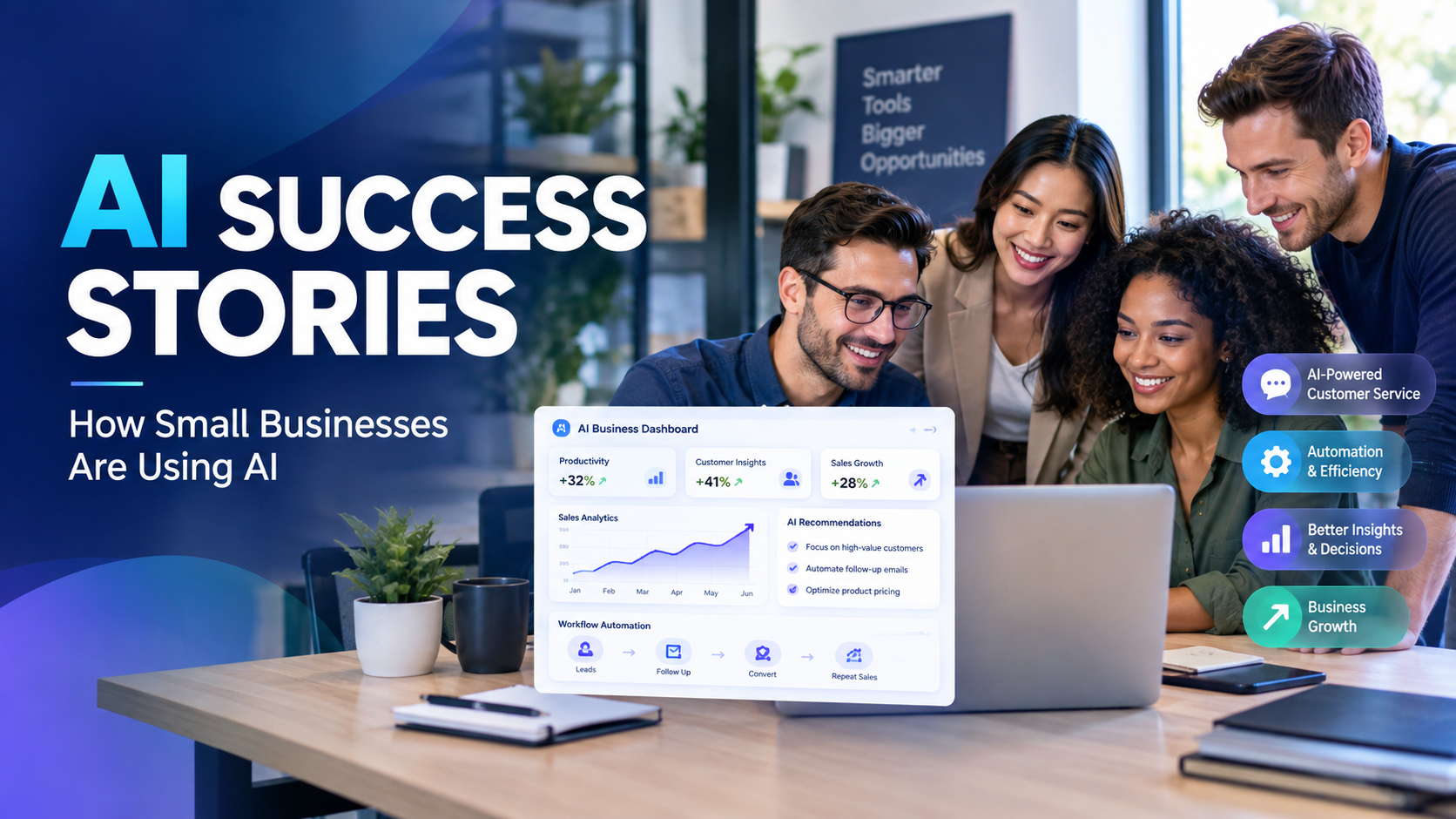
AI success stories are no longer limited to large technology companies. Small and medium-sized businesses are using artificial intelligence to automate repetitive work, improve customer service, analyze business information, create content, support employees, and make better use of data.
The important lesson is not that every business needs a sophisticated AI system. The more useful lesson is that successful AI adoption usually starts with a specific business problem: too much manual work, slow customer responses, inconsistent information, difficult data analysis, or a workflow that does not scale efficiently.
This article examines real-world examples of businesses using AI and related technologies, explains the patterns behind those implementations, and shows how a smaller business can apply the same principles without attempting to copy an enterprise-scale technology stack.
What Are AI Success Stories?
AI success stories are documented examples of organizations using artificial intelligence to solve a business problem or improve an existing process. A useful success story should explain the original problem, how AI was introduced, what changed, and what limitations or human responsibilities remained.
For a small business, the most valuable success story is not necessarily the company with the biggest AI budget. It is the example that demonstrates a problem similar to the one the business owner is trying to solve.
For example, a retailer may learn more from an AI-assisted customer-service workflow than from a large research laboratory developing a new machine-learning model. A restaurant may gain more practical insight from automated demand analysis than from an enterprise-scale AI transformation program.
Why AI Success Stories Matter to Small Businesses
AI success stories make an abstract technology easier to understand. Instead of asking, "What can AI do?", a business owner can ask a more useful question: "Which repetitive, data-heavy, or information-intensive task in my business could AI improve?"
This distinction matters because artificial intelligence is not automatically valuable simply because it is technically impressive. A business receives value when an AI-assisted process improves a meaningful outcome such as response time, employee productivity, consistency, customer experience, decision support, or operating efficiency.
Real examples also reveal an important principle: successful adoption often involves integrating AI into an existing workflow rather than replacing the entire workflow with an autonomous system.
What Successful AI Adoption Usually Has in Common
Across different industries, several patterns appear repeatedly in documented AI implementations. These patterns can help small businesses evaluate whether an AI project is worth pursuing.
- A clearly defined business problem: The project begins with a specific operational or customer problem.
- Useful data or knowledge: The AI system has access to information relevant to the task.
- A measurable workflow: The business can observe whether the process improved.
- Human oversight: People remain responsible for important decisions and exceptions.
- Integration with existing work: AI becomes part of a process employees already understand.
- Controlled expansion: The organization starts with a practical use case before expanding.
These principles are more transferable to a small business than the specific AI product used by a large organization.
Real-World AI Success Stories
The following examples illustrate different ways AI and related technologies are being used in business. They should not be interpreted as evidence that the same technology will produce identical results for every company. Each organization has different data, processes, customers, budgets, and technical requirements.
1. Mystore: Using AI to Help Small Sellers Manage Ecommerce
Mystore is an Indian ecommerce marketplace connected to the Open Network for Digital Commerce (ONDC). Its business model includes supporting smaller sellers that may not have the technical resources to create polished product listings or manage large catalogs manually.
According to a Google Cloud customer story, Mystore uses Google AI in its seller dashboard to automate parts of cataloging and product approval. The system can generate product information such as titles, descriptions, categories, and HSN codes from a product image, while AI-assisted approval checks help enforce quality and compliance requirements.
Google Cloud reports that Mystore's product approval process decreased from one to two days to under an hour and that the company reported a 60–70% improvement in operational efficiency for that process. These figures are company case-study claims reported by Google Cloud, rather than a universal benchmark for ecommerce businesses.
The important lesson for a small business is the workflow design. Instead of asking AI to run an entire ecommerce operation, Mystore applied AI to specific bottlenecks that involved repetitive product information and approval work.
What a Small Business Can Learn
- Business type: Ecommerce
- Problem: Product information and approval can require repetitive manual work.
- AI application: Product information generation and automated checking.
- Potential benefit: Faster catalog operations and more consistent listings.
- Human oversight: Employees should verify important product information before publication.
2. FDC Dental: Using AI to Simplify Customer Booking
FDC Dental in Indonesia provides another example of AI being applied to a customer-facing workflow. According to Google Cloud, the company developed an AI-powered platform that supports patient booking through conversational interactions.
Google Cloud reports that the booking process, which previously could take up to an hour, was reduced to approximately 15 seconds through an AI-assisted booking experience. The company also uses AI in other operational processes, including CV screening.
The interesting part of this example is that the technology is connected to a concrete customer journey. The AI is not simply producing text. It is helping a customer move through a business process: communicating, selecting a clinic, and completing a booking-related transaction.
For smaller businesses, this illustrates an important distinction between an AI chatbot and an AI-enabled workflow. A chatbot that only answers questions may be useful, but an AI system that can safely connect an inquiry with the next operational step can potentially create more practical value.
What a Small Business Can Learn
- Business type: Healthcare service
- Problem: Manual booking can consume substantial staff time.
- AI application: Conversational booking assistance.
- Potential benefit: Faster customer interaction and reduced administrative workload.
- Human oversight: Sensitive customer information and exceptions require appropriate controls.
3. Toffin: Connecting Business Data With AI-Ready Infrastructure
Indonesian hospitality supplier Toffin provides a different type of example. Google Cloud describes how the company integrated data from its enterprise resource planning (ERP) environment into mobile applications used by employees and customers.
Google Cloud reports a 20–30% improvement in employee productivity associated with the company's broader technology implementation and says Toffin has been exploring Gemini for AI-assisted use cases across Google Cloud and Google Workspace.
This example is useful because AI success is not always about generating content or answering questions. Data integration can be an important foundation for AI because useful automation and decision support depend on access to reliable business information.
For a small business, the equivalent might be connecting sales records, inventory information, customer inquiries, and financial data before attempting advanced AI analysis.
What a Small Business Can Learn
- Business type: Hospitality supplier
- Problem: Business information can become fragmented across systems.
- AI-related application: Data integration and exploration of AI assistants.
- Potential benefit: Better access to information and decision support.
- Human oversight: Business owners must verify the quality and relevance of underlying data.
4. New Aim: Using AI for Ecommerce Operations
Australian ecommerce technology company New Aim is another useful example of applying AI to operational problems. Google Cloud describes the company's work with AI for pricing insights, market trends, product-listing image optimization, and supplier information.
One particularly practical use case involves supplier information. Supplier inputs can vary significantly in quality and structure, creating manual editing and rewriting work for category teams. AI can assist with processing and organizing this information before employees review the resulting product information.
This is a common pattern for smaller businesses: AI can be useful when information arrives in inconsistent formats and employees repeatedly transform it into a standardized format.
What a Small Business Can Learn
- Business type: Ecommerce and retail technology
- Problem: Supplier information can be inconsistent and time-consuming to process.
- AI application: Information processing, product content support, and analysis.
- Potential benefit: Less repetitive preparation work.
- Human oversight: Product information still needs review for accuracy.
5. Xero: Embedding Generative AI Into Everyday Work
Xero is a larger technology company rather than a typical small business, but its AI implementation offers a useful lesson for smaller organizations. Google Workspace reports that Xero integrated Gemini into everyday work across applications such as Gmail, Docs, Meet, Sheets, and Slides.
Google reports that Xero employees using Gemini saved an average of 3.4 hours per week and that the company reported a return on investment within eight months. Those figures are specific to Xero's implementation and should not be treated as expected results for every organization.
The more transferable lesson is Xero's evaluation process. The company evaluated AI tools against consistent criteria and considered how well the technology could be embedded into existing workflows.
For a small business, this suggests a practical approach: rather than selecting an AI tool because it is popular, evaluate whether it fits the applications, data, employees, and processes already used by the business.
AI Success Stories by Business Function
The examples above can be translated into several common business functions. A small business does not need to adopt all of them. The goal is to identify the function where AI can remove a meaningful bottleneck.
| Business Function | Possible AI Application | Good Starting Point | Human Review |
|---|---|---|---|
| Customer service | FAQ assistance, conversation summaries, routing | High-volume repetitive questions | Important complaints and unusual cases |
| Marketing | Content drafts, research assistance, audience analysis | First drafts and repetitive research | Brand, factual, and strategic review |
| Sales | Lead summaries, follow-up drafts, customer research | Administrative sales work | Pricing and customer decisions |
| Operations | Document processing, workflow automation, forecasting | Repetitive information handling | Exceptions and critical decisions |
| Finance | Document classification, reporting assistance, analysis | Low-risk administrative tasks | Financial decisions and compliance |
| Product management | Feedback analysis, categorization, research summaries | Organizing large volumes of feedback | Product and customer decisions |
Hypothetical AI Success Stories for Small Businesses
The following examples are hypothetical scenarios, not documented customer case studies. They demonstrate how a small business could translate the lessons from real-world implementations into a smaller, lower-risk project.
Retail Store: Customer Questions
Problem: A retail store receives the same questions about opening hours, product availability, delivery, and returns every day.
How AI is used: An AI-assisted FAQ system provides answers from an approved knowledge base and transfers unusual questions to an employee.
Expected benefit: Staff spend less time answering repetitive questions and more time helping customers with complicated needs.
Human oversight: Employees review the knowledge base and handle complaints, unusual requests, and situations where the AI lacks reliable information.
Restaurant: Demand and Inventory Support
Problem: A restaurant wants to understand which ingredients are used most frequently and identify patterns in historical sales.
How AI is used: AI-assisted analysis organizes sales and inventory information and highlights patterns for management review.
Expected benefit: Managers can spend less time manually preparing reports and more time evaluating purchasing and menu decisions.
Human oversight: Managers remain responsible for purchasing decisions because weather, events, supplier availability, and local conditions may change demand.
Professional Services Firm: Document Summaries
Problem: Employees spend significant time reading long internal documents before meetings.
How AI is used: An approved AI assistant creates preliminary summaries and identifies questions for employees to investigate.
Expected benefit: Faster preparation and easier access to relevant information.
Human oversight: Employees verify important facts rather than treating an AI-generated summary as the authoritative document.
What These AI Success Stories Teach Small Businesses
The strongest lesson from these examples is that AI works best when it is attached to a clearly defined business process. The technology itself is not the strategy.
1. Start With a Bottleneck
Look for work that is repetitive, time-consuming, information-heavy, or difficult to scale. Examples include preparing product descriptions, summarizing customer feedback, answering repetitive questions, organizing documents, or preparing routine reports.
2. Define the Desired Outcome
Before choosing a tool, define what improvement you want. The objective might be faster response times, fewer manual steps, better consistency, faster research, or more useful business information.
3. Start With a Small Workflow
A small pilot is easier to evaluate than a company-wide AI transformation. Choose one process with a manageable amount of risk and determine whether AI actually improves it.
4. Keep Humans Responsible for Important Decisions
AI systems can produce incorrect, incomplete, outdated, or misleading outputs. Human review becomes particularly important when an output affects money, customers, legal obligations, safety, privacy, employment, or reputation.
5. Measure the Workflow, Not the Hype
Ask whether the process actually improved. Useful measures can include time spent per task, error rates, response time, employee workload, customer satisfaction, or cost per completed process.
If the numbers do not improve and employees find the new workflow harder to use, there may be no business case for continuing the project.
How to Build Your Own AI Success Story
A small business can use a simple eight-step process to move from an interesting AI idea to a controlled business experiment.
- Identify one repetitive or data-heavy task. Choose a process that happens frequently enough to justify improvement.
- Define the current process. Document who performs the task, what information they need, how long it takes, and where errors occur.
- Define the desired outcome. Decide what success would look like before introducing AI.
- Select an appropriate AI approach. This might be a generative AI assistant, document-processing workflow, predictive model, business intelligence feature, or automation system.
- Test on a limited dataset or workflow. Avoid changing an important business process before understanding how the AI performs.
- Review quality and risk. Test for incorrect answers, missing information, privacy problems, inconsistent outputs, and unexpected behavior.
- Measure the results. Compare the AI-assisted process with the previous workflow.
- Expand only when the evidence supports it. If the pilot creates meaningful value without unacceptable risk, consider expanding it gradually.
This approach turns AI adoption into a business experiment rather than a technology shopping exercise.
When AI May Not Be the Right Solution
A responsible AI strategy also requires knowing when not to use AI. A task may be too infrequent, too simple, too sensitive, or too dependent on judgment to justify automation.
For example, if a business completes a task only a few times a year, a conventional process may be more economical than building an AI workflow. Likewise, if a task involves highly sensitive information and the business cannot establish appropriate data controls, postponing AI adoption may be reasonable.
AI can also add unnecessary complexity. Employees may spend more time checking, correcting, and managing an AI system than they previously spent completing the original task.
The objective should therefore be better business processes, not maximum AI adoption.
Risks and Limitations to Consider
AI success stories can create an overly positive impression if they discuss only the outcome. Every business should evaluate the risks alongside the potential benefits.
- Incorrect outputs: Generative AI can produce convincing but inaccurate information.
- Data privacy: Businesses need to understand what information is entered into an AI service and how that information is handled.
- Security: AI systems can introduce new access, integration, and information-security considerations.
- Data quality: Poor business data can lead to poor analysis or unreliable recommendations.
- Cost: Subscription, API, integration, training, and monitoring costs can add up.
- Integration complexity: AI may require connections to existing software and databases.
- Employee training: Employees need to understand both the capabilities and limitations of the system.
- Over-automation: Removing human review from sensitive workflows can create unnecessary risk.
These risks do not mean a business should avoid AI. They mean AI should be implemented with appropriate controls and a clear understanding of the process being changed.
How to Measure an AI Success Story
A useful AI success story should be measurable. Instead of saying that an AI tool "improved productivity," define what productivity means for the particular workflow.
| Measure | Question to Ask |
|---|---|
| Time | How long does the task take before and after AI? |
| Quality | Are outputs accurate and consistent? |
| Volume | Can the team handle more work without proportional additional effort? |
| Cost | Does the improvement justify the total cost of the AI workflow? |
| Customer experience | Does the customer receive a faster or more useful service? |
| Risk | Has the new process introduced unacceptable privacy, security, or accuracy risks? |
Businesses evaluating financial outcomes can also use a ROI calculator to structure a simple return-on-investment estimate. The calculation should include the full cost of the workflow rather than only the AI subscription price.
How AI Fits Into a Broader Small-Business Strategy
AI should not exist as an isolated technology project. It should support a broader business strategy that defines priorities, responsibilities, data practices, risk controls, and measurable outcomes.
Businesses that are still developing their overall approach can use this article as an example library, then move into a more structured AI strategy for small businesses.
The broader AI for MSMEs topic also provides useful context for businesses that want to understand how artificial intelligence fits into productivity, operations, customer service, decision-making, and long-term digital transformation.
Frequently Asked Questions About AI Success Stories
What is an AI success story?
An AI success story is a documented example of an organization using artificial intelligence to address a business problem or improve a process. A useful story explains the original problem, the AI-assisted solution, the resulting change, and relevant limitations rather than simply claiming that AI produced better results.
Can small businesses benefit from AI?
Yes. Small businesses can use AI for tasks such as customer-service assistance, content drafting, document processing, data analysis, sales administration, product information, and workflow automation. The appropriate use depends on the business problem, available data, cost, risk, and ability to maintain human oversight.
What is the best AI use case for a small business?
There is no single best use case for every business. A strong starting point is usually a repetitive, measurable task where employees spend substantial time handling information. The business should test whether AI reduces effort or improves quality before expanding the implementation.
Do AI success stories mean the same results can be expected by every business?
No. Published case studies describe specific organizations operating with particular data, processes, technology, budgets, and employees. Their results should be treated as examples rather than guaranteed benchmarks. A small business should conduct its own pilot and measure the actual outcome.
Should small businesses automate everything with AI?
No. Automation is most useful when it improves a defined process without introducing unacceptable risk. Tasks involving sensitive information, important financial decisions, legal obligations, or unusual customer situations may require significant human involvement even when AI is used to assist the workflow.
How should a business measure whether an AI project is successful?
Measure the business process before and after implementation. Depending on the use case, relevant measures can include time, cost, output quality, error rates, customer response time, employee workload, or revenue-related outcomes. The business should also monitor privacy, security, and reliability risks.
Can a small business start using AI without a large technology team?
Many AI applications can be tested without building a custom machine-learning system. A business can begin with an existing AI-enabled product or workflow, provided it understands the product's capabilities, limitations, data handling, and costs. More complex implementations may require technical expertise or an integration partner.
What should a business do before adopting AI?
Start by identifying the business problem, documenting the existing workflow, defining the desired outcome, reviewing data and privacy requirements, and choosing a small pilot. This creates a basis for deciding whether AI actually improves the process rather than adopting it simply because it is a current technology trend.
Conclusion: The Most Useful AI Success Stories Start With a Business Problem
The most useful AI success stories are not simply stories about companies using advanced technology. They show how a specific business problem was connected to a practical AI-assisted workflow.
The examples of Mystore, FDC Dental, Toffin, New Aim, and Xero demonstrate different approaches: ecommerce automation, customer booking, data integration, product-information processing, and everyday workplace assistance. Their circumstances and reported results differ, but the underlying lesson is consistent: AI becomes more useful when it is connected to a clearly defined workflow and evaluated against a meaningful business objective.
For a small business, the next step does not have to be a large AI transformation. Choose one repetitive or information-heavy task, define what improvement would look like, test a controlled workflow, review the risks, and measure the outcome.
If the evidence shows that the process is faster, more consistent, more useful, or more scalable without creating unacceptable risk, that first experiment can become the foundation for a broader AI strategy.